Solar Panel Cost in Colonie, NY: The Three Tax Checks
In Colonie the cost of solar is not settled by the quote alone. Three separate taxing authorities decide part of it, and neighbours can get different answers.
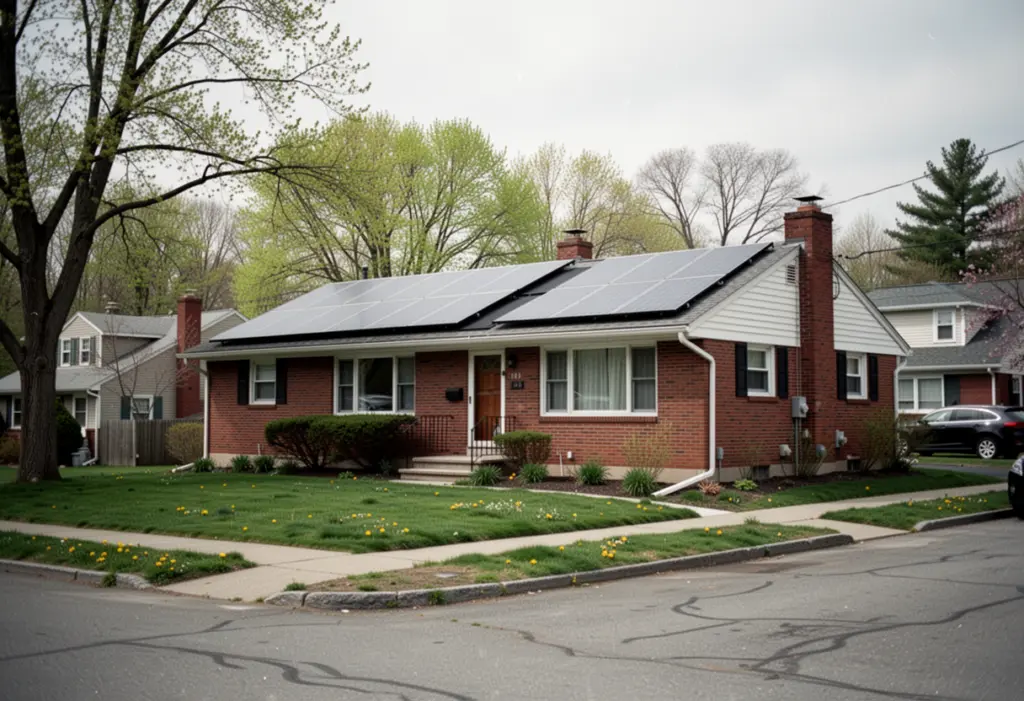
Two Colonie households can pay the same price for the same system and end up with different total costs of ownership, because part of the cost is decided by taxing authorities rather than by the installer. In a town this large, with villages inside it and several school districts reaching across it, the local checks are worth doing before you compare proposals at all.
The property tax exemption is three questions, not one
RPTL 487 exempts the added value of a solar energy system from real property tax for 15 years. It is not automatic and it is not one decision. A county, city, town or village may opt out by local law, and a school district may opt out by resolution. So there are three independent answers to collect:
- The municipality. For most addresses this is the Town of Colonie, but the Village of Colonie and the Village of Menands are separate municipal corporations inside the town with their own governments. Latham and Loudonville are hamlets of the town rather than villages, so they answer to the town.
- Albany County. A single answer for every address in the town.
- The school district. This is the one that varies inside the town. North Colonie and South Colonie are separate districts, and other districts reach into the town at its edges. Two houses on the same road can therefore get different answers on the school portion of the exemption, which is a real difference in what the system costs to hold for 15 years.
Ask the assessor’s office for all three positions and get them before contract. Note also that the exemption applies to the added value of the system rather than reducing your existing bill, and that section 487 requires the system to be constructed before 1 January 2030.
What the system costs each month regardless
Colonie is served by National Grid. The Customer Benefit Contribution is charged monthly on the DC size of the array, not on production, at $0.97 per kW-month for 2026. On an 8.4 kW system that is $8.15 a month, about $98 a year. The charge applies to systems interconnected on or after 1 January 2022, and it is recalculated annually rather than fixed at the date of interconnection — a proposal that shows it as a fixed 25-year line is being optimistic about a number nobody controls.
Set against it, Phase One net metering credits exported energy at the full retail rate and the structure holds for 20 years from interconnection, which is the single most valuable thing in the whole arrangement and the reason to interconnect rather than to wait.
If somebody else owns the panels
The 2026 picture has changed the balance between buying and third-party ownership, and it is worth understanding before a lease or a power purchase agreement is presented as the cheaper option. Section 25D, the 30 percent residential credit, is terminated for expenditures made after 31 December 2025, with an expenditure treated as made when the original installation is completed. A homeowner buying in 2026 claims nothing federally. The business-side credit survives and is claimed by the company that owns a leased or PPA system, which is why third-party offers can still price in an incentive the household never sees directly.
New York’s own credit does reach these arrangements, but with conditions that are easy to state wrongly:
- The agreement must run for at least ten years. That minimum applies to a lease as well as to a power purchase agreement, so a five or seven year lease does not qualify at all.
- The $5,000 is a lifetime ceiling per agreement for a lease or PPA, not an annual figure, and amounts claimed in previous years are subtracted.
- On an agreement running more than 15 years, no credit is allowed after the fifteenth year, even if the $5,000 has not been used up.
Ask any third-party offer to show you the contract term in years before you compare its monthly number to a purchase.
Mid-century houses, and the two items to price
Much of Colonie was built between the 1950s and the 1970s. Two things follow that belong in the quote as their own line items rather than as a change order: the service panel, because 100 amp service is common and a solar breaker may require an upgrade or a line-side tap, and the roof covering, because an array installed over shingles with a few years left is an array that has to come off and go back on. Ask for both as separate numbers so you can see what is solar cost and what is deferred maintenance.
Mature street canopy is the third local factor. The December sun sits low, and a maple that is irrelevant in July can remove hours in the month your credit bank is being drawn down. Ask for an on-site shading assessment and for the December and January production figures on their own.
The rest of the 2026 position
For an owner-occupier buying outright, the live incentives are the 25 percent state credit capped at $5,000 on Form IT-255 for a principal residence, the state sales tax exemption on residential solar equipment, and the property tax exemption above. NY-Sun, a contractor-applied price reduction paid in megawatt blocks, is not among them for now: as of September 2026 NYSERDA has no open NY-Sun block for homes in any utility territory; check NYSERDA’s NY-Sun dashboard for a new one. If your address happens to be served by a municipal electric utility such as the Green Island Power Authority in this county, the utility-side rules on this page do not apply to you at all — municipal utilities are outside Public Service Commission jurisdiction, so ask them directly. All of these programmes are revised from time to time; verify the current terms with NYSERDA, the Department of Taxation and Finance and your assessor before you commit.
Frequently Asked Questions
Why does the solar property tax exemption vary within Colonie?
Because RPTL 487 can be opted out of separately by the municipality, the county and the school district. The Town of Colonie contains the Villages of Colonie and Menands, and North Colonie and South Colonie are separate districts, so answers differ by address.
Does a solar lease qualify for the New York state tax credit?
Only if it runs for at least ten years. The ten-year minimum applies to a lease as well as a power purchase agreement, the $5,000 is a lifetime ceiling for that agreement rather than annual, and no credit is allowed after the fifteenth year.
What is the monthly capacity charge on an 8.4 kW system here?
National Grid's 2026 residential Customer Benefit Contribution is $0.97 per kW-month of DC size, so about $8.15 a month or roughly $98 a year on 8.4 kW. It is billed on size, not on output, and is reset annually.
Do I need a service panel upgrade for solar in Colonie?
Possibly. Much of the town dates from the 1950s to 1970s and 100 amp service is common, so a solar breaker may require an upgrade or a line-side tap. Ask for it as a separate line item rather than discovering it as a change order.
This article is general information, not tax, legal or financial advice. Incentive amounts, eligibility rules and deadlines change and depend on your utility, your tax situation and your property. Confirm current terms with NYSERDA, your utility and a qualified tax professional before making a decision.
NY Solar Incentives
Independent New York solar research. We summarise NYSERDA, NY-Sun and federal programme rules from published sources and state plainly when a figure is an estimate. We are not a government agency and do not sell equipment.
Run the arithmetic on your own system
Check the dated program table and your arrangement before counting an incentive. Standard residential NY-Sun blocks are closed; Long Island Affordable Solar has a conditional income-verification route. The NY credit depends on qualified costs and tax liability, while the NYC abatement reduces future property-tax bills. The estimator keeps those timings separate.