Solar Panel Installation in Valley Stream, NY
In a village of small lots and two family houses, the question that decides a Valley Stream solar project is often which electric meter the array is wired to.
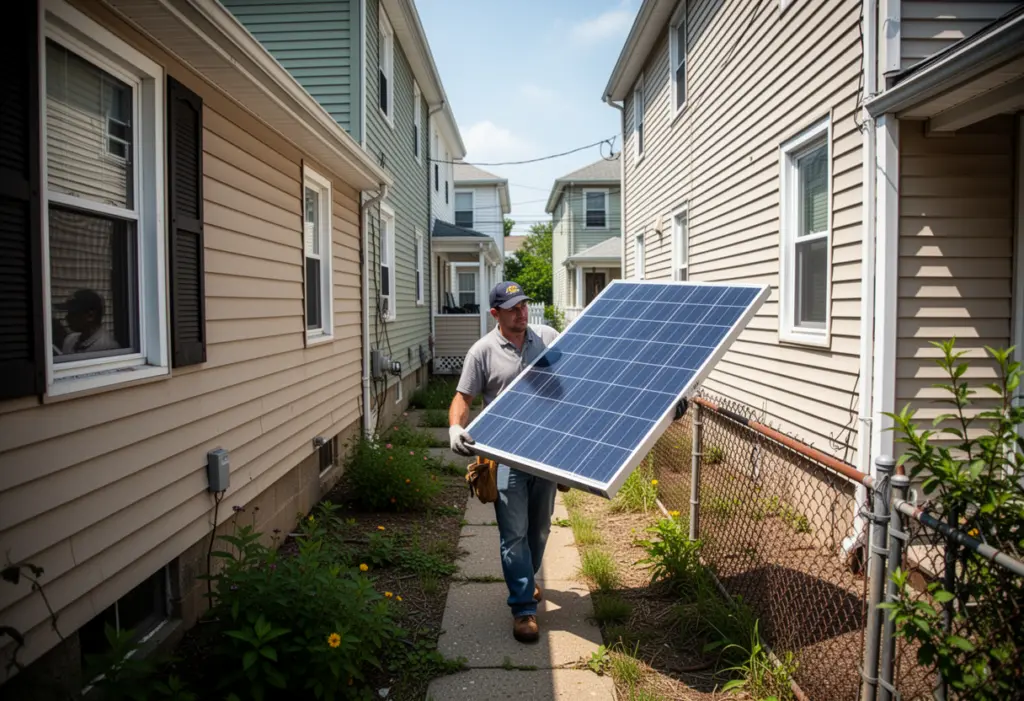
A solar installation in Valley Stream runs into two local realities before it runs into anything technical: the lots are small and close together, and a great many houses are set up for two households. Both change the design, and the second one changes who benefits from the system. Settle them at the survey, not at the inspection.
Which meter does the array feed
A house arranged as a two family or a mother-daughter usually has more than one electric account. A rooftop array is wired to one service, and the net metering credits flow to that account and no other. That single decision determines who sees the bill reduction, and it is not reversible without rewiring.
The tax position runs alongside it. New York’s credit on Form IT-255 requires the system to be installed and used at the taxpayer’s principal residence. If you live in the house, that test is met for you as the owner-occupant. If you have moved out and rent the whole property, it is not, and no amount of restructuring the paperwork changes that. Where a tenant occupies the unit whose meter the array feeds, work through with your accountant who is paying for what before anyone signs. This is a genuinely common situation in the village and it is the sort of thing that is expensive to discover late.
Access, staging and the neighbours
On a narrow lot with a driveway a car wide, the crew still has to move full size modules, rails and a lift or scaffold to the roof. Ask at the survey where material will be staged, whether the driveway will be blocked and for how long, and whether any part of the work needs access over a neighbour’s property. Getting a yes from the neighbour in advance is easier than getting one with a crew standing in the yard. Ask too how roof edges and gutters are protected, because on a tight site there is nowhere to put anything down.
Permits and the paper trail
Inside the incorporated village, the Village of Valley Stream building department issues the permit, covering the 11580, 11581 and 11582 addresses that fall within the village boundary. New York’s Unified Solar Permit standardises residential applications for systems of 25 kW DC and under and has been adopted by more than 300 authorities having jurisdiction statewide, so ask which form is being used and ask to see the package before it is filed. The electrical work is normally certified by an approved electrical inspection agency rather than inspected by the municipality directly, and that certificate feeds the utility’s final approval. Keep a copy: it is one of the documents a buyer’s attorney asks for.
Where the equipment goes
- The service panel. Establish the rating and the free breaker positions before design. Older Nassau housing frequently runs a 100 amp service, and an EV charger or heat pump later will compete for the same space.
- Conduit runs. On a small house with a finished attic there may be no concealed route, so ask where the conduit will be visible and whether that is acceptable to you.
- Inverter placement. Ask what it sounds like, how warm it runs and how close to a bedroom window or a neighbour’s wall it will sit.
- Rapid shutdown and labelling. Ask to see the disconnect location and the labelling that the inspector and the fire service rely on.
Sequence and switch-on
The order is survey, design, interconnection application to PSEG Long Island which operates the LIPA system serving the village, building permit, installation, electrical certificate, then permission to operate. The array stays off until that final approval. Ask for the sequence in writing with a named owner for each step, and ask what happens to your deposit if an application is refused.
The charge that follows the size
The Customer Benefit Contribution is billed monthly on DC system size rather than output, on systems interconnected on or after 1 January 2022. At the 2026 residential rate of $1.13 per kW-month, a 4.8 kW array — a realistic size for a small roof with one usable plane — pays about $5.42 a month, roughly $65 a year. The rate is recalculated annually. If the roof cannot carry a system that covers your usage, a community solar subscription is worth pricing as an alternative: subscribers pay no capacity charge at all and no roof work is involved.
The 2026 incentive position
A buyer gets nothing federally. Section 25D ended for expenditures made after 31 December 2025, and an expenditure is treated as made when the original installation is completed, so 2026 installations are outside it. New York’s credit remains at 25 percent of qualified expenditure capped at $5,000, non-refundable but carried forward for up to five years, and it reaches leases and power purchase agreements of ten years or more — the ten year minimum applies to the lease as much as to the agreement to buy power. Residential solar equipment is exempt from state sales tax, and RPTL 487 exempts the added value for 15 years where the village, Nassau County and the relevant school district have each not opted out. NY-Sun, which your contractor applies as a reduction in the price when a block is open, and its Affordable Solar incentive are not available now: as of September 2026 NYSERDA has no open NY-Sun block for homes in any utility territory; check NYSERDA’s NY-Sun dashboard for a new one. Confirm all of it with NYSERDA and New York State Taxation and Finance before you sign.
Frequently Asked Questions
Which meter should a two family house connect solar to?
Whichever account you want the net metering credits to reduce, because they flow to that service and no other. It is not reversible without rewiring, so decide it at the survey rather than at installation.
Can a landlord claim the New York solar credit?
The credit on Form IT-255 requires the system to be installed and used at the taxpayer's principal residence in New York State. An owner-occupant meets that test; an owner who has moved out and rents the whole property does not. Work it through with your accountant first.
What should I ask about access on a narrow lot?
Where material will be staged, whether the driveway is blocked and for how long, whether any work needs access over a neighbour's property, and how gutters and roof edges are protected. Arrange neighbour access in advance rather than on the day.
Is a small array still worth it here?
It can be, but price a community solar subscription alongside it. Subscribers pay no capacity charge and need no roof work, whereas a 4.8 kW rooftop array carries about $5.42 a month at the 2026 rate of $1.13 per kW-month.
This article is general information, not tax, legal or financial advice. Incentive amounts, eligibility rules and deadlines change and depend on your utility, your tax situation and your property. Confirm current terms with NYSERDA, your utility and a qualified tax professional before making a decision.
NY Solar Incentives
Independent New York solar research. We summarise NYSERDA, NY-Sun and federal programme rules from published sources and state plainly when a figure is an estimate. We are not a government agency and do not sell equipment.
Run the arithmetic on your own system
Check the dated program table and your arrangement before counting an incentive. Standard residential NY-Sun blocks are closed; Long Island Affordable Solar has a conditional income-verification route. The NY credit depends on qualified costs and tax liability, while the NYC abatement reduces future property-tax bills. The estimator keeps those timings separate.