Stacking New York Solar Incentives Correctly, in Order
The order matters, because each incentive attaches at a different moment — the contract, the purchase, the tax return, the assessment roll — and one item in the stack is a cost rather than a benefit.
On this page 8 sections
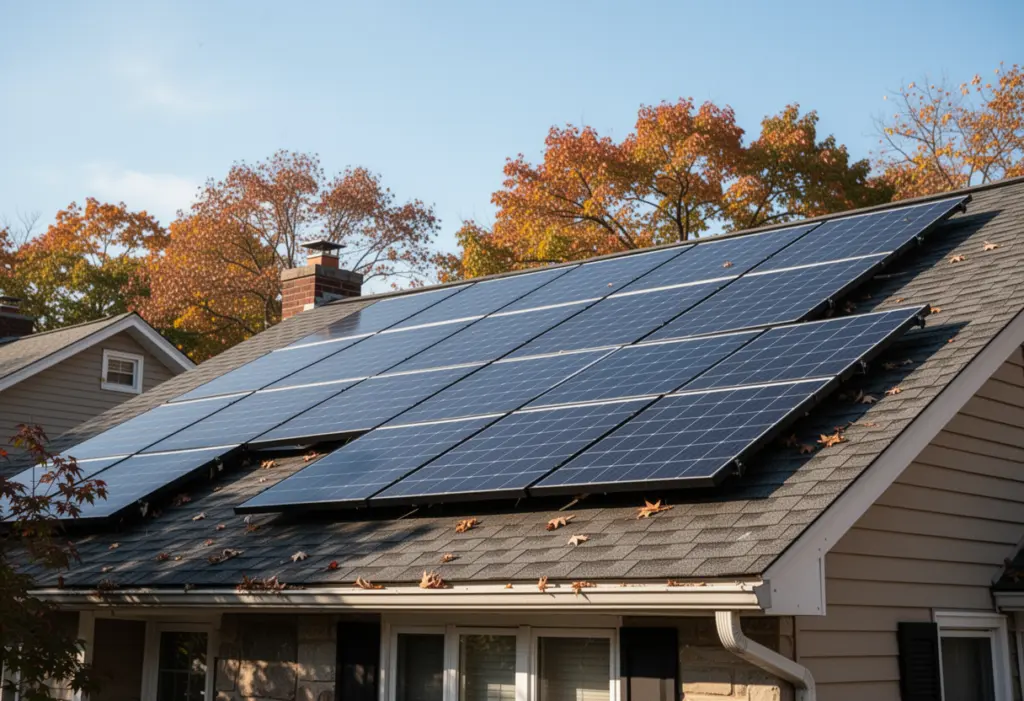
New York’s solar incentives are not a single pot to be divided. They attach at four different moments — when you sign the contract, when you buy the equipment, when you file your state return, and when the assessment roll is prepared — and each has its own conditions. Stack them in that order and the arithmetic behaves. Treat them as one lump and you will double count something, most often the state credit.
The order of operations
- NY-Sun, at the contract, when a block is open. A contractor-applied reduction on the price, sized by system and region and stepping down as each region’s megawatt block fills. As of September 2026 NYSERDA has no open NY-Sun block for homes in any utility territory; check NYSERDA’s NY-Sun dashboard for a new one. You file nothing. If a block opens, ask for the rate per watt and the block it assumes as an itemised line; until then this step is $0.
- The Affordable Solar incentive, also at the contract, also closed for now. An additional NYSERDA amount for households under 80 percent of area median income. Its residential blocks are closed too: Con Edison’s ended on 15 October 2025 and the Upstate region’s on 9 March 2026, and none is open on Long Island. If one opens, remember it is applied by the contractor, so an installer who does not raise it will not apply it.
- The sales tax exemption, at purchase. New York State exempts residential solar energy systems equipment. Localities may separately elect to exempt their local share, so the total relief differs by county and by city — do not assume a neighbour’s figure applies to your address.
- The IT-255 credit, on your state return. 25 percent of qualified expenditure capped at $5,000, for equipment installed and used at your principal residence in New York. It is not refundable, it is limited by your actual state liability, and unused amounts carry forward up to five years.
- RPTL 487, on the assessment roll. A 15-year exemption on the added value of the system, requiring construction before 1 January 2030.
- The Customer Benefit Contribution, monthly, in the other direction. This one is a cost, not an incentive, and it belongs in the stack precisely because proposals leave it out.
Where the stack breaks: the cap
The state credit is 25 percent up to $5,000, so it stops growing at roughly $20,000 of qualified expenditure. On a $22,000 system, 25 percent is $5,500 and you receive $5,000. On a $34,000 system, 25 percent is $8,500 and you still receive $5,000. Everything above the cap line is carried entirely by the household, which is why an upsell that adds panels because incentives will cover it deserves the arithmetic done in front of you.
If a NY-Sun block for homes opens again, a second question belongs with a tax preparer rather than an installer: whether a contractor-applied NY-Sun reduction reduces the expenditure base on which the 25 percent is computed. That is a question about your return, and the person who benefits from the larger answer is not the person who should be giving it.
Three separate checks for the property tax exemption
RPTL 487 is often described as automatic. It is not. A county, city, town or village may opt out by local law and a school district may opt out by resolution, and those are three independent checks that can come back differently for one parcel. Ask the assessor for all three by name.
Two details are routinely stated backwards. Section 487 is not limited to areas outside New York City — the city’s Department of Finance administers it in the five boroughs as the Clean Energy Systems Exemption. And in the Big Five city school districts — New York City, Buffalo, Rochester, Syracuse and Yonkers — the districts are fiscally dependent and levy no separate property tax, so there is no separate school check to make in those five cities. Inside New York City the Title 4-C abatement, filed on form PTA4 with the Department of Buildings over a four-year compliance period, layers on top of section 487 rather than replacing it.
The line that must not be in the stack
Section 25D, the 30 percent federal residential credit, is terminated for expenditures made after 31 December 2025, and an expenditure is treated as made when the original installation is completed — not when the system is energised. That distinction rescues a system finished in December 2025 and switched on in January 2026, and it excludes one finished in 2026 no matter when it was ordered. Where the work forms part of constructing or reconstructing a structure, the test instead becomes when your original use of the structure begins. A 2026 proposal that stacks a 30 percent federal line on top of the state items is not aggressive, it is wrong.
If you do not own the system
The credit that survived federally is the business-side one and it belongs to whoever owns the equipment, which is why third-party offers can price in an incentive the resident never sees. New York’s credit does reach lease and power purchase agreement customers, but only where the agreement runs ten years or more — and that minimum applies to the lease as well as to the power purchase agreement, which is the single most commonly mis-stated rule in this area. On such an agreement the $5,000 is a lifetime ceiling for that agreement rather than an annual figure, and no credit is allowed after the fifteenth year even if the ceiling has not been reached.
The negative item, with numbers
The Customer Benefit Contribution is charged on DC capacity for systems interconnected on or after 1 January 2022, in every month, whether or not the array produced anything. A 9 kW system on Long Island pays 9 × $1.13, about $10.17 a month or $122 a year at the 2026 residential rate. The same array under Central Hudson would pay $15.03 a month. Rates are recalculated annually and are not locked in at interconnection, so any 25-year model treating this as a constant is estimating, not calculating.
Check the current position yourself
Every item above moves on its own schedule: NY-Sun blocks step down and close as capacity fills (none is open for homes as of September 2026), the contribution rates are reset annually, opt-out decisions are made locally, and tax rules change with legislation. Verify NY-Sun and Affordable Solar with NYSERDA, the credit with the Department of Taxation and Finance and Form IT-255, the exemption with your assessor, and anything touching the bill with the utility named on it.
Frequently Asked Questions
In what order do New York solar incentives apply?
NY-Sun and the Affordable Solar incentive come off the contract price when NYSERDA has a residential block open (none is as of September 2026), the sales tax exemption applies at purchase, the IT-255 credit is claimed on your state return, and RPTL 487 affects the assessment roll. The monthly capacity charge runs in the other direction.
Can I stack the federal credit with the New York one?
Not in 2026. Section 25D was terminated for expenditures made after 31 December 2025, with an expenditure treated as made when the original installation is completed. Only the state items remain for a buyer.
At what system size does the $5,000 cap bite?
At roughly $20,000 of qualified expenditure, because 25% of that is $5,000. On a $34,000 system the credit is still $5,000, so everything above the cap line is carried entirely by the household.
Is the property tax exemption automatic?
No. A county, city, town or village may opt out by local law and a school district by resolution, which is three separate checks with your assessor. In the Big Five city school districts there is no separate school levy to check.
This article is general information, not tax, legal or financial advice. Incentive amounts, eligibility rules and deadlines change and depend on your utility, your tax situation and your property. Confirm current terms with NYSERDA, your utility and a qualified tax professional before making a decision.
NY Solar Incentives
Independent New York solar research. We summarise NYSERDA, NY-Sun and federal programme rules from published sources and state plainly when a figure is an estimate. We are not a government agency and do not sell equipment.
Run the arithmetic on your own system
Check the dated program table and your arrangement before counting an incentive. Standard residential NY-Sun blocks are closed; Long Island Affordable Solar has a conditional income-verification route. The NY credit depends on qualified costs and tax liability, while the NYC abatement reduces future property-tax bills. The estimator keeps those timings separate.