Solar Loan Interest Rates in New York in 2026
A low advertised rate on a New York solar loan is usually bought with a fee inside the system price. One question separates the two, and it has to be asked before signing.
On this page 8 sections
- 01The one question to ask before comparing any rate
- 02The term is where a good rate turns into a large total
- 03What changed for 2026, and why old loan structures now misfire
- 04Where the fee and the credit interact
- 05The options a New York homeowner should price against the dealer offer
- 06Two more things to get in writing
- 07Incentives that stand behind the financing in 2026
- 08Frequently Asked Questions
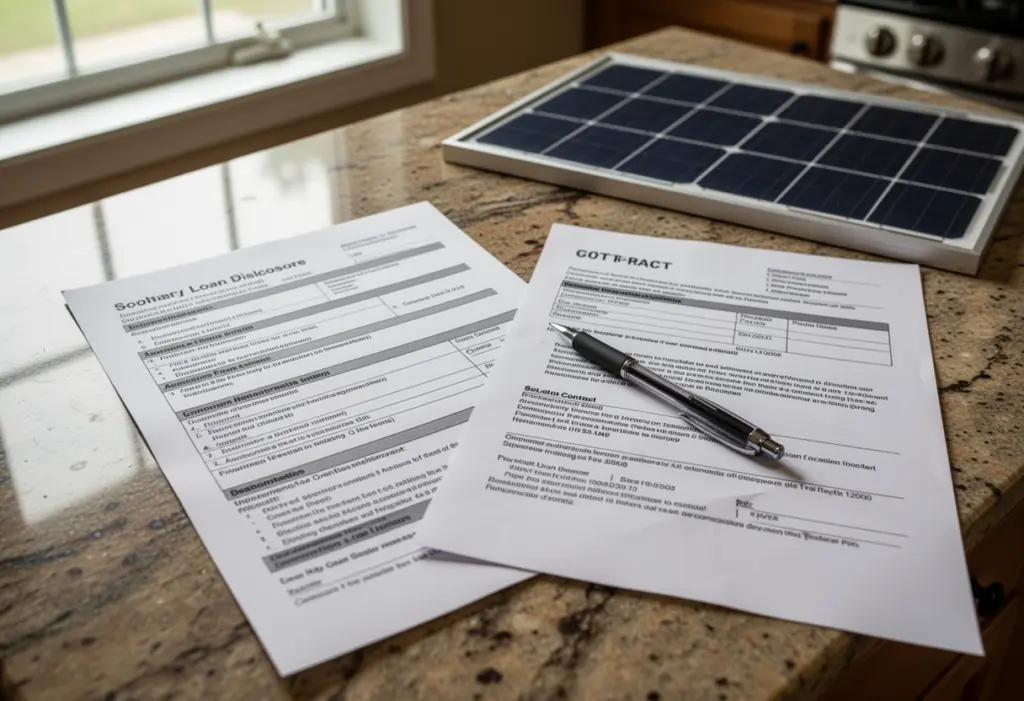
The advertised interest rate is the number every solar finance conversation is built around, and it is the wrong thing to shop. What you owe over the life of the agreement is decided by three things — the amount borrowed, the rate and the term — and the amount borrowed is the one that a low rate quietly increases.
The one question to ask before comparing any rate
Ask each installer: what is the cash price for this exact system, and what is the price if I finance it through you? Insist on the same hardware, the same module count and the same DC size on both, and get both in writing.
If those two prices differ, the difference is a dealer fee that buys down the rate. It is not a discount for paying cash; it is the cost of the finance, moved from the interest column into the price column. And because it lands inside the amount you borrow, you pay interest on it as well. A rate that looks unbeatable and a price that looks high are usually the same fact stated twice.
Do the comparison in total dollars. For each offer, multiply the monthly payment by the number of payments and add any closing fee. Then compare that total against the cash price plus whatever a credit union or home equity option would cost. This takes ten minutes and it is the entire exercise.
The term is where a good rate turns into a large total
A long term at a low rate frequently costs more in total than a shorter term at a higher one, because you are paying a smaller percentage across many more years. Ask for the annual percentage rate, the term in months, the total of payments and the payoff terms on every offer. If a salesperson will discuss the monthly payment but not the total of payments, that is the answer to the question you asked.
What changed for 2026, and why old loan structures now misfire
The 30% federal residential credit is gone. Section 25D was terminated for expenditures made after 31 December 2025, and an expenditure is treated as made when the original installation is completed, so a system completed in 2026 earns nothing federally. There is one exception in the other direction worth knowing: for equipment installed in connection with the construction of a structure, the expenditure counts when the taxpayer's original use of the structure begins, which excludes some new builds that were finished earlier.
This matters to loan shopping specifically, because a great many solar loan products were designed around a large voluntary principal payment in month sixteen to eighteen, funded by that credit. The structure did not disappear when the credit did. If an offer in front of you has a lower payment for a first period and a higher one after, ask exactly what principal reduction that assumes and where the lender expects the money to come from. If the answer involves a federal tax credit, the offer is built on something that will not happen.
New York's credit is not a substitute. It is 25% of qualified expenditure capped at $5,000 on Form IT-255, for a principal residence in the state, and it is limited by your actual state tax liability with a five-year carryforward. It is not refundable: it reduces the New York tax you owe when you file, and it does nothing to the price at closing.
Where the fee and the credit interact
A dealer fee raises the contract price, and the state credit is a percentage of qualified expenditure — so on a small system a higher price does return a little of the fee through the credit. On any system large enough that 25% already exceeds $5,000, which is to say any system priced above $20,000, the cap has bound and the fee returns you nothing at all. Larger systems and financed prices are exactly the combination where the fee is least recoverable.
The options a New York homeowner should price against the dealer offer
- NYSERDA financing through Energy Finance Solutions — the Smart Energy Loan, and the On-Bill Recovery Loan which is repaid through your utility bill. Ask about eligibility, term and what happens if you sell the house.
- A credit union. Unsecured, no dealer involvement, and the loan is not tied to a specific contractor, which preserves your ability to walk away from a quote.
- Home equity. Cheaper because it is secured on the house, which is the whole caution — a solar payment problem becomes a housing problem.
- Cash, where it exists. Paying cash removes the fee, the lien and the term question at once, and it is the option a financed proposal is least likely to show you beside its own.
Two more things to get in writing
Ask whether the loan is secured by a filing against your property or equipment, and what has to happen to discharge it when you sell or refinance. Ask whether there is a prepayment penalty, since a plan to pay the loan down early is worth nothing if the note charges for it.
Incentives that stand behind the financing in 2026
Whatever you borrow, the incentives are unaffected by how you pay. NY-Sun, which contractors used to apply as a reduction in the contract price, offers homes nothing at present, and neither does its income-qualified Affordable Solar rate. As of September 2026 NYSERDA has no open NY-Sun block for homes in any utility territory; check NYSERDA’s NY-Sun dashboard for a new one. Residential solar equipment is exempt from state sales tax. RPTL 487 exempts the added value from property tax for 15 years where the municipality, the county and the school district have each not opted out, for systems constructed before 1 January 2030. And the state credit reaches leases and power purchase agreements of ten years or more, with $5,000 as a per-agreement lifetime ceiling — which is worth knowing before you conclude that borrowing is the only route. Programme terms change; confirm them at NYSERDA and the Department of Taxation and Finance before signing.
Frequently Asked Questions
What interest rate should I expect on a New York solar loan in 2026?
Shop the total cost rather than the rate. Ask for the cash price and the financed price of the identical system; the gap is a dealer fee that raises the amount you borrow and pay interest on.
Why do some solar loans have a payment that increases?
They assume a large principal payment by month sixteen to eighteen. Many were designed around the federal credit, which ended for expenditures made after 31 December 2025, so the assumption no longer holds.
Is a longer solar loan term cheaper?
The monthly payment is smaller and the total is usually larger. Ask for the APR, the term in months and the total of payments on every offer, and compare the totals rather than the payments.
Are there state backed solar loans in New York?
NYSERDA offers financing through Energy Finance Solutions, including the Smart Energy Loan and the On-Bill Recovery Loan repaid on your utility bill. Confirm current eligibility and terms with them directly.
This article is general information, not tax, legal or financial advice. Incentive amounts, eligibility rules and deadlines change and depend on your utility, your tax situation and your property. Confirm current terms with NYSERDA, your utility and a qualified tax professional before making a decision.
NY Solar Incentives
Independent New York solar research. We summarise NYSERDA, NY-Sun and federal programme rules from published sources and state plainly when a figure is an estimate. We are not a government agency and do not sell equipment.
Run the arithmetic on your own system
Check the dated program table and your arrangement before counting an incentive. Standard residential NY-Sun blocks are closed; Long Island Affordable Solar has a conditional income-verification route. The NY credit depends on qualified costs and tax liability, while the NYC abatement reduces future property-tax bills. The estimator keeps those timings separate.