Solar Panel Cost Per Watt in New York in 2026
Dollars per watt is the number every New York homeowner is told to compare, and it is the easiest number on a proposal to construct differently. Here is how to normalise it.
On this page 8 sections
- 01Fix the denominator first
- 02Fix the numerator second
- 03The 2026 trap in the third of those
- 04NY-Sun moved block by block, and for homes no block is open now
- 05The per-watt cost nobody puts in the ratio
- 06Five questions that make two quotes comparable
- 07What is left to claim in 2026
- 08Frequently Asked Questions
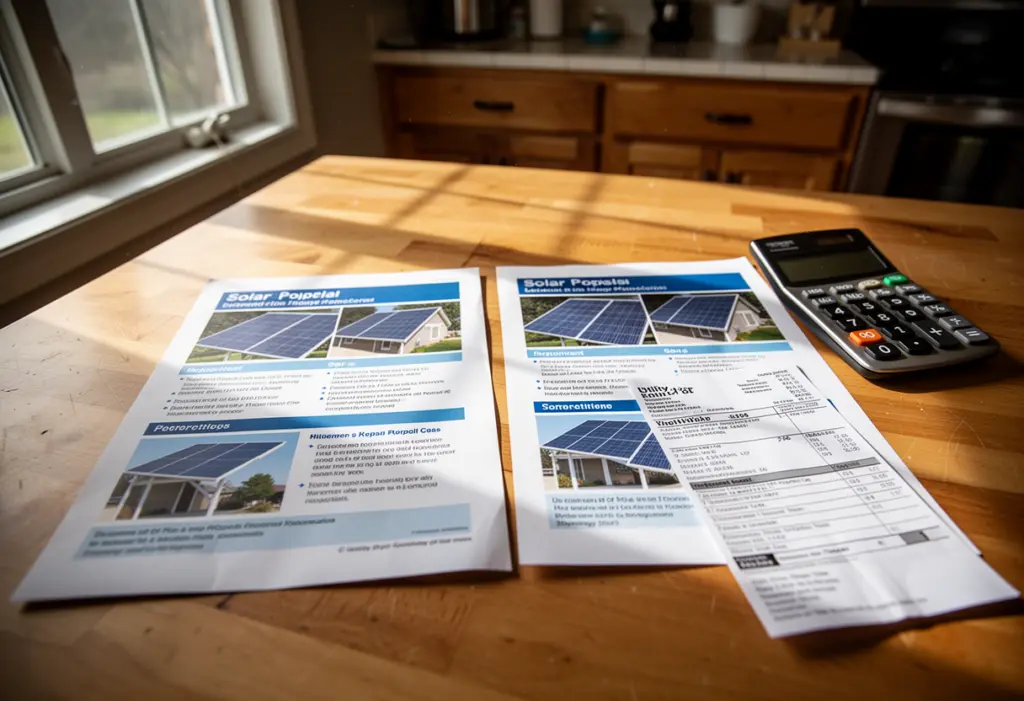
Dollars per watt is a ratio, and a ratio can be changed by moving either half of it. In 2026 both halves are moving for New York buyers, which is why two proposals for the same roof can quote very different per-watt figures and both be arithmetically correct. Normalise them before you compare them.
Fix the denominator first
Ask for the system size in kilowatts DC — the sum of the module nameplate ratings. Some proposals quote AC size instead, which is set by the inverter and is normally lower, and dividing the same price by a smaller number produces a higher per-watt figure for identical hardware. It matters beyond arithmetic: the Customer Benefit Contribution and most incentive calculations run on DC size, so DC is the figure you will meet again.
Then check what is inside the price. A quote that includes a main panel upgrade, tree removal or a detach-and-reset allowance is a different transaction from one that does not, and its per-watt figure will look worse for a good reason.
Fix the numerator second
There are at least four prices for the same system, and per-watt can be computed from any of them:
- Gross price before any incentive.
- Net of NY-Sun, which is the number New York contractors used to lead with, because the incentive was paid through them as a price reduction rather than to you. With no residential block open as of September 2026, on a home quote it should equal the gross.
- Net of tax credits, which is a forecast of your tax position, not a price.
- Financed price, which on a low advertised rate usually contains a dealer fee that the cash price does not.
Ask every installer for gross and for any NY-Sun deduction on the same page (for a home there should be none while NYSERDA has no residential block open), and compute per-watt from the gross. That is the only one of the four that describes the job rather than your paperwork.
The 2026 trap in the third of those
Any 2026 quote showing a 30% federal line is wrong. Section 25D was terminated for expenditures made after 31 December 2025, and an expenditure is treated as made when the original installation is completed. Take the gross figure from your own proposal and multiply by 0.3 — on a $30,000 gross, that is $9,000 of purchasing power the page is promising you and that will not arrive. A net-of-credits per-watt figure computed that way understates the true cost by nearly a third, and any installer still printing it in 2026 has not updated their software.
Business and farm projects sit under a different provision entirely and must not be reasoned about from the residential rule. If that is your situation, take it to your accountant rather than to a sales sheet.
NY-Sun moved block by block, and for homes no block is open now
The NY-Sun incentive is itself expressed per watt, and it is structured as a megawatt block: each region has capacity blocks and the per-watt level steps down as each block fills. It is designed to phase out as the market matures, and for homes it already has: Con Edison’s last standard residential block closed on 29 May 2025, the Upstate one on 17 December 2025 and Long Island’s on 17 April 2016, and the income-qualified Affordable Solar blocks closed on 15 October 2025 in Con Edison territory and on 9 March 2026 Upstate. As of September 2026 NYSERDA has no open NY-Sun block for homes in any utility territory; check NYSERDA’s NY-Sun dashboard for a new one. A per-watt incentive someone quotes from memory is stale, so if a home proposal still shows a NY-Sun line item, ask which open block it comes from.
The per-watt cost nobody puts in the ratio
The Customer Benefit Contribution is also a per-watt charge — it just recurs. At $1.29 per kW-month on Con Edison, that is about a tenth of a cent per watt every month, for as long as you own the system, on capacity rather than production. On a 9 kW array the 2026 residential rates give $8.73 a month on National Grid — $104.76 a year — $11.61 on Con Edison, or $139.32 a year, and $15.03 on Central Hudson, which is $180.36 a year. It applies to systems interconnected on or after 1 January 2022, is recalculated annually rather than locked in, and does not apply to community solar subscribers or to municipal electric utility customers, who are outside Public Service Commission jurisdiction. A per-watt comparison that ignores it treats a Central Hudson roof and a National Grid roof as the same purchase, and they are not.
Five questions that make two quotes comparable
- What is the system size in kW DC, and what is the total gross price before any incentive?
- Is there a NY-Sun reduction and, if so, from which open block, shown as its own line?
- What is the cash price for this identical system, if I do not finance it?
- What is excluded — panel upgrade, tree work, structural letter, permit fees, detach and reset?
- Which authority issues the permit for my address, and who files the interconnection application?
What is left to claim in 2026
New York's 25% credit capped at $5,000 on Form IT-255 remains for a principal residence in the state, and it reaches leases and power purchase agreements of ten years or more, where the $5,000 is a per-agreement lifetime ceiling rather than an annual figure. The state sales tax exemption on residential solar equipment stands; the local share is exempt only where the county or city has opted in. RPTL 487 gives a 15-year exemption on the added value where the municipality, the county and the school district have each not opted out, for systems constructed before 1 January 2030. Incentive rules change; confirm the current position with NYSERDA and the Department of Taxation and Finance before you sign.
Frequently Asked Questions
Should I compare solar quotes on DC or AC watts?
DC. It is the sum of module nameplate ratings, and it is the basis for the Customer Benefit Contribution and most incentive calculations. AC size is set by the inverter and is normally lower.
Why do two New York quotes show different costs per watt?
Usually because one is computed after incentives and the other before, or one includes work such as a panel upgrade. Ask both for gross price and DC size and recompute the ratio yourself.
Can I still subtract 30% federal from a 2026 price per watt?
No. Section 25D ended for expenditures made after 31 December 2025, treated as made when the original installation is completed. A net figure built on 30% federal understates the real cost by nearly a third.
What is the NY-Sun incentive per watt right now?
For a home, nothing at present. As of September 2026 NYSERDA has no open NY-Sun block for homes in any utility territory; check NYSERDA’s NY-Sun dashboard for a new one. When a block is open, the rate depends on your region and steps down as blocks fill, so rely on the dashboard rather than on a figure quoted earlier.
This article is general information, not tax, legal or financial advice. Incentive amounts, eligibility rules and deadlines change and depend on your utility, your tax situation and your property. Confirm current terms with NYSERDA, your utility and a qualified tax professional before making a decision.
NY Solar Incentives
Independent New York solar research. We summarise NYSERDA, NY-Sun and federal programme rules from published sources and state plainly when a figure is an estimate. We are not a government agency and do not sell equipment.
Run the arithmetic on your own system
Check the dated program table and your arrangement before counting an incentive. Standard residential NY-Sun blocks are closed; Long Island Affordable Solar has a conditional income-verification route. The NY credit depends on qualified costs and tax liability, while the NYC abatement reduces future property-tax bills. The estimator keeps those timings separate.