What Solar Panels Cost in Woodstock, New York
Woodstock quotes vary more than most, for two reasons you can settle before an installer visits: how much tree work the site needs, and whether the house is your principal residence.
On this page 6 sections
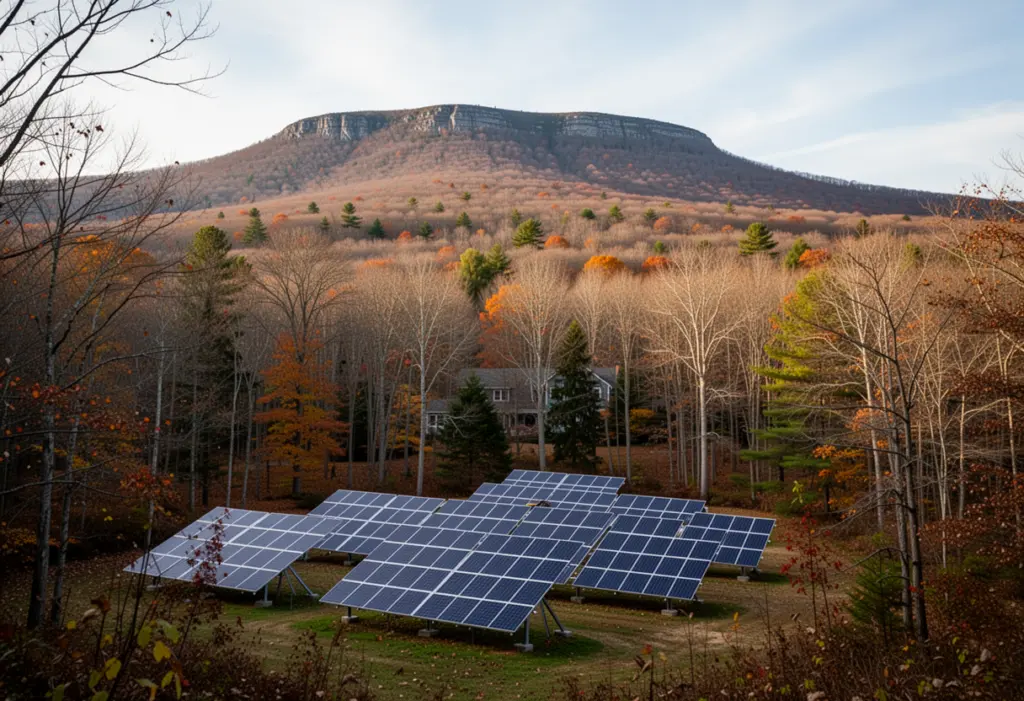
Woodstock quotes vary more than most, and the two reasons are trees and tax residence. A wooded parcel under the Catskill escarpment can need real clearing before an array makes sense at all, and a house used as a weekend place does not qualify for the state credit that carries much of the economics. Both can be settled before an installer ever visits.
The principal residence rule is worth five thousand dollars
The New York State credit on Form IT-255 is 25% of qualifying cost with a ceiling of five thousand dollars, and it requires the equipment to be installed and used at the taxpayer’s principal residence in New York State. A second home, a seasonal house or a property let to others does not qualify — and Woodstock has a great deal of all three. If the house is your principal residence, claim it. If it is not, take that credit out of the arithmetic before you compare proposals, because a payback built on it will simply not arrive.
Trees, ridges and the shape of a Woodstock estimate
- Clearing. Tree work can exceed the entire price difference between two panel brands. Have it quoted separately, ideally by an arborist, rather than folded into a solar contract as one lump.
- The escarpment. High ground north and west of the hamlet shortens the usable day at one or both ends for some parcels. Ask for a horizon modelled from the site rather than a default profile.
- Ground mount in a clearing. Where the roof is shaded and the yard is not, a ground mount may be the only design that produces anything worth having. Price the trench run back to the service, because it is charged by distance.
- Regrowth. A shading model built on today’s canopy is optimistic on a wooded lot. Ask what it assumes about ten more years of growth.
One building department, and a horizon that will not change
There is no incorporated village in Woodstock, so the town permits the hamlet at 12498, Bearsville at 12409 and everything between them. That is simpler than the village-and-town split found downriver. Ask the building department which approvals your address needs and whether the New York State Unified Solar Permit is used for systems of 25 kW DC and under.
One local point worth knowing: part of the town lies inside the Catskill Park, and land there in the state Forest Preserve is constitutionally protected as forever wild. If the trees shading your southern horizon stand on Forest Preserve land, they are not coming down at any price. For a shading assessment that is a permanent condition rather than something to negotiate with a neighbour, and it should be modelled as one.
Central Hudson and the capacity charge
Central Hudson serves Woodstock, and its residential Customer Benefit Contribution for 2026 is the steepest in the state table at $1.67 per kW-month of DC size. A 13 kW array — plausible on a large rural house with electric heat — is charged 13 × $1.67 = $21.71 a month, about $261 a year, billed on capacity rather than on output and payable on systems interconnected on or after 1 January 2022. The rates are recalculated annually rather than fixed at interconnection, so it is not a figure to hold constant across a twenty-year model. Confirm the supplier from the name printed on your own bill before you model anything on it.
What is actually available this year
Federally, nothing for a residential buyer. Section 25D ended for expenditures made after 31 December 2025 and the operative test is completion of the original installation. There is a separate rule where solar goes in as part of constructing or reconstructing a house: the test then is when the owner’s original use of the structure begins. That matters here, because new builds and gut renovations are common on these parcels, and it can reverse the answer. Anyone in that position should have the date question answered by their own tax preparer rather than by an installer.
From the state: the IT-255 credit described above, the sales tax exemption on residential equipment, and RPTL 487 exempting the added assessed value for fifteen years where the Town of Woodstock, Ulster County and the school district have each not opted out, with construction required before 1 January 2030. NY-Sun and its income-qualified Affordable Solar incentive, both applied through the contractor, are not available to homes at present: as of September 2026 NYSERDA has no open NY-Sun block for homes in any utility territory, the Affordable Solar blocks included; check NYSERDA’s NY-Sun dashboard for a new one. Confirm the opt-out position with the assessor before signing, because every one of these programmes changes.
Frequently Asked Questions
Does a weekend house in Woodstock qualify for the state credit?
No. The IT-255 credit requires the equipment to be installed and used at the taxpayer's principal residence in New York State, so a second home, a seasonal house or a rental property does not qualify and the credit should be left out of the arithmetic.
How much does tree clearing add to a solar project?
It varies with the trees and the access, and on a wooded Woodstock parcel it can exceed the price difference between two panel brands. Have it quoted separately by an arborist rather than accepting it folded into the solar contract.
What does Central Hudson charge per kW-month in 2026?
$1.67 per kW-month of DC size for residential net metered systems, the steepest of the seven utilities. A 13 kW array pays $21.71 a month, about $261 a year, charged on capacity regardless of what it produces.
Who issues solar permits in Woodstock?
The Town of Woodstock, since there is no incorporated village here. Ask whether it uses the New York State Unified Solar Permit for systems of 25 kW DC and under, and which approvals apply to your specific parcel.
This article is general information, not tax, legal or financial advice. Incentive amounts, eligibility rules and deadlines change and depend on your utility, your tax situation and your property. Confirm current terms with NYSERDA, your utility and a qualified tax professional before making a decision.
NY Solar Incentives
Independent New York solar research. We summarise NYSERDA, NY-Sun and federal programme rules from published sources and state plainly when a figure is an estimate. We are not a government agency and do not sell equipment.
Run the arithmetic on your own system
Check the dated program table and your arrangement before counting an incentive. Standard residential NY-Sun blocks are closed; Long Island Affordable Solar has a conditional income-verification route. The NY credit depends on qualified costs and tax liability, while the NYC abatement reduces future property-tax bills. The estimator keeps those timings separate.