What Solar Panels Cost in Tarrytown, New York
Tarrytown is built on a hillside, and the hill decides much of what an array costs here: which way the roof faces, how hard it is to reach, and how much capacity you need to buy.
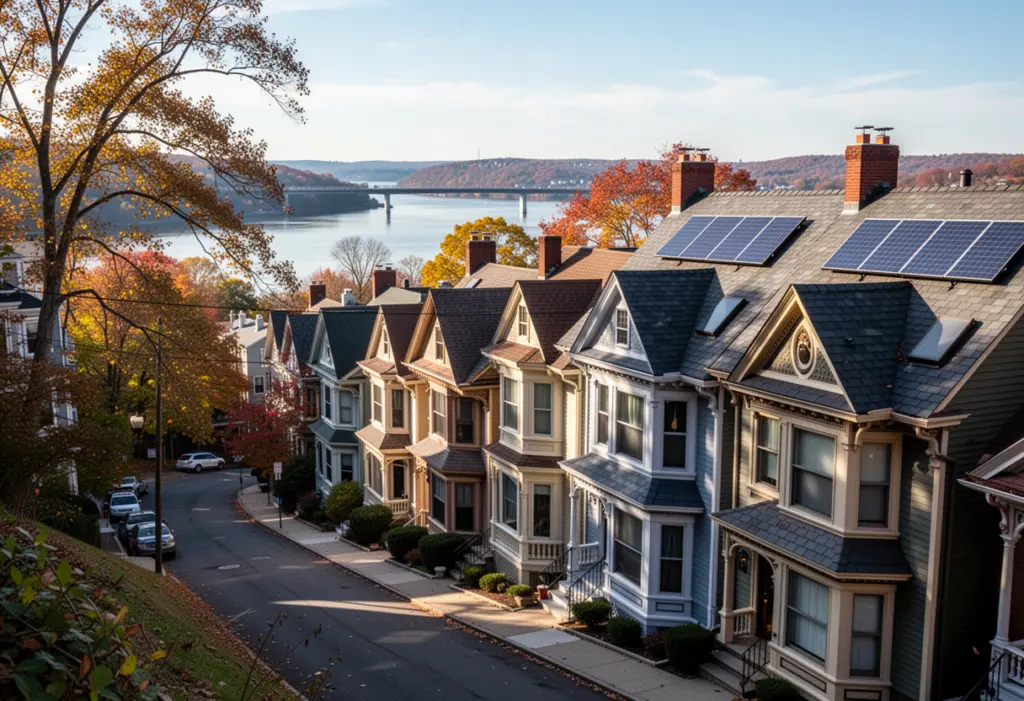
Tarrytown is built on a hillside, and the hill is the first thing that decides what an array costs here. Roof planes face wherever the street grid and the slope put them rather than where the sun is, access on a steep lot is harder, and the village runs its own approvals. All three land in the labour side of a quote rather than in the equipment side.
Orientation, not equipment, sets the payback
A south-facing roof at a reasonable pitch is the reference case. East and west planes still work, and on a Hudson slope they are frequently the only option, but they produce less for the same installed capacity. Less output per kW means more kW for the same annual production — and more kW means a larger monthly capacity charge for the whole life of the system. Ask for production modelled per roof plane instead of as one house total, so you can see what each face actually contributes before you agree a size.
The Con Edison capacity charge in numbers
Con Edison serves Tarrytown, and its residential Customer Benefit Contribution for 2026 is $1.29 per kW-month of DC size. A 7.5 kW array pays 7.5 × $1.29 = $9.68 a month, about $116 a year, whether the month is June or a grey December. It applies to systems interconnected on or after 1 January 2022, so a neighbour who went solar in 2019 pays nothing of the kind and their bill is not a guide to what yours will look like.
Village, not town, and not Sleepy Hollow
Tarrytown is an incorporated village inside the Town of Greenburgh, and Sleepy Hollow next door is a separate village with its own building department. A timeline or a permit story from someone a few streets away may have gone through an entirely different authority. Ask which office issues yours, whether the New York State Unified Solar Permit is in use there for systems of 25 kW DC and under, and whether architectural or historic review applies to a street-facing array on your block.
Old housing stock, predictable extras
- Service capacity. Late nineteenth and early twentieth century houses on the hill frequently have 100 amp service. A solar breaker, and an EV charger later, can push that past what the panel will take.
- Roof structure. A structural letter is common on older framing and it is cheap compared with finding the problem halfway through an installation.
- Access. A narrow driveway on a slope can mean staging from the street, longer set-up and sometimes a lift. Ask whether access is priced into the bid or excluded from it.
- Roof covering. Slate and standing-seam are both present here, and both change the mounting hardware and the hours before anything else is decided.
What the incentives look like from a Tarrytown roof
The 30% federal residential credit no longer exists for a buyer. Section 25D was terminated for expenditures made after 31 December 2025, and the expenditure is treated as made when the original installation is completed rather than when the utility grants permission to operate. That distinction is exactly why a system finished in December 2025 and energised in January 2026 still qualifies, while one installed this year does not.
What is left: the state credit on Form IT-255 at 25% of qualifying cost with a five thousand dollar ceiling, at your principal residence, carried forward up to five years where your state tax liability does not absorb it in one year. NY-Sun, which used to come off the contract price through the installer, is not available to homes at present: as of September 2026 NYSERDA has no open NY-Sun block for homes in any utility territory; check NYSERDA’s NY-Sun dashboard for a new one. The sales tax exemption covers residential equipment. RPTL 487 exempts the added assessed value for fifteen years where the village, Westchester County and the school district have each not opted out, and it requires construction before 1 January 2030.
Ask for each of these as a separate line on the proposal. A single net figure hides which have actually been applied, and the contractor-applied ones are precisely the items you cannot go back and check on your own tax return afterwards. Every one of these programmes moves, so check whether NYSERDA has opened a new NY-Sun block for homes before you sign, ask the assessor for the three opt-out answers in writing, and read the utility name printed on your own bill rather than taking it from a map.
Frequently Asked Questions
Does an east or west facing roof still work in Tarrytown?
Yes, and on a Hudson hillside it is often the only option. It produces less per kW, so you need more capacity for the same annual output, and the monthly capacity charge is billed on that larger size for the life of the system.
What is the Con Edison solar charge in Tarrytown?
For 2026 the residential Customer Benefit Contribution is $1.29 per kW-month of DC size. A 7.5 kW array pays $9.68 a month, about $116 a year, and it applies only to systems interconnected on or after 1 January 2022.
Who issues a solar permit in Tarrytown?
The Village of Tarrytown, which sits inside the Town of Greenburgh. Neighbouring Sleepy Hollow is a separate village with its own department, so a friend's timeline from a few streets away may reflect a different authority entirely.
Will my electrical service need upgrading?
Often, in the older houses on the hill. A 100 amp service carrying a solar breaker and later an EV charger can exceed what the panel will take, and a service upgrade should appear in the written proposal rather than as a change order.
This article is general information, not tax, legal or financial advice. Incentive amounts, eligibility rules and deadlines change and depend on your utility, your tax situation and your property. Confirm current terms with NYSERDA, your utility and a qualified tax professional before making a decision.
NY Solar Incentives
Independent New York solar research. We summarise NYSERDA, NY-Sun and federal programme rules from published sources and state plainly when a figure is an estimate. We are not a government agency and do not sell equipment.
Run the arithmetic on your own system
Check the dated program table and your arrangement before counting an incentive. Standard residential NY-Sun blocks are closed; Long Island Affordable Solar has a conditional income-verification route. The NY credit depends on qualified costs and tax liability, while the NYC abatement reduces future property-tax bills. The estimator keeps those timings separate.