Solar Panel Cost in Poughkeepsie, NY: What Sets the Price
Central Hudson is headquartered in Poughkeepsie and charges its customers the highest residential solar capacity rate in New York. That number, and which of two building departments holds your parcel, shape the cost more than the hardware does.
On this page 7 sections
- 01City or town, and why a mailing address will not tell you
- 02Old housing, and the three items that surprise people
- 03The number every Central Hudson customer should work out first
- 04What a proposal has to show before it can be compared
- 05Where the $5,000 ceiling starts to bite
- 062026, in plain terms
- 07Frequently Asked Questions
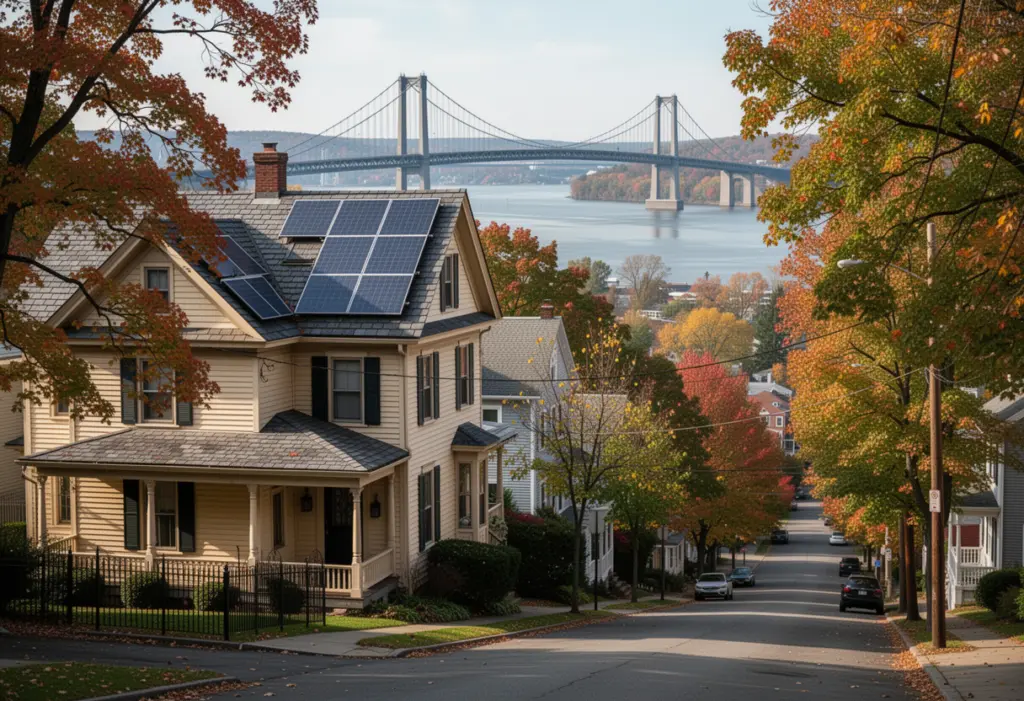
Poughkeepsie covers ZIP codes 12601 and 12603 on the east bank of the Hudson in Dutchess County. Central Hudson has its headquarters here, which buys local customers nothing at all: the utility charges the highest residential solar capacity rate in New York State. That figure, the age of the housing and which of two building departments holds your parcel are what actually move a quote in this city.
City or town, and why a mailing address will not tell you
The City of Poughkeepsie and the Town of Poughkeepsie are separate municipalities with their own building departments, fee schedules and review processes. A great many addresses that say Poughkeepsie are in the town. Establish which authority covers your parcel first, then ask it whether it uses the New York State Unified Solar Permit, which applies to residential systems of 25 kW DC and under and standardises the application where it has been adopted.
Inside the city, ask a second question: whether your address sits in a locally designated historic district. Poughkeepsie keeps several concentrations of nineteenth-century housing, and where architectural review applies it happens before the building permit. The board decides what the roof may look like, and only then does an inspector consider whether it is safe. Ask when that board meets, because a monthly cycle turns a missed deadline into a lost month, and the array cannot start offsetting your bill until it is approved and built.
Old housing, and the three items that surprise people
Much of the city and the older parts of the town predate modern construction. Three consequences recur:
- Slate and steep pitch. Both are workable and both add labour. Ask to see finished penetrations the installer has done on slate rather than a description of how it would be done.
- A structural letter. Nineteenth-century framing draws an engineer’s review far more often than a modern truss roof. Budget for it rather than meeting it after contract.
- 100 amp service. Common in this housing stock, and a solar breaker may not fit without a panel upgrade or a line-side connection. Have the rating and the busbar capacity checked at the property and the consequence priced into the contract.
The number every Central Hudson customer should work out first
Systems interconnected on or after 1 January 2022 pay a Customer Benefit Contribution calculated from the DC size of the array rather than from anything it generates. Central Hudson’s 2026 residential rate is $1.67 per kW-month, the highest residential figure charged by any utility in the state. Confirm from your own bill that Central Hudson is your supplier before applying it, because territory boundaries in Dutchess do not follow municipal lines. An 8.4 kW array therefore pays $14.03 a month, about $168 a year, in a month with heavy snow cover exactly as in June.
Two honest caveats. The rates are recalculated annually and are not locked in at interconnection, so you cannot multiply today’s figure by twenty and call it a twenty-year cost. And the charge does not apply to community solar subscribers at all, which is part of why community solar prices differently for a Dutchess County household than a rooftop system does. Set against the charge, Phase One net metering credits your exports at the full retail rate and holds that structure for 20 years from interconnection.
What a proposal has to show before it can be compared
This site does not publish a price per watt, because a figure like that is out of date the week it is written and a page that quotes one without dating it is telling you very little. What you can do is force every proposal into the same shape and compare them properly. Insist on all of the following in writing:
- The gross price before any incentive, and the price in dollars per watt of DC capacity.
- The DC and AC sizes stated separately, since the capacity charge is billed on DC.
- No NY-Sun deduction unless the installer names the open block it comes from. As of September 2026 NYSERDA has no open NY-Sun block for homes in any utility territory, so a NY-Sun figure carried over from an old proposal no longer exists; check NYSERDA’s NY-Sun dashboard for a new one.
- Monthly production estimates, not just an annual total, and the shading assessment they came from.
- Every item that is excluded: tree work, roof repair, a service upgrade, an engineer’s letter.
And treat any proposal that still shows a 30% federal credit as a finding about the seller rather than a clerical slip.
Where the $5,000 ceiling starts to bite
New York’s credit is 25% of qualified expenditure, capped at $5,000, on Form IT-255. On a $22,000 system the arithmetic is 25% of $22,000, which is $5,500, so the cap applies and the last $2,000 of spend returns nothing from the state. The credit is not refundable and cannot exceed your actual New York tax liability for the year, though unused credit carries forward for up to five years, and it requires the system to serve your principal residence in New York.
2026, in plain terms
The federal residential credit is not available for a system completed this year. Section 25D was terminated for expenditures made after 31 December 2025, and an expenditure is treated as made when the original installation is completed rather than when the utility swaps the meter.
Live and worth pursuing: the state credit above; the state sales tax exemption on residential solar equipment; and RPTL 487, a 15-year exemption on the added value where the city or town, Dutchess County and the school district have each not opted out, for construction completed before 1 January 2030. Poughkeepsie is not one of the five fiscally dependent Big Five school districts, so that third check is a real one here. NY-Sun, which a contractor used to apply block by block, is not on that list: as of September 2026 NYSERDA has no open NY-Sun block for homes in any utility territory. Verify each of them yourself at tax.ny.gov and nyserda.ny.gov close to the day you sign, because programme terms move and a proposal only records what was true when it was printed.
Frequently Asked Questions
What does Central Hudson charge a Poughkeepsie solar customer?
The 2026 residential Customer Benefit Contribution is $1.67 per kW-month of DC size, the highest residential rate in New York. An 8.4 kW array pays about $14.03 a month, roughly $168 a year, and the rate is recalculated annually.
Do I permit through the City or the Town of Poughkeepsie?
They are separate municipalities with separate building departments, and many addresses reading Poughkeepsie are in the town. Confirm which one covers your parcel before an installer files, and ask whether it uses the Unified Solar Permit.
What should a Poughkeepsie solar quote show?
The gross price before incentives, the price per watt of DC capacity, DC and AC sizes separately, monthly production estimates, and every exclusion such as tree work or a service upgrade. It should not show a NY-Sun deduction: as of September 2026 NYSERDA has no open NY-Sun block for homes in any utility territory.
When does the $5,000 state credit cap start to matter?
Above $20,000 of qualified expenditure. On a $22,000 system, 25% would be $5,500, so the cap limits it to $5,000 and the last $2,000 of spend earns nothing back from the state.
This article is general information, not tax, legal or financial advice. Incentive amounts, eligibility rules and deadlines change and depend on your utility, your tax situation and your property. Confirm current terms with NYSERDA, your utility and a qualified tax professional before making a decision.
NY Solar Incentives
Independent New York solar research. We summarise NYSERDA, NY-Sun and federal programme rules from published sources and state plainly when a figure is an estimate. We are not a government agency and do not sell equipment.
Run the arithmetic on your own system
Check the dated program table and your arrangement before counting an incentive. Standard residential NY-Sun blocks are closed; Long Island Affordable Solar has a conditional income-verification route. The NY credit depends on qualified costs and tax liability, while the NYC abatement reduces future property-tax bills. The estimator keeps those timings separate.