Solar Panel Cost in Port Chester, NY: Small Roofs, Fixed Costs
Port Chester roofs are small, close together and often flat, and the fixed costs of a solar project do not shrink with them. That is the single fact that explains most quotes here.
On this page 7 sections
- 01Three places called Rye, and only one of them permits your roof
- 02A small roof does not buy a small price
- 03The Byram River and the flood map
- 04Check the county licence before the reviews
- 05What Con Edison charges, and the option with no charge at all
- 06The 2026 incentive position
- 07Frequently Asked Questions
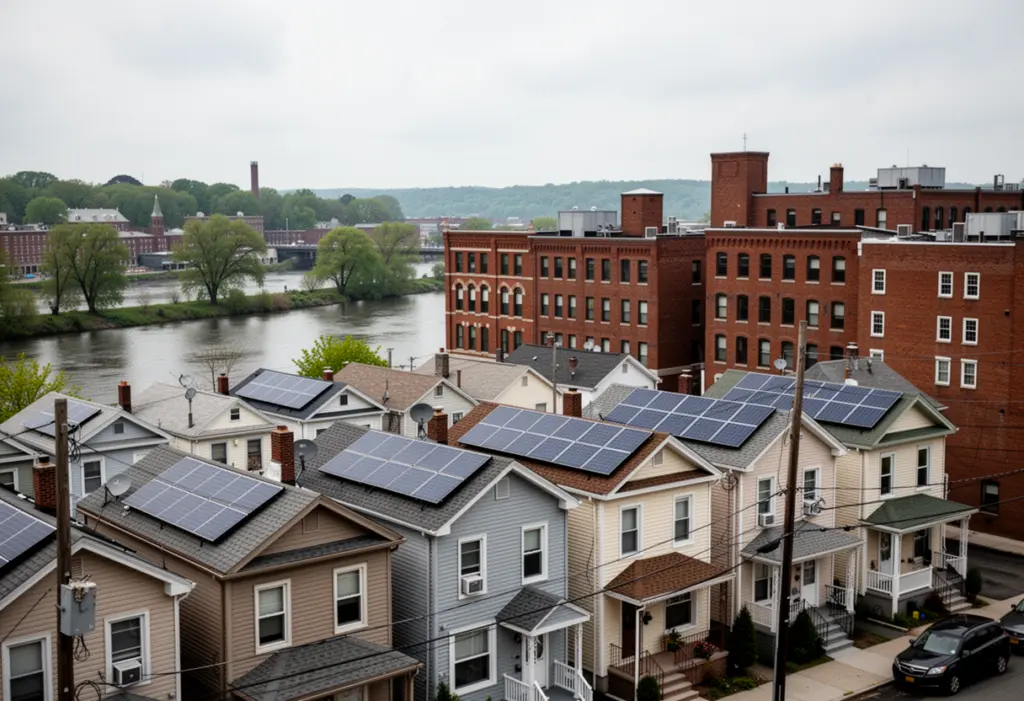
Port Chester, ZIP code 10573, is a dense village on the Connecticut line in southeastern Westchester County, in Con Edison territory. Ask what solar costs here and the useful answer is about geometry: the roofs are small, the lots are tight, and the parts of a solar project that cost the same regardless of system size do not get any cheaper because your array is modest.
Three places called Rye, and only one of them permits your roof
This is genuinely confusing and it wastes time on almost every project. The Village of Port Chester is an incorporated village inside the Town of Rye. The City of Rye is a separate municipality and is not the same thing as the Town of Rye. The Village of Rye Brook shares the 10573 ZIP code with Port Chester and has its own building department. A mailing address of 10573 therefore does not tell an installer which authority receives the application.
Settle it before anything is filed, then ask that department whether it uses the New York State Unified Solar Permit for residential systems of 25 kW DC and under, what the fee is, and how long a complete application is currently taking.
A small roof does not buy a small price
Several costs in a solar project are close to fixed. The site visit, the engineering and layout, the permit application and fee, the interconnection application to Con Edison, the inspections, the mobilisation of a crew and the safety setup all happen whether the array is 4 kW or 12 kW. Spread across fewer watts, they raise the dollars per watt substantially.
On the dense blocks here the roof is small before anyone starts subtracting from it, and then the subtractions begin: fire code access paths, setbacks from the roof edge or parapet, plumbing vents and chimneys, and the shadow of the house next door on a narrow lot. A roof that measures adequately from the street can hold surprisingly little.
Two questions make this visible instead of hidden. Ask for the gross price before any incentive and the price in dollars per watt of DC capacity, and ask for the DC and AC sizes separately. Then ask what the same installer would charge for a larger array on a larger roof. If the per-watt gap is wide, you now know what you are actually paying for, and you can weigh it against the alternative below.
The Byram River and the flood map
Downtown Port Chester and the low ground along the Byram River include mapped flood zones, and the village has taken real flooding within living memory. Where a parcel is in a flood zone the inverter, the disconnects, the production meter and any battery generally must be mounted above a specified elevation. That is a design requirement and it removes the basement as a battery location. Ask early, because it changes the equipment layout rather than merely the paperwork.
Check the county licence before the reviews
Home improvement contractors working in Westchester County are licensed by the county’s consumer protection office. Ask for the licence number, verify it with the county directly rather than accepting a logo on a proposal, and confirm that the entity named on the licence is the same entity named on your contract. That is a five-minute check with more value than any amount of reading about brands.
What Con Edison charges, and the option with no charge at all
Every rooftop system interconnected on or after 1 January 2022 pays a Customer Benefit Contribution calculated from DC system size rather than output. Con Edison’s 2026 residential rate is $1.29 per kW-month. Confirm the supplier from your own bill rather than from the address, then do the sum: a 5 kW array, which is a realistic size for a small Port Chester roof, pays $6.45 a month, about $77 a year. The rate is reset annually rather than fixed at interconnection. Phase One net metering, in the other direction, credits exports at the full retail rate and holds for 20 years from interconnection.
For a household that rents, lives in a multi-family building, or has a roof too small or too shaded to justify the fixed costs above, community solar is the honest comparison. It requires no roof, no permit, no interconnection application and no capital, and subscribers pay no Customer Benefit Contribution at all. In a village with this much rented and divided housing, that is not a fallback, it is the mainstream answer for a large share of addresses.
The 2026 incentive position
A homeowner buying in 2026 claims nothing federally. Section 25D ended for expenditures made after 31 December 2025 and the operative test is completion of the original installation, so a proposal still showing a 30% federal line is materially wrong about your net cost.
The state package still applies to a purchase here: the 25% New York credit capped at $5,000 on Form IT-255 for your principal residence, which also reaches leases and power purchase agreements of ten years or more, the state sales tax exemption on residential equipment, and RPTL 487 exempting the added value for 15 years, on a system constructed before 1 January 2030, where the village, the town, Westchester County and the school district have each declined to opt out. In a village address that is four separate jurisdictions to ask, not three. NY-Sun, which used to arrive as a contractor-applied reduction, is not part of the package: as of September 2026 NYSERDA has no open NY-Sun block for homes in any utility territory; check NYSERDA’s NY-Sun dashboard for a new one. Verify the current position at tax.ny.gov and nyserda.ny.gov yourself before you sign, because these rules are revised on a schedule that has nothing to do with your project.
Frequently Asked Questions
Why is solar more expensive per watt on a small Port Chester roof?
Design, permitting, the interconnection application, inspections and crew mobilisation cost much the same at 4 kW as at 12 kW. Spread over fewer watts, those fixed costs raise the dollars per watt even when the total price is lower.
Which authority issues a solar permit in Port Chester?
The Village of Port Chester, which sits inside the Town of Rye and is separate from the City of Rye. The neighbouring Village of Rye Brook shares the 10573 ZIP code and has its own building department, so confirm the parcel first.
Does a flood zone change a solar installation?
Yes. Where the parcel is in a mapped flood zone the inverter, disconnects, meter and any battery generally have to be mounted above a specified elevation, which rules out the basement as a battery location.
What is the alternative if the roof is rented or too small?
Community solar. It needs no roof, no permit and no capital, and subscribers pay no Customer Benefit Contribution at all, which makes it the realistic option for much of the village's rented and divided housing.
This article is general information, not tax, legal or financial advice. Incentive amounts, eligibility rules and deadlines change and depend on your utility, your tax situation and your property. Confirm current terms with NYSERDA, your utility and a qualified tax professional before making a decision.
NY Solar Incentives
Independent New York solar research. We summarise NYSERDA, NY-Sun and federal programme rules from published sources and state plainly when a figure is an estimate. We are not a government agency and do not sell equipment.
Run the arithmetic on your own system
Check the dated program table and your arrangement before counting an incentive. Standard residential NY-Sun blocks are closed; Long Island Affordable Solar has a conditional income-verification route. The NY credit depends on qualified costs and tax liability, while the NYC abatement reduces future property-tax bills. The estimator keeps those timings separate.