What Solar Costs in Carmel, NY: Lots, Trees and Reservoirs
Carmel is one of the few places in the lower Hudson Valley where the permit question has a simple answer and the site question does not. Lot size makes ground mounts realistic here, and that changes the whole cost structure.
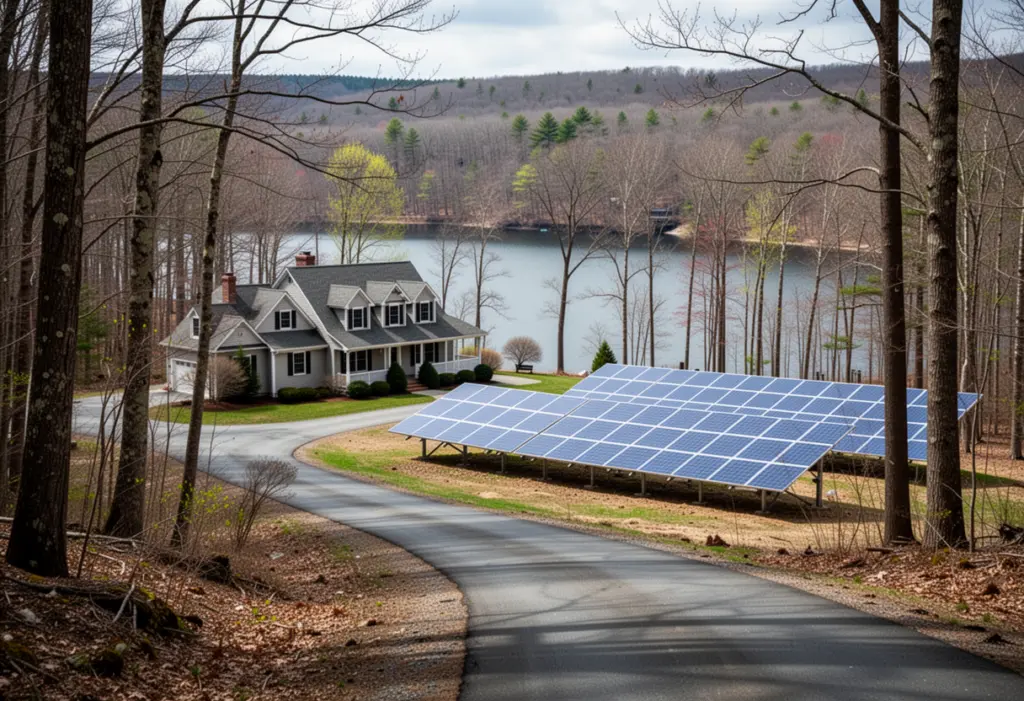
Carmel is one of the few places in the lower Hudson Valley where the permit question has a simple answer and the site question does not. The Town of Carmel contains no incorporated villages, so the town building department handles the whole town, the hamlet of Carmel around 10512 and Mahopac around 10541 alike. That removes a step that trips up quotes in neighbouring communities. What replaces it is a site question about trees, water and where the array should physically go.
Roof or ground, and why it matters to the price
Lots here are large and heavily wooded, and many are on private well and septic. That makes a ground mount a real option rather than a theoretical one, and a ground mount is a different cost structure, not a discount:
- Trenching and a longer DC run between the array and the house.
- A foundation, whether concrete piers or driven piles, and the site work that comes with it.
- Siting constrained by the septic field, the well and its setbacks, and by wetlands or steep slope.
- Its own permit review, which is not the same as a roof-mounted application.
The offsetting advantage is real: a ground mount can face true south at an optimal tilt and sit clear of the canopy, while a roof takes whatever orientation the house was built with. Ask for both designed and priced, and compare the estimated annual production rather than the sticker.
Water is a permitting input here
Carmel is reservoir country. Lake Gleneida sits in the hamlet, Lake Mahopac in the town, and the West Branch and Croton Falls reservoirs are part of New York City’s water supply system. Land disturbance for a ground mount, trenching included, can bring stormwater review into a project that would otherwise be routine. Ask the town what disturbance threshold applies before you commit to that layout, because discovering it after a contract is signed is how a schedule slips a season.
Trees are the production variable
Mature hardwood is the single most common reason a Carmel array underperforms its estimate. Get two things in writing: whether the production model assumes trees currently standing, and what the estimate becomes if they stay. Removal, where it is even desirable, belongs in its own line with its own price rather than folded into the system cost where it cannot be compared.
The charge that follows array size
The Customer Benefit Contribution is billed monthly on DC system size for systems interconnected on or after 1 January 2022, regardless of production. Putnam sits where Hudson Valley service territories meet, so read the utility name from your own bill before doing this arithmetic:
- Central Hudson bills $1.67 per kW-month in 2026, so a 10 kW ground mount carries $16.70 a month, about $200 a year, before it produces a single kilowatt-hour.
- Under NYSEG at $1.19 that identical 10 kW array carries $11.90 a month, about $143 a year — a gap of roughly $58 a year decided by the meter rather than by the design.
Ground mounts tempt people into larger systems precisely because the space exists. That charge, plus the fact that Phase One net metering pays you in credits rather than cash, is the argument for sizing to consumption instead of to the clearing.
What you can actually claim in 2026
The New York solar energy system equipment credit is 25 percent of qualified expenditure capped at $5,000, claimed on Form IT-255, and it requires the equipment to be installed and used at your principal residence in the state. A weekend or second home on one of the lakes does not qualify, which is a distinction worth checking here specifically. The credit is not refundable, is limited by your New York liability, and unused amounts carry forward for up to five years.
For property tax, RPTL 487 exempts the added value of the system for fifteen years where each taxing body has not opted out — Putnam County, the Town of Carmel and your school district, which is not the same district across the whole town, so use the one named on your own tax bill. The system must be constructed before 1 January 2030 for the exemption to be available. The state sales tax exemption covers residential solar equipment with local shares elected separately. As of September 2026 NYSERDA has no open NY-Sun block for homes in any utility territory; check NYSERDA’s NY-Sun dashboard for a new one. The income-qualified Affordable Solar incentive has closed as well: outside Con Edison and Long Island it ran from 18 December 2025 to 9 March 2026.
The federal 30 percent residential credit is gone: section 25D ended for expenditures made after 31 December 2025, with an expenditure treated as made when the original installation is completed. A proposal that still carries it should be corrected before it is compared to anything else. Programmes change, so verify at tax.ny.gov and nyserda.ny.gov rather than relying on a sales document.
Frequently Asked Questions
Who issues a solar permit in Carmel?
The Town of Carmel building department covers the entire town, including the hamlet of Carmel and Mahopac, because there are no incorporated villages inside the town.
Is a ground mount worth it in Carmel?
Often, where trees shade the roof and the lot has clear space. It adds trenching, a foundation and site work, so have both a roof design and a ground design priced with their estimated annual production side by side.
Does the New York City watershed affect a solar project here?
It can, for ground mounts. Land disturbance and trenching may trigger stormwater review, so ask the town what threshold applies before committing to that layout.
Does a lake house in Carmel qualify for the state credit?
Only if it is your principal residence in New York. A seasonal or second home does not qualify for the Form IT-255 credit, whatever the installation cost.
This article is general information, not tax, legal or financial advice. Incentive amounts, eligibility rules and deadlines change and depend on your utility, your tax situation and your property. Confirm current terms with NYSERDA, your utility and a qualified tax professional before making a decision.
NY Solar Incentives
Independent New York solar research. We summarise NYSERDA, NY-Sun and federal programme rules from published sources and state plainly when a figure is an estimate. We are not a government agency and do not sell equipment.
Run the arithmetic on your own system
Check the dated program table and your arrangement before counting an incentive. Standard residential NY-Sun blocks are closed; Long Island Affordable Solar has a conditional income-verification route. The NY credit depends on qualified costs and tax liability, while the NYC abatement reduces future property-tax bills. The estimator keeps those timings separate.