Zero Down Solar in New York: What It Really Means
Zero down describes what happens on the day you sign. It says nothing about what the system costs, who owns it, or which New York incentives you can actually use.
On this page 9 sections
- 01Three products, one phrase
- 02The dealer fee inside a low advertised rate
- 03The payment that steps up in month nineteen
- 04Zero down is still secured
- 05What each product does to your New York credit
- 06The charge that arrives regardless
- 07Three questions that settle it
- 08Where the 2026 incentives actually land
- 09Frequently Asked Questions
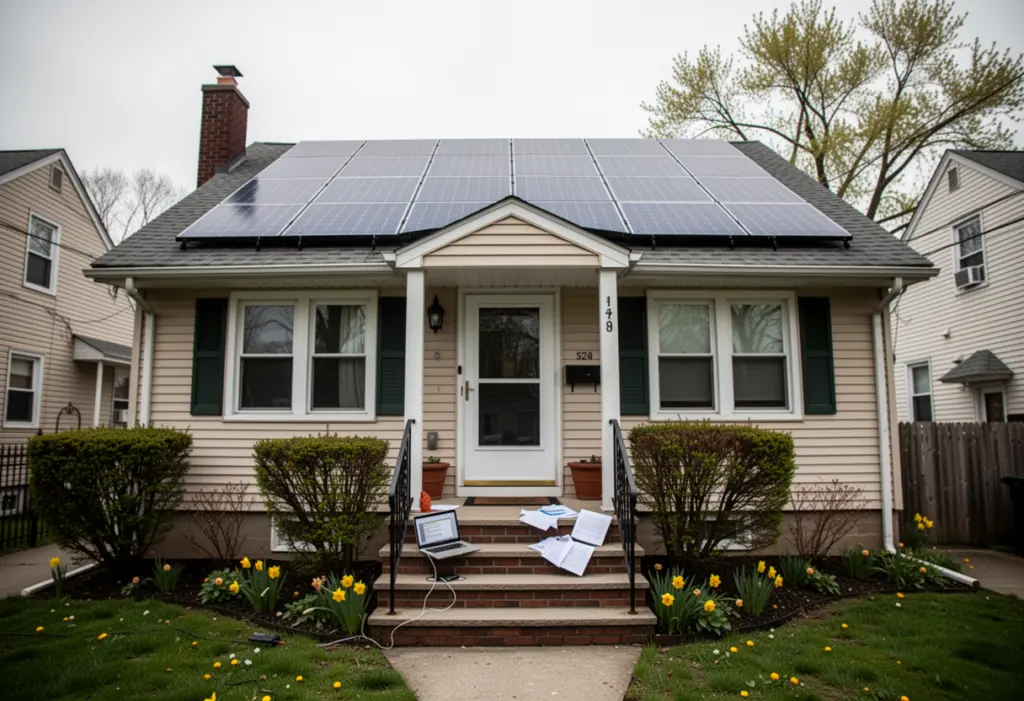
Zero down describes what happens on the day you sign, and nothing else. It says nothing about what the system costs, who owns it, or what you are able to claim. In New York in 2026 at least three different products are sold under that phrase, and they diverge sharply the moment you look past the first payment.
Three products, one phrase
- A zero down loan. You own the equipment and you owe a lender.
- A lease. A third party owns the equipment and you pay for the right to have it on your roof.
- A power purchase agreement. A third party owns the equipment and you pay for the electricity it produces.
Ownership is the fork in the road, because ownership decides who claims what. Ask which of the three you are being offered before you discuss a monthly payment, and get the answer in writing rather than from a slide.
The dealer fee inside a low advertised rate
A solar loan advertised well below what an unsecured personal loan carries is not charity. The gap is normally paid up front by the contractor to the lender and recovered inside the system price, and it does not appear as a line item because it appears as a higher contract price. The test costs nothing: ask for the cash price of the same system, in writing, and compare. Where the cash price is materially lower, that difference is what the financing costs, and the loan should be judged against it rather than against its advertised rate.
The payment that steps up in month nineteen
Many solar loans are written assuming the borrower makes a large principal payment within the first eighteen months, and the low figure on the illustration is the payment that follows only if that happens. Miss it and the loan re-amortises: the balance is spread across the remaining term and the monthly payment rises, sometimes sharply.
For years the money for that payment was the federal credit. In 2026 it is not there. Section 25D was terminated for expenditures made after 31 December 2025, with an expenditure treated as made when the original installation is completed, so a 2026 buyer claims nothing federally. A loan still structured around a 30 percent paydown is structured around money that does not exist. Ask what the payment becomes if no lump sum is ever made, and treat that as the real payment.
Zero down is still secured
Nothing about zero down means nothing is filed. A loan will normally carry a fixture filing against the property; a lease or PPA carries its own filing and a transfer clause. Both surface when you refinance or sell, and both give a buyer or a title company something to ask about. Get the payoff terms, or the transfer terms, before you sign rather than when the house is already under contract.
What each product does to your New York credit
The state credit on Form IT-255 is 25 percent of qualified expenditure capped at $5,000, for a principal residence in New York.
- Buying with a loan. You own the equipment, so the credit is yours against the system cost, and how you paid does not change it. On a $24,000 contract price, 25 percent is $6,000, the cap holds it to $5,000, and the effective rate falls to about 20.8 percent.
- Lease or PPA. The credit reaches you only where the agreement runs ten years or more, and that minimum applies to the lease as well as to the PPA. The $5,000 is a lifetime ceiling for the agreement, and nothing is allowed after the fifteenth year on a longer term.
The credit is not refundable. It is limited by your actual New York tax liability, with unused amounts carried forward up to five years, so a household with a small state liability does not receive the whole $5,000 quickly whatever the multiplication says.
The charge that arrives regardless
The Customer Benefit Contribution is billed monthly on the DC size of the array, on systems interconnected on or after 1 January 2022, and it is indifferent to how the system was financed. At the 2026 residential rates a 10 kW array is $9.70 a month on National Grid at $0.97 per kW-month, $11.90 on NYSEG at $1.19 and $12.90 on Con Edison at $1.29, which is roughly $116 to $155 a year for the identical array depending only on which utility the roof sits under. The rates are recalculated annually and are not locked in at interconnection.
Three questions that settle it
- What is the cash price of this exact system, in writing?
- Who owns the equipment, and if it is not me, how many years does the agreement run?
- What is the monthly payment if I make no lump sum in the first two years?
Where the 2026 incentives actually land
As of September 2026 NYSERDA has no open NY-Sun block for homes in any utility territory; check NYSERDA’s NY-Sun dashboard for a new one. When a block is open, NY-Sun is applied by the contractor as a price reduction, so on a zero down deal it should shrink the amount financed rather than appear later as a rebate, and it belongs on the contract where you can see it. The income-qualified Affordable Solar incentive has closed as well: it ran from 30 May to 15 October 2025 in Con Edison territory and from 18 December 2025 to 9 March 2026 in the rest of the state outside Long Island. The state sales tax exemption covers residential solar equipment, with localities electing separately on their own share. RPTL 487 exempts the added value from property tax for fifteen years where the county, the municipality and the school district have each not opted out, and it requires construction before 1 January 2030. Confirm all of it at tax.ny.gov and nyserda.ny.gov rather than taking it from a proposal.
Frequently Asked Questions
Does zero down mean solar is free?
No. It means no payment is due at signing. The cost appears as loan payments, lease payments or a per-kilowatt-hour rate, and in a financed purchase it can also appear inside a higher system price.
What is a dealer fee on a solar loan?
It is the amount a contractor pays a lender to offer a below-market rate, recovered inside the system price rather than shown as a line item. Asking for the cash price of the same system in writing is how you find it.
Can I claim the New York credit on a zero down lease?
Only where the lease runs ten years or more. The ten-year minimum applies to leases as well as PPAs, the $5,000 is a lifetime ceiling for the agreement, and the property must be your principal residence.
Is the 30% federal credit still available in 2026?
No. Section 25D ended for expenditures made after 31 December 2025, and an expenditure counts as made when the original installation is completed. Any 2026 quote showing a 30% federal line for a buyer is wrong.
This article is general information, not tax, legal or financial advice. Incentive amounts, eligibility rules and deadlines change and depend on your utility, your tax situation and your property. Confirm current terms with NYSERDA, your utility and a qualified tax professional before making a decision.
NY Solar Incentives
Independent New York solar research. We summarise NYSERDA, NY-Sun and federal programme rules from published sources and state plainly when a figure is an estimate. We are not a government agency and do not sell equipment.
Run the arithmetic on your own system
Check the dated program table and your arrangement before counting an incentive. Standard residential NY-Sun blocks are closed; Long Island Affordable Solar has a conditional income-verification route. The NY credit depends on qualified costs and tax liability, while the NYC abatement reduces future property-tax bills. The estimator keeps those timings separate.