Solar Financing for Seniors in New York
Age is rarely what decides whether solar works for a retired New York household. State tax liability and how long you expect to own the house usually decide it instead.
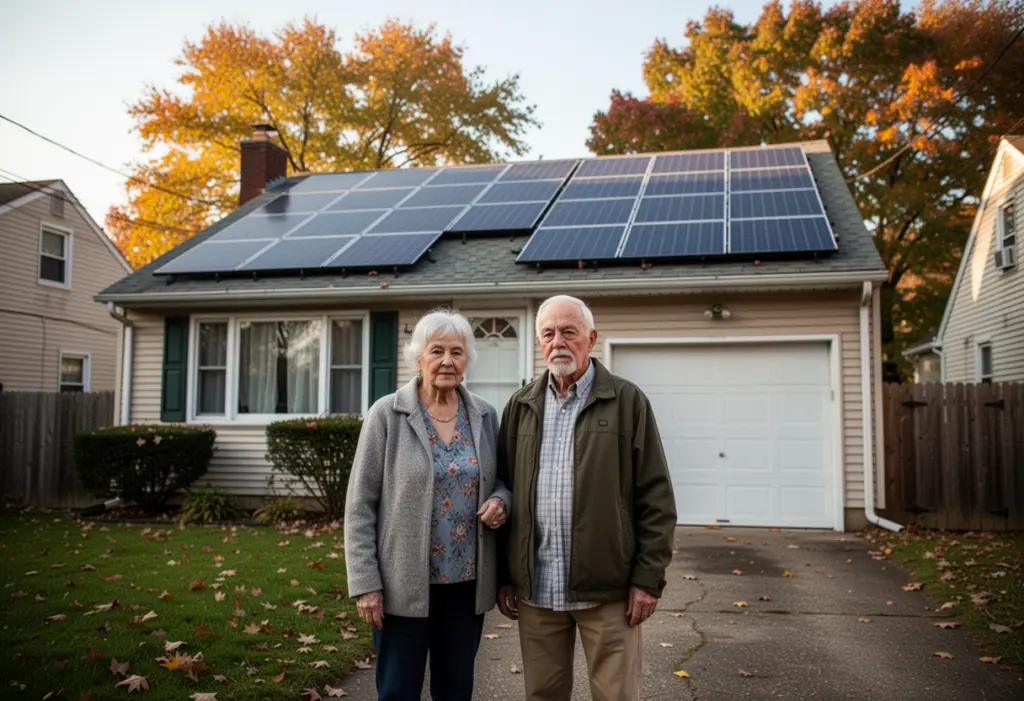
Almost every question about solar financing for an older New York household resolves into two: how much New York State income tax do you actually pay, and how long do you expect to own this house. Those two answers decide more than any interest rate on any product, and they are worth settling before an installer is in the room.
Why state tax liability is the first question
New York’s solar credit is 25 percent of qualifying expenditure capped at $5,000, claimed on Form IT-255 for equipment installed at your principal residence in the state. It is not refundable. It reduces the tax you owe, and if you owe little, it reduces little.
Retirement income changes that arithmetic in ways working households never encounter. The credit does carry forward for up to five years, so a modest liability spread over several years can still absorb a meaningful part of it — but a household with almost no New York taxable income may never use the full amount, and a proposal that subtracts the whole $5,000 from year one is showing a saving that will not appear. Take the number to whoever prepares your return before you sign, not afterwards.
There is no federal credit to soften this in 2026. Section 25D was terminated for expenditures made after 31 December 2025, with an expenditure treated as made when the original installation is completed, so a residential buyer this year claims nothing federally at all.
Why the time horizon is the second
A long loan term makes a monthly payment look small, and a long loan on a house you may not own in seven years is a different product from a long loan on a house you will die in. Two things follow, and both are worth saying plainly.
- Financed equipment usually carries a filing against it. A lender or lessor records a security interest in the equipment, and it surfaces in a title search at sale. It does not take your house, but it has to be released, subordinated or paid off before a closing completes.
- An obligation that transfers with the property is a negotiation with a buyer. Ask directly whether the product you are being offered stays with you or with the house, and what the buyer has to qualify for if it stays with the house.
If the plan involves a move to smaller accommodation, or the house passing to family, put those facts in front of the installer and the lender rather than around them. A twenty-year commitment entered quietly is the version that goes wrong in the estate.
The routes that do not require borrowing
Community solar asks for no equipment, no roof work and no loan. You subscribe to a share of an off-site project and receive credits on your bill. Two consequences matter here: there is nothing attached to the property to unwind when you sell, and subscribers pay no Customer Benefit Contribution at all, because that charge applies to net metered systems behind your own meter rather than to front-of-the-meter projects. Ask about the notice period for cancelling before you enrol.
A lease or a power purchase agreement of at least ten years also reaches the New York credit, and the ten-year minimum applies to the lease as much as to the PPA — a five or seven year lease does not qualify. For those agreements the $5,000 is a lifetime ceiling for that agreement rather than an annual figure, and no credit is allowed after the fifteenth year. All of it is still limited by the tax you actually owe.
The income-based adder has closed, so do not count on it
NYSERDA’s Affordable Solar incentive increased the NY-Sun incentive for income-qualified households, and it was applied by the contractor rather than claimed by you. It has closed: in Con Edison territory it ran from May 30 to October 15, 2025, and Upstate from December 18, 2025 to March 9, 2026. As of September 2026 NYSERDA has no open NY-Sun block for homes in any utility territory; check NYSERDA’s NY-Sun dashboard for a new one. A fixed retirement income is exactly the circumstance the adder was built for, so if a new block opens, raise it in the first conversation and ask for the incentive line to be shown separately on the quote.
The monthly charge nobody mentions on the doorstep
The Customer Benefit Contribution is billed on the DC size of the array rather than on production, on systems interconnected on or after 1 January 2022. A conservatively sized 5 kW array in RG&E territory is 5 x $1.31 = $6.55 a month, about $79 a year. It is recalculated annually and is not fixed at interconnection. That is one more reason a smaller array sized to a smaller retirement-era electricity bill is often the better system rather than the compromise one.
Beyond the credit, the state sales tax exemption applies to residential equipment and RPTL 487 exempts the added value from property tax for 15 years, on systems constructed before 1 January 2030 and where the municipality, the county and the school district have each not opted out — which for an older household on a fixed budget is often the incentive that matters most, because it protects the bill you already struggle to predict. Check the current position with your assessor and with NYSERDA before committing.
Frequently Asked Questions
Can I claim the New York solar credit on a small retirement income?
Only up to the New York State tax you actually owe. The credit is 25 percent capped at $5,000 and is not refundable, though unused amounts carry forward for up to five years. Ask your preparer before accepting a proposal that assumes the full amount.
Is there still a federal credit for a purchase in 2026?
No. Section 25D was terminated for expenditures made after 31 December 2025, and an expenditure is treated as made when the original installation is completed. A quote showing a 30 percent federal line in 2026 is materially wrong.
What happens to a solar loan if I sell or move to assisted living?
It depends on the product. Financed equipment usually carries a filing that must be released, subordinated or paid off at closing, and some obligations can transfer with the property if the buyer qualifies. Ask which applies before signing.
Is there an option with no loan and nothing attached to the house?
Community solar. You subscribe to an off-site project and receive bill credits, with no equipment on your roof, nothing to unwind at sale, and no Customer Benefit Contribution. Ask about the cancellation notice period before enrolling.
This article is general information, not tax, legal or financial advice. Incentive amounts, eligibility rules and deadlines change and depend on your utility, your tax situation and your property. Confirm current terms with NYSERDA, your utility and a qualified tax professional before making a decision.
NY Solar Incentives
Independent New York solar research. We summarise NYSERDA, NY-Sun and federal programme rules from published sources and state plainly when a figure is an estimate. We are not a government agency and do not sell equipment.
Run the arithmetic on your own system
Check the dated program table and your arrangement before counting an incentive. Standard residential NY-Sun blocks are closed; Long Island Affordable Solar has a conditional income-verification route. The NY credit depends on qualified costs and tax liability, while the NYC abatement reduces future property-tax bills. The estimator keeps those timings separate.