Is Solar Worth It in New York in 2026?
Solar still pays in New York in 2026 for an owner-occupier with state tax liability and an unshaded roof. It pays less than it did in 2025, and one deleted line in the federal tax code is the whole reason.
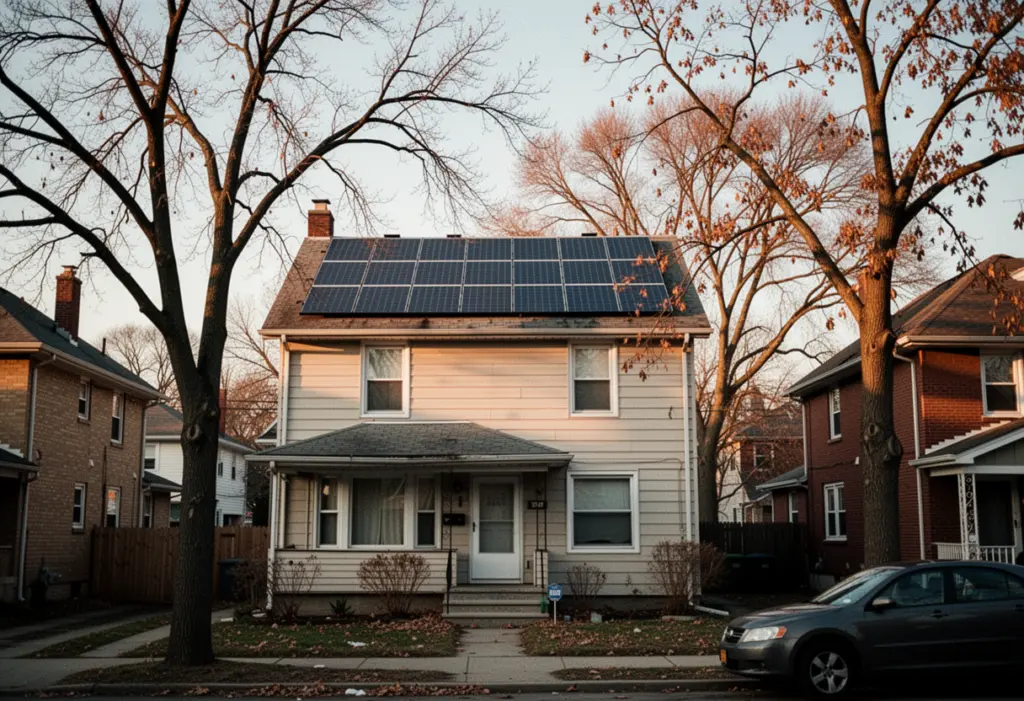
The short answer for 2026: solar still pays for a New York homeowner who owns the house, lives in it, has state tax liability to offset, and has a roof that is not heavily shaded. It pays noticeably less than it did in 2025, and the reason is a single line that has disappeared from the federal tax code.
What changed, and by how much
The 30% federal residential credit is gone. Section 25D was terminated for expenditures made after 31 December 2025, and the operative test is when the original installation is completed — not when the system is placed in service, and not when the utility energises it. A system finished in December 2025 and switched on in January 2026 still qualifies. A system installed during 2026 does not, and there is no phase-down, no transition rule and no carryover of a credit that was never earned.
One exception runs the other way. Where the expenditure is made in connection with the construction or reconstruction of a structure, it counts as made when your original use of that structure begins. Panels fitted in December 2025 to a house first occupied in 2026 therefore fall outside the credit rather than inside it.
The practical consequence is blunt: if a 2026 proposal shows a 30% federal line, that proposal is materially wrong, and every net cost and payback figure built on top of it is wrong by the same amount. Check that before you compare anything else in the document.
What still applies in New York
- The state credit — 25% of qualified solar equipment expenditure, capped at $5,000, claimed on Form IT-255. It requires the equipment to be installed and used at your principal residence in New York. It is not refundable, it is limited by your actual state tax liability, and unused credit carries forward for up to five years.
- The state sales tax exemption on residential solar equipment, with localities separately electing whether to exempt their own share.
- RPTL 487 — a 15-year exemption on the value the system adds, available where your municipality, your county and your school district have each not opted out. Three separate checks, and the system has to be constructed before 1 January 2030.
- Phase One net metering — exports credited at the full retail rate, with that structure held for 20 years from interconnection.
Not open in 2026: NY-Sun and Affordable Solar. As of September 2026 NYSERDA has no open NY-Sun block for homes in any utility territory; check NYSERDA’s NY-Sun dashboard for a new one. The last standard residential blocks closed on 29 May 2025 in Con Edison territory, on 17 December 2025 Upstate and on 17 April 2016 on Long Island, and the Affordable Solar blocks for lower-income households closed on 15 October 2025 (Con Edison) and 9 March 2026 (Upstate).
The arithmetic that decides it
Take twelve months of bills and add the total. That is the number solar is competing with. Then subtract the two costs that survive the array: the fixed customer charge your utility bills whether or not you produce anything, and the Customer Benefit Contribution, which is charged monthly on the DC size of the system regardless of production, on systems interconnected on or after 1 January 2022.
For 2026 the residential rate runs from $0.97 per kW-month on National Grid to $1.67 on Central Hudson. A 7 kW array pays 7 x $1.29 = $9.03 a month on Con Edison, about $108 a year, and 7 x $0.97 = $6.79 on National Grid, about $81. The rates are recalculated annually and are not locked in at interconnection, so treat them as a moving cost rather than a fixed one.
Against that, apply the state credit — there is no NY-Sun amount to subtract first — and apply it honestly. The $5,000 cap does not scale. On a large array the credit is effectively a flat amount, so every extra kilowatt beyond the point where the cap binds receives no state help at all while still adding to the monthly capacity charge.
Where the answer turns negative
- Little or no New York tax liability. The credit offsets tax you owe. Five years of carryforward helps a modest liability and does nothing for none.
- A second home, a seasonal house or a rental. The state credit needs a principal residence, so a weekend house in the Catskills or a property you let out does not reach it.
- A roof with under ten years left. Removing and reinstalling an array to reroof is a real cost against a 20-year net metering horizon.
- An oversized array. Building an export credit balance you never consume is not free: you paid for the panels, and you pay the monthly charge on their capacity forever.
- A battery bought for the economics. Under full retail rate net metering the grid already stores your surplus at full value. A battery in New York is a resilience purchase, and it is a good one if you lose power often — but the savings case for it is thin.
Ownership is not the only route
The business-side credit survives for the company that owns a leased or PPA system, which is why third party offers still price in an incentive a buyer never sees. New York also reaches lease and PPA customers with the same 25% credit, provided the agreement runs ten years or more — the ten-year minimum applies to a lease as well as to a PPA, and the $5,000 is a lifetime ceiling for that agreement rather than an annual figure. Community solar subscribers pay no capacity charge at all and need no roof.
Check it yourself before you sign
Incentive programmes here move: block levels step down, capacity charge rates are reset annually, and municipalities can opt out of the property tax exemption. Confirm the state credit at the Department of Taxation and Finance, confirm NY-Sun at NYSERDA, confirm the exemption with your assessor, and confirm the utility from the name printed on your own bill.
Frequently Asked Questions
Is the federal solar tax credit still available in New York in 2026?
No. Section 25D was terminated for expenditures made after 31 December 2025, and an expenditure counts as made when the original installation is completed. A 2026 quote showing a 30% federal line is materially wrong.
What is solar actually worth in New York now?
It depends on three things you can check quickly: whether you have New York State tax liability to offset the 25% credit capped at $5,000, which utility bills you, and how much shade the roof carries.
Does a bigger system always save more?
No. The monthly Customer Benefit Contribution is charged on DC system size regardless of production, and the state credit stops helping once the $5,000 cap binds. An oversized array builds credits you never consume and still pays for its capacity.
Is a battery worth adding in New York?
Treat it as a resilience purchase rather than an economic one. Phase One net metering credits exports at the full retail rate for 20 years, so the grid already stores surplus at full value.
This article is general information, not tax, legal or financial advice. Incentive amounts, eligibility rules and deadlines change and depend on your utility, your tax situation and your property. Confirm current terms with NYSERDA, your utility and a qualified tax professional before making a decision.
NY Solar Incentives
Independent New York solar research. We summarise NYSERDA, NY-Sun and federal programme rules from published sources and state plainly when a figure is an estimate. We are not a government agency and do not sell equipment.
Run the arithmetic on your own system
Check the dated program table and your arrangement before counting an incentive. Standard residential NY-Sun blocks are closed; Long Island Affordable Solar has a conditional income-verification route. The NY credit depends on qualified costs and tax liability, while the NYC abatement reduces future property-tax bills. The estimator keeps those timings separate.