Solar Incentives in Bronx County, NY: What Applies
In the Bronx the incentives are the state ones plus a city layer, and the permitting is nothing like the rest of New York State. Both change what a quote should say.
On this page 7 sections
- 01Permitting: the state unified permit does not apply here
- 02The utility, and the charge on capacity
- 03Property tax: the state exemption and the city abatement together
- 04What the housing stock does to the arithmetic
- 05ZIP codes and what a local quote should show
- 06The incentives worth naming, in order
- 07Frequently Asked Questions
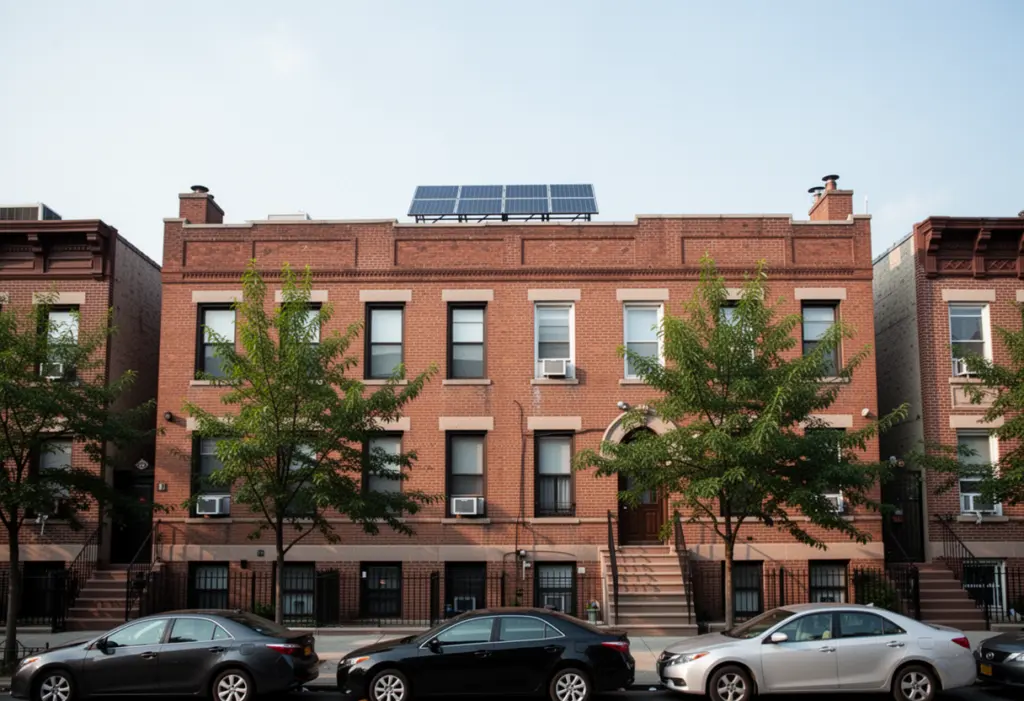
A Bronx homeowner gets the same state incentives as everyone else in New York, plus a city property tax abatement that exists nowhere upstate, and faces a permitting process that has nothing to do with the state’s unified solar permit. Those three facts change what a proposal for a Bronx roof should contain, and a quote written from a generic New York template will get at least one of them wrong.
Permitting: the state unified permit does not apply here
The NYS Unified Solar Permit standardises residential permitting for systems of 25 kW DC and under across more than 300 authorities having jurisdiction, and it explicitly does not apply in the five boroughs. In the Bronx the filing goes to the Department of Buildings, which means a registered design professional, an electrical filing, and inspections on the city’s schedule rather than a town clerk’s. Ask what the installer assumes for that timeline before believing an installation date, and ask who signs the drawings.
There is a second review that catches people out. If the property sits in a designated historic district, or is an individual landmark, the Landmarks Preservation Commission comes before the Department of Buildings. The Bronx has designated districts, Mott Haven and Longwood among them, and parts of Riverdale are covered as well. It is a map check, it takes minutes, and it should happen before anyone designs a layout around a street-facing slope.
The utility, and the charge on capacity
The Bronx is Con Edison territory. That sets both the value of what you export and the monthly charge you pay for having the array at all. The Customer Benefit Contribution is billed on DC system size regardless of output, and Con Edison’s 2026 residential rate is $1.29 per kW-month. A 6 kW system on a Bronx roof therefore pays $7.74 a month, about $92.88 a year, and a 9 kW system pays $11.61 a month. The charge applies to systems interconnected on or after 1 January 2022 and is recalculated annually rather than fixed at interconnection. Confirm the utility from your own bill, since only the name printed there settles it.
Phase One net metering credits exports at the full retail rate and holds that structure for 20 years from interconnection, which is what makes a correctly sized array work in a borough with high retail rates.
Property tax: the state exemption and the city abatement together
RPTL 487 is not restricted to areas outside New York City. The Department of Finance administers it in the five boroughs as the Clean Energy Systems Exemption, on form RP-487, preceded by a Notice of Intent to Construct Clean Energy Systems. Separately, the city’s Title 4-C solar abatement is filed on form PTA4 with the Department of Buildings and taken across a four-year compliance period. The important part is that the abatement is additional to section 487 rather than the city’s substitute for it. There is also no separate school district opt-out to check here: the New York City school district is fiscally dependent and levies no separate property tax, so the three-way check that applies upstate narrows here to the city itself, which is the taxing jurisdiction. Section 487 is not open-ended either: the system has to be constructed before 1 January 2030.
What the housing stock does to the arithmetic
Much of the borough is flat-roofed and much of it is multifamily. Both matter. A flat roof usually means ballasted racking, which depends on the roof’s ability to carry the weight, and it means the shadows come from your own parapets, bulkheads, water tanks and neighbouring buildings rather than from trees. Ask for the shade study to show those obstructions at 9am and 3pm in December, not an annual average.
On a two-family house the question to settle first is which meter the array feeds, because in this borough the answer is often not obvious and cannot be changed cheaply afterwards. If the building is a co-op or a condominium, the roof is a common element and the board decides, not you. And if you rent, no rooftop project reaches your bill: community solar does, with credits on your own account and no Customer Benefit Contribution at all.
ZIP codes and what a local quote should show
Bronx ZIP codes run from 10451 to 10475, covering Mott Haven and Melrose in the south through Fordham, Belmont and Morris Park to Riverdale, Throggs Neck, Country Club and Co-op City. A quote written for this borough should name the scope of work honestly: roof age and remaining membrane life, whether the service is 100 amp and needs upgrading, the Department of Buildings filing fee, and the capacity charge as an ongoing cost rather than an afterthought.
The incentives worth naming, in order
The city abatement is the local differentiator and it should be visible on a Bronx proposal by name and form number. Underneath it sit New York’s 25 percent credit capped at $5,000 on Form IT-255 for a principal residence and the state sales tax exemption on residential solar equipment, where localities separately elect on their own share, so ask what the tax line on the quote assumes. The NY-Sun incentive is not among them: in Con Edison territory the last residential block closed on 29 May 2025 and the Affordable Solar block on 15 October 2025. As of September 2026 NYSERDA has no open NY-Sun block for homes in any utility territory; check NYSERDA’s NY-Sun dashboard for a new one. What must not appear anywhere is the 30 percent federal residential credit: section 25D ended for expenditures made after 31 December 2025, with an expenditure treated as made when the original installation is completed. Incentive levels and the capacity charge both change, so confirm them at NYSERDA and the Department of Finance before signing rather than trusting a printed figure.
Frequently Asked Questions
Which permit applies in the Bronx?
The Department of Buildings process, not the NYS Unified Solar Permit, which does not apply in the five boroughs. Expect a registered design professional on the drawings and city inspection scheduling. Landmarks review comes first if the property is designated.
What does Con Edison charge for having solar?
The Customer Benefit Contribution, $1.29 per kW-month for residential customers in 2026, billed on DC system size whatever the array produces. A 6 kW system pays $7.74 a month, about $92.88 a year, and the rate is reset annually.
Does the fifteen year property tax exemption apply in the Bronx?
Yes. RPTL 487 has no New York City carve-out and the Department of Finance administers it as the Clean Energy Systems Exemption on form RP-487. The city's own abatement, filed on form PTA4, is additional rather than a replacement.
I rent in the Bronx. Is there anything for me?
Community solar. You subscribe to an off-site project and credits arrive on your own utility account with no roof and no equipment, and subscribers pay no Customer Benefit Contribution. Check the cancellation notice period in the agreement.
This article is general information, not tax, legal or financial advice. Incentive amounts, eligibility rules and deadlines change and depend on your utility, your tax situation and your property. Confirm current terms with NYSERDA, your utility and a qualified tax professional before making a decision.
NY Solar Incentives
Independent New York solar research. We summarise NYSERDA, NY-Sun and federal programme rules from published sources and state plainly when a figure is an estimate. We are not a government agency and do not sell equipment.
Run the arithmetic on your own system
Check the dated program table and your arrangement before counting an incentive. Standard residential NY-Sun blocks are closed; Long Island Affordable Solar has a conditional income-verification route. The NY credit depends on qualified costs and tax liability, while the NYC abatement reduces future property-tax bills. The estimator keeps those timings separate.