Temperature Coefficient: Why It Matters on a NY Roof
Every module is rated at a cell temperature no New York roof holds in July. The temperature coefficient is the line that tells you how much output that costs you.
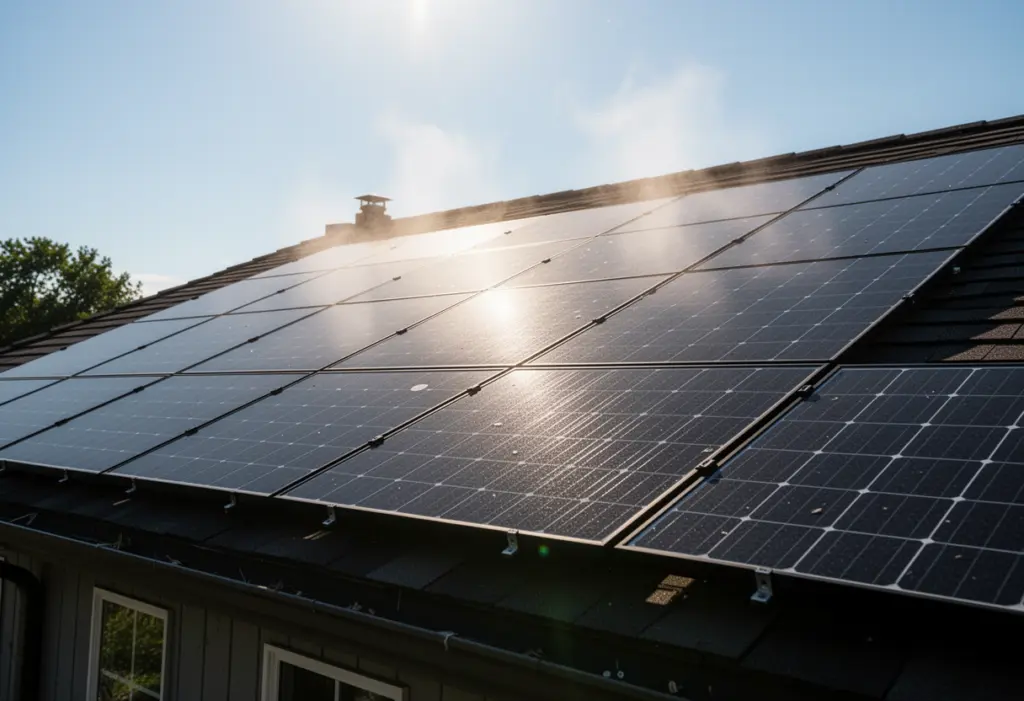
Every solar module is rated under standard test conditions, which include a cell temperature of 25 degrees Celsius. A dark roof in a New York July is nowhere near that. The temperature coefficient on the datasheet is the line that tells you what the difference costs, expressed as a percentage of output lost for each degree the cell runs above the rating point.
How to read it
The figure is negative and small, given as a percentage per degree Celsius for maximum power. To use it, multiply the coefficient by how far the cell temperature exceeds 25 degrees.
Worked with an illustrative datasheet figure: if the coefficient is minus 0.30% per degree and the cells are running 30 degrees above the rating point on a hot still afternoon, the array is delivering roughly 9% below its nameplate at that moment. Note what that is and is not. It is an instantaneous derating in the worst hours of the worst weeks. It is not an annual loss, and it is not a defect.
Cell temperature is also not air temperature. A module in full sun sits well above the shade temperature, which is why the honest version of this calculation uses an assumed cell temperature rather than what the thermometer on the porch says.
The part that surprises New Yorkers
The same physics runs in the other direction. On a cold bright day in March, with snow on the ground reflecting light and cells running below 25 degrees, a well-sited array can produce above its nameplate rating for a period. Anyone who has watched a monitoring app through a clear February afternoon has seen it.
This is a genuine reason New York winter production is better than newcomers assume, and it is worth holding onto when somebody implies that a cold state is a bad state for solar. The limiting factors here are day length, sun angle and snow cover, not the cold itself. Cold is help.
Where it actually changes a decision
Three places, and only three.
- Mounting and airflow. Modules flush against a dark roof with little clearance run hotter than modules on a rack with air moving behind them. On a low pitch or a flat roof with a ballasted array the effect is larger still. If your installer proposes minimal standoff on a dark roof, ask what cell temperature the production model assumed.
- Very hot, very still sites. An unshaded low pitch roof with no breeze is where the coefficient earns its attention. A breezy site loses less.
- Comparing two otherwise equal modules. If two proposals are genuinely alike on wattage, warranty and price, the better coefficient is a tiebreaker.
Where it does not, and the upsell to watch
Be blunt about the ranking. Among modern modules the spread in temperature coefficient is narrow, and its effect across a New York year is far smaller than the effect of a shading problem, a poor orientation, or an array sized wrong for the household. A salesperson building a premium tier on the strength of a marginally better coefficient is selling you the smallest available lever.
If you are being asked to pay more for it, ask for the two production estimates side by side, run with the same shading assessment and the same weather data, and look at the annual difference in kilowatt-hours. Then judge the price against that number rather than against the specification.
The bill line that is flat all year
Whatever the roof temperature does, the Customer Benefit Contribution does not move. It is billed on DC nameplate capacity per month on systems interconnected on or after 1 January 2022, so a hot July when the array is derated costs exactly what a cold clear March costs. At the 2026 National Grid residential rate of $0.97 per kW-month, the lowest residential rate in the state this year, a 13 kW array pays $12.61 a month, about $151 a year. The same array under Con Edison at $1.29 pays $16.77 a month. Rates are recalculated annually and are not fixed at interconnection, and community solar subscribers pay none of it.
Incentives, and who chooses the module
Specification questions only matter if you are the one specifying. Under a lease or a power purchase agreement the equipment is chosen by the company that owns the system, and your leverage is the contract rather than the datasheet.
New York’s 25% credit capped at $5,000 on Form IT-255 does reach those arrangements, unlike the dead federal one, but only where the agreement runs ten years or more — and that ten-year minimum applies to a lease just as it does to a power purchase agreement. A five or seven year lease does not qualify, whatever a sales sheet implies. For lease and power purchase agreements the $5,000 is a lifetime ceiling per agreement rather than an annual figure, and no credit is allowed after the fifteenth year of an agreement running longer than that.
If you are buying outright, the same 25% credit applies to equipment at your principal residence, alongside the state sales tax exemption. NY-Sun adds nothing in 2026: as of September 2026 NYSERDA has no open NY-Sun block for homes in any utility territory; check NYSERDA’s NY-Sun dashboard for a new one. The federal residential credit is gone for expenditures made after 31 December 2025, tested by when the original installation was completed, so treat any 2026 quote showing a 30% federal line as materially wrong. Verify current terms with NYSERDA and the Department of Taxation and Finance before you sign anything.
Frequently Asked Questions
What is a solar panel temperature coefficient?
A datasheet figure giving the percentage of maximum power output lost for each degree Celsius the cell runs above the 25 degree standard test condition. It is negative and small, and it describes an instantaneous derating rather than an annual loss.
Do solar panels really work better in the cold?
Yes. On a cold bright day, with cells below the 25 degree rating point, a well-sited array can produce above its nameplate for a period. What limits New York winter output is day length, sun angle and snow, not the cold.
Should I pay more for a better temperature coefficient?
Usually not. The spread between modern modules is narrow and its annual effect is much smaller than shading, orientation or sizing. Ask for two production estimates run on the same shading data and judge the price against the kilowatt-hour difference.
Does mounting affect how hot my panels run?
Yes. Modules flush against a dark roof with little clearance run hotter than modules on a rack with airflow behind them, and a low pitch or ballasted flat roof array runs hotter still. Ask what cell temperature the production model assumed.
This article is general information, not tax, legal or financial advice. Incentive amounts, eligibility rules and deadlines change and depend on your utility, your tax situation and your property. Confirm current terms with NYSERDA, your utility and a qualified tax professional before making a decision.
NY Solar Incentives
Independent New York solar research. We summarise NYSERDA, NY-Sun and federal programme rules from published sources and state plainly when a figure is an estimate. We are not a government agency and do not sell equipment.
Run the arithmetic on your own system
Check the dated program table and your arrangement before counting an incentive. Standard residential NY-Sun blocks are closed; Long Island Affordable Solar has a conditional income-verification route. The NY credit depends on qualified costs and tax liability, while the NYC abatement reduces future property-tax bills. The estimator keeps those timings separate.