How Many Batteries to Run a House in New York?
The number of batteries follows from two different figures, not one: the peak kilowatts you need at any instant, and the kilowatt-hours you need across the outage. In New York, heating decides both.
On this page 8 sections
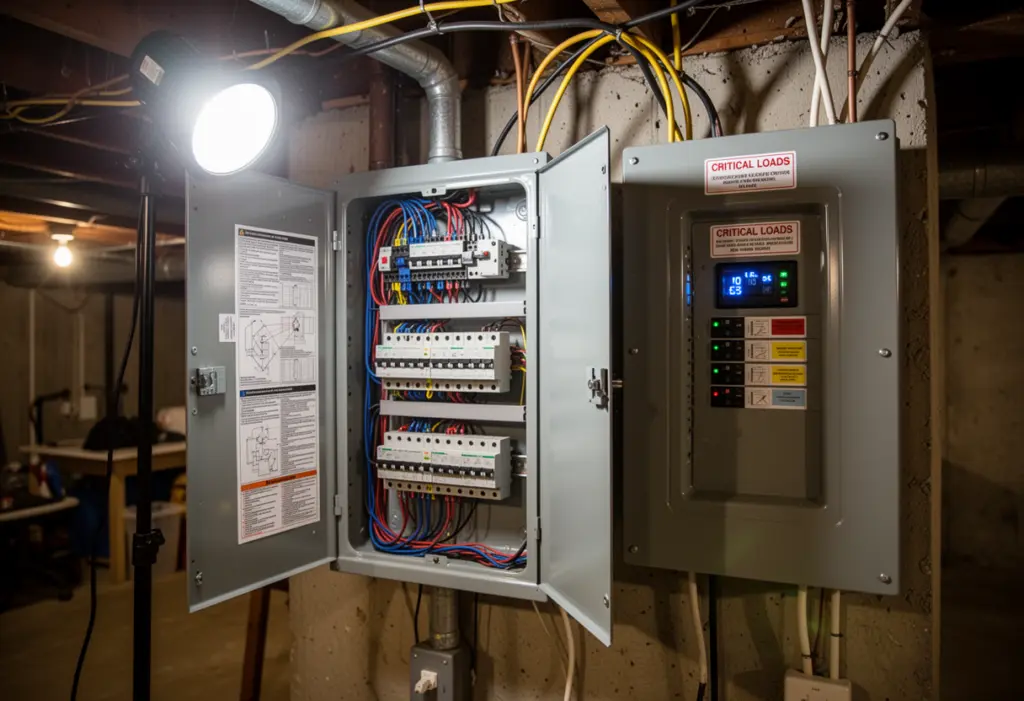
The question has the wrong shape, and that is why the answers people get vary so wildly. The number of batteries follows from two different figures rather than one: the peak kilowatts you need at any instant, and the kilowatt-hours you need across the whole outage. A system can be right on one and hopeless on the other. In New York, how you heat decides both.
Do the arithmetic on a list, not on the house
Walk around with a notepad and write down what genuinely has to keep running. Read the nameplate on each item, which gives its watts, and multiply by the hours you expect to use it in a day. Add the results and you have your daily kilowatt-hours. Add the watts of everything that could plausibly run at the same moment and you have your peak kilowatts.
Do the sum with your own nameplate figures rather than with typical values from an article, because the spread between two refrigerators or two well pumps is wide enough to change the answer. Then multiply your daily figure by the number of days you want to cover. If your list comes to 6 kWh a day and you want two days without any recharging, you need about 12 kWh of usable capacity, and usable is the word to check in the specification: it is not the same as nominal.
Kilowatts is what fails first
Most disappointing backup systems fail on power, not on energy. Anything with a motor, a well pump, a submersible sump pump, a fridge compressor, a furnace blower, draws a brief surge far above its running figure when it starts. If two of them start together and the inverter cannot supply the combined surge, the system trips and everything goes dark while the battery is still nearly full.
Ask for the system’s continuous output and its surge output, both as numbers, and check them against the largest motor loads on your list rather than against the total.
Heat is the New York problem
This is the uncomfortable part. Electric resistance heat will empty any residential battery in hours, and a cold-climate heat pump running through a January night is the largest load in most houses that have one, at exactly the time of year when an outage is most likely and the array behind the battery produces least.
If your heat is gas, oil or propane, you are in much better shape than you think: the burner does not need the battery, only the blower, the circulator pump and the controls do, and that is a modest load that a small system can carry for a long time. Which is why the sensible design in most New York homes is not a bigger battery. It is a shorter list.
Partial backup usually wins
A critical loads subpanel is a small second panel holding only the circuits you decided matter: the heating controls, the fridge, the sump pump, the well pump, some lighting, the internet, the outlets you charge phones from. Everything else stays on the main panel and goes dark. It costs less than whole-house backup, it makes the battery last several times longer on the same capacity, and it removes the failure mode where someone turns on an electric oven during an outage and the whole system drops out.
Whole-house backup is a real option and some households need it. It just needs to be a decision made with the arithmetic in front of you rather than a default.
Recharging during the outage
People assume solar refills the battery every day of an outage. Ask three questions to find out whether it will in your case. Is the system configured to island, so that the array keeps producing when the grid is down? What does the manufacturer expect the array to deliver on a short overcast December day? And who clears snow off the panels, given that the outages you are sizing for are frequently the storms that put the snow there in the first place?
Sizing up the array has a monthly price
If the conclusion is a larger array to support more storage, put the Customer Benefit Contribution into the decision. It is charged on DC system size every month regardless of production, on systems interconnected on or after 1 January 2022. Going from 8 kW to 11 kW on RG&E at $1.31 per kW-month adds about $3.93 a month, roughly $47 a year, whether or not those three extra kilowatts ever earn anything for you. On Central Hudson at $1.67 the same three kilowatts cost about $60 a year, and on National Grid at $0.97 about $35.
And oversizing does not quietly pay for itself elsewhere. Under Phase One net metering exports are credited at full retail for 20 years from interconnection, which is excellent, but building a credit balance you never consume is not a return on the panels that built it.
What the incentives will and will not cover
Size the system for the house rather than for the incentives, because in 2026 the incentives are thinner than the sales material of recent years suggests. The 30% federal residential credit is gone: section 25D was terminated for expenditures made after 31 December 2025, with an expenditure treated as made when the original installation is completed. New York’s 25% credit on Form IT-255 is capped at $5,000, which means it stops growing well before a large array and battery do, applies only to solar energy system equipment at your principal residence, and is limited by your actual state tax liability, though unused credit carries forward for up to five years. The state sales tax exemption applies to the residential solar equipment, and RPTL 487 exempts the added value from property tax for 15 years where the municipality, the county and the school district have each not opted out, provided the system is constructed before 1 January 2030. NY-Sun adds nothing here: as of September 2026 NYSERDA has no open NY-Sun block for homes in any utility territory; check NYSERDA’s NY-Sun dashboard for a new one. Check the current position at tax.ny.gov and with NYSERDA before sizing anything around a number you were quoted months ago.
Frequently Asked Questions
How do I calculate how many batteries I need?
Add the nameplate watts of everything that must run, multiply by the hours you need them, and multiply by the days you want covered. That gives usable kilowatt-hours. Separately add what could run at once to get peak kilowatts.
Why does my backup system trip when the battery is still full?
That is a power limit rather than an energy limit. Motors surge well above their running draw at startup, so two starting together can exceed the inverter output. Ask for both continuous and surge ratings and check them against your largest motor loads.
Can a battery run electric heat in a New York winter?
Electric resistance heat will empty any residential battery in hours, and a heat pump is the largest load in most homes that have one. With gas, oil or propane heat only the blower, circulator and controls need backing up, which is a far smaller job.
Is whole-house backup worth it?
Usually a critical loads subpanel is better value. It costs less, makes the same capacity last several times longer, and removes the failure mode where somebody switches on a large appliance during an outage and drops the whole system.
This article is general information, not tax, legal or financial advice. Incentive amounts, eligibility rules and deadlines change and depend on your utility, your tax situation and your property. Confirm current terms with NYSERDA, your utility and a qualified tax professional before making a decision.
NY Solar Incentives
Independent New York solar research. We summarise NYSERDA, NY-Sun and federal programme rules from published sources and state plainly when a figure is an estimate. We are not a government agency and do not sell equipment.
Run the arithmetic on your own system
Check the dated program table and your arrangement before counting an incentive. Standard residential NY-Sun blocks are closed; Long Island Affordable Solar has a conditional income-verification route. The NY credit depends on qualified costs and tax liability, while the NYC abatement reduces future property-tax bills. The estimator keeps those timings separate.