Battery Storage Permit Requirements in New York
There is no one statewide battery permit. What you need is set by the authority having jurisdiction over your address, and a solar permit does not automatically bring the battery with it.
On this page 7 sections
- 01Three separate approvals that people run together
- 02The Unified Solar Permit, and where its edges are
- 03Interconnection is a different queue
- 04What the installer should hand you at the end
- 05Timelines, and who pays when something fails
- 06The incentive with a deadline behind it
- 07Frequently Asked Questions
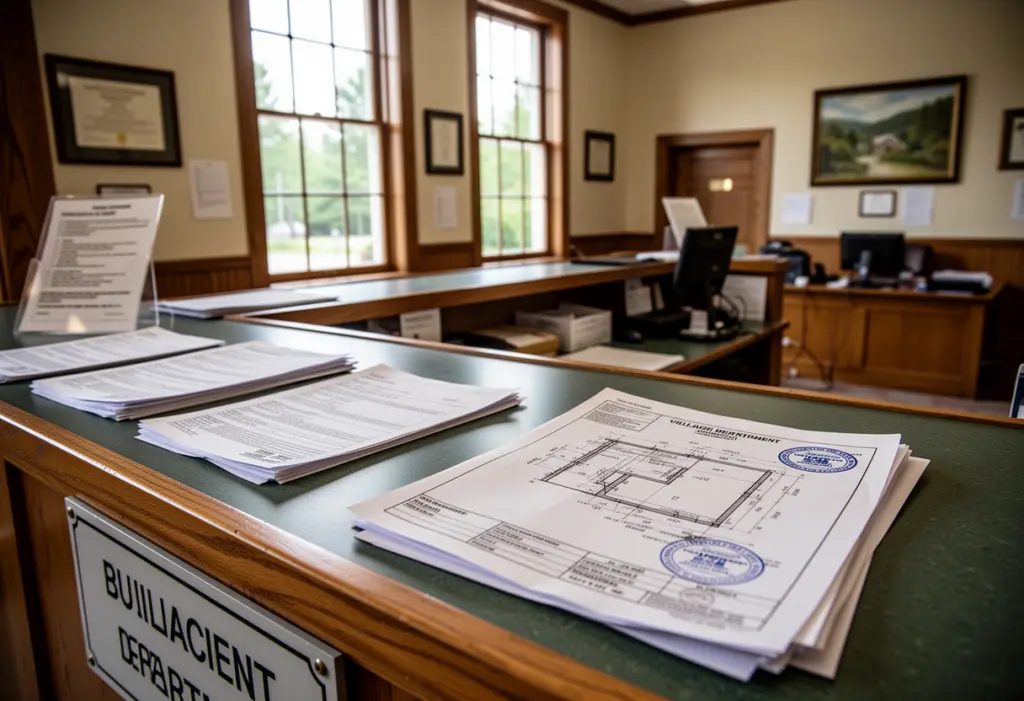
There is no single statewide battery permit in New York. What you need is set by the authority having jurisdiction over your address, and the most common misunderstanding is worth stating first: a solar permit does not automatically bring the battery with it. Ask that question specifically, of the building department, before anyone orders equipment.
Three separate approvals that people run together
A home storage project typically needs three things, and none of them substitutes for another.
- A building and electrical permit from the local authority having jurisdiction, with inspection afterwards. This is what makes the installation lawful.
- Review by the fire official, covering where the equipment sits, how it is separated from living space and how it is reached in an emergency. In some municipalities this is folded into the building permit and in others it is a separate sign-off.
- Utility interconnection approval, which is not a permit at all. It is the utility’s consent to connect to its network, and it ends with permission to operate.
Projects stall most often because one of the three was assumed to be covered by another. Ask your installer to name which authority issues each, and to give you the reference number for each when it is issued.
The Unified Solar Permit, and where its edges are
NYSERDA and the Department of State developed the New York State Unified Solar Permit to standardise residential and small commercial solar permitting. It applies to systems of 25 kW DC and under and has been adopted by over 300 authorities having jurisdiction. It does not apply in the five boroughs of New York City, which permit through the Department of Buildings.
Two things follow. First, whether your town uses it at all is a question with a definite answer, and the building department will give it to you in a phone call. Second, the permit was designed around solar. Whether your municipality’s version covers a battery, or requires a separate application for it, varies, so ask about the storage specifically rather than about the solar and hoping.
Interconnection is a different queue
Interconnection for utility customers runs through the state process overseen by the Public Service Commission, and it moves on the utility’s timetable rather than the town’s. That is why permission to operate can be the last thing to arrive even after inspection has passed.
If you are served by a municipal electric utility, none of that applies. Municipal utilities sit outside Public Service Commission jurisdiction, so there is no state interconnection process, no Public Service Commission net metering and no Customer Benefit Contribution. The terms are whatever that utility sets, and you have to ask it directly. Confirm which utility you are on from the name printed on your own bill rather than from an installer’s coverage map, because the boundary does not follow county or village lines the way people assume.
What the installer should hand you at the end
- The permit numbers, and the issuing authority for each.
- The signed inspection certificate or its equivalent from your municipality.
- The written permission to operate from the utility, if you are a utility customer.
- As-built drawings showing the final position of the battery, the disconnect and any critical loads subpanel.
- Manufacturer documentation and the commissioning report for the system as installed.
This paperwork matters twice. It matters when something needs servicing, and it matters years later when you sell the house and a buyer’s attorney asks whether the equipment was permitted. An unpermitted battery discovered at closing is a problem with no good solutions.
Timelines, and who pays when something fails
Ask three questions before signing. What is the expected elapsed time from contract to permission to operate for a project like yours in this specific municipality? Who pays for redesign and resubmission if the application is rejected? And is any part of the payment schedule tied to a permit milestone rather than to a delivery date, so that you are not paying for progress that has not happened?
The incentive with a deadline behind it
Permitting delays usually cost nothing but patience. One exception is worth planning around: RPTL 487, the 15-year property tax exemption on the added value of the system, requires construction before 1 January 2030, and depends on the municipality, the county and the school district having each declined to opt out. Those are three separate checks with three separate answers, except in New York City, Buffalo, Rochester, Syracuse and Yonkers, where the school districts are fiscally dependent and levy no separate property tax. Ask the assessor now rather than after the work, because the answer may change whether the project is worth doing at all.
The rest of the incentive picture is unaffected by permitting. NY-Sun is not part of it, because as of September 2026 NYSERDA has no open NY-Sun block for homes in any utility territory; check NYSERDA’s NY-Sun dashboard for a new one. The state credit of 25% capped at $5,000 is claimed by you on Form IT-255 for equipment at your principal residence. The state sales tax exemption applies to residential solar energy systems equipment. And the 30% federal residential credit is gone: section 25D was terminated for expenditures made after 31 December 2025, with an expenditure treated as made when the original installation is completed. Programmes and local requirements both change, so confirm the current position with your building department and at tax.ny.gov rather than relying on a page written earlier in the year.
Frequently Asked Questions
Do I need a separate permit for a home battery in New York?
Frequently yes, and it depends on your authority having jurisdiction. A solar permit does not automatically cover storage. Ask the building department about the battery specifically before any equipment is ordered.
Does the New York Unified Solar Permit include batteries?
It was designed around solar, applies to systems 25 kW DC and under, has been adopted by over 300 authorities having jurisdiction, and does not apply in the five boroughs. Whether a given municipality's version covers storage varies, so ask.
Is interconnection approval the same as a permit?
No. A permit comes from the local authority and makes the installation lawful. Interconnection is the utility's consent to connect, ending in permission to operate, and it runs on a separate timetable through the state process.
What paperwork should I keep after installation?
Permit numbers and issuing authorities, the inspection sign-off, the written permission to operate, as-built drawings showing the battery and any critical loads subpanel, and the commissioning report. A buyer's attorney will ask for it at closing.
This article is general information, not tax, legal or financial advice. Incentive amounts, eligibility rules and deadlines change and depend on your utility, your tax situation and your property. Confirm current terms with NYSERDA, your utility and a qualified tax professional before making a decision.
NY Solar Incentives
Independent New York solar research. We summarise NYSERDA, NY-Sun and federal programme rules from published sources and state plainly when a figure is an estimate. We are not a government agency and do not sell equipment.
Run the arithmetic on your own system
Check the dated program table and your arrangement before counting an incentive. Standard residential NY-Sun blocks are closed; Long Island Affordable Solar has a conditional income-verification route. The NY credit depends on qualified costs and tax liability, while the NYC abatement reduces future property-tax bills. The estimator keeps those timings separate.