Solar Panel Installation in Chatham, NY
A Chatham address can sit in any of several towns, and most of them are farm country with room for an array on the ground. Both facts change the project before equipment is discussed.
On this page 7 sections
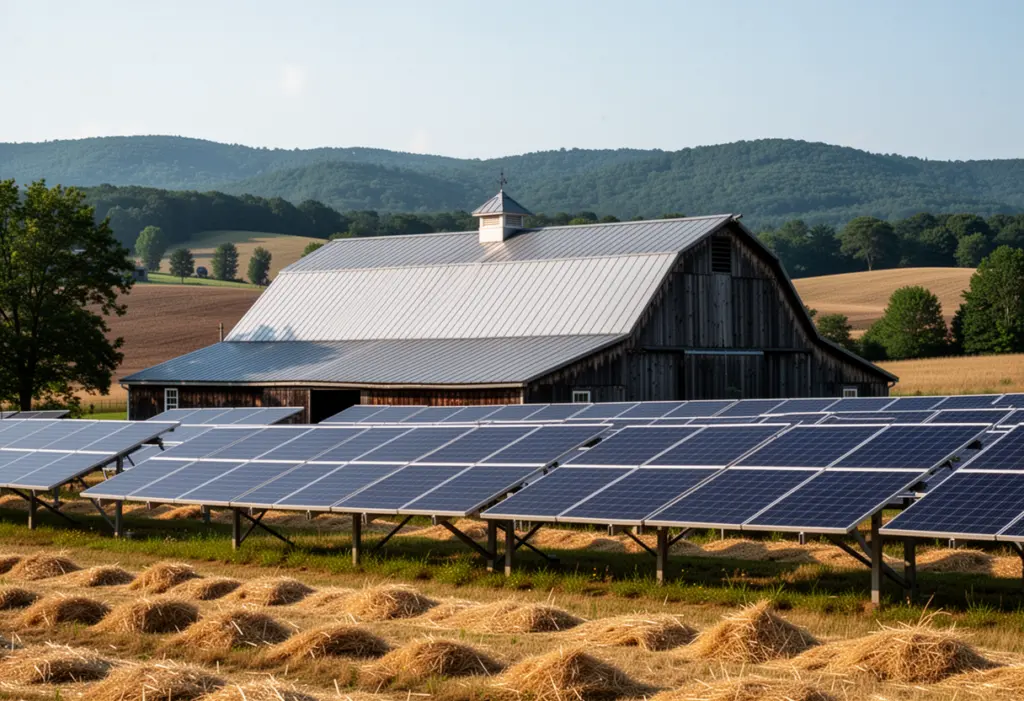
Chatham is a village inside the Town of Chatham, in eastern Columbia County. ZIP code 12037. It is farm country: rolling agricultural land, old farmsteads, and a small compact village at the centre of it. That mix produces two questions that a general New York solar guide never asks.
A Chatham address does not tell you who issues the permit
Postal boundaries and municipal boundaries do not agree here. A Chatham mailing address can sit in the Village of Chatham, the Town of Chatham, the Town of Ghent, the Town of Austerlitz or a neighbouring town, and each is a separate authority with its own building department, fee schedule and turnaround.
Confirm by parcel, not by envelope, before an installer files anything. A permit lodged with the wrong department is weeks lost rather than a small correction. Worth asking at the same time: whether the authority uses the NYS Unified Solar Permit, the standardised residential and small commercial application developed by NYSERDA and the Department of State for systems of 25 kW DC and under. More than 300 authorities having jurisdiction across the state have adopted it. Where it is in use the paperwork is a known quantity; where it is not, ask what the local process involves instead.
Farm buildings change what is possible
Barns, equipment sheds and older outbuildings frequently carry standing-seam metal roofs, which is the best mounting surface available anywhere in this county. The racking clamps straight onto the seams, nothing is drilled through the covering, and a roof like that will usually still be there when the modules are retired.
Two cautions that come with the opportunity:
- An agricultural building is not automatically strong enough. Older barn framing draws a structural engineer’s letter more often than a house roof does, and that is a cost to budget rather than discover.
- A system offsets only the meter it is connected behind. If the barn sits on a separate agricultural meter, an array there does not reduce the house bill. Establish how many meters the property has and which one you are trying to offset before any design is drawn.
Ground mounts are the normal answer here, not the exception
Most parcels in this part of Columbia County have open land, and a ground mount lets tilt and orientation be chosen rather than inherited from whatever direction the farmhouse roof happens to face. The roof-age question disappears, and maintenance and snow clearing happen at ground level.
Ask early what the town wants by way of setbacks and site plan review, how deep the foundations go below the frost line, how far the trench runs back to the service, and how high the lowest row sits above the ground, because drifted snow will sit on an array mounted too low for weeks at a time. On working land, ask also whether the siting affects any agricultural assessment on the parcel.
Old houses, and the low December sun
The farmhouses and village housing here are old, and three things follow from that. Shingles with under about a decade left in them should be replaced before an array is fixed on top. Slate turns up and wants somebody who has genuinely worked on it, so ask for photographs of finished penetrations. And 100 amp service is common enough that the panel upgrade or line-side tap should be a priced line in the quote rather than a conversation after the contract is signed.
The land here rolls, and a hillside or a treeline on the southern side takes far more in December than it does in June. Insist on an on-site horizon assessment and ask what the model says about December and January specifically, not just the annual total.
Which utility, and what it charges
Whatever the array is mounted on, the utility charges for its capacity. The Customer Benefit Contribution falls on every system interconnected on or after 1 January 2022, is calculated from DC size rather than from generation, and is re-set each year. Central Hudson bills it in 2026 at $1.67 per kW-month, the highest residential rate of any utility in New York:
- A 14 kW array: $23.38 a month, about $281 a year.
- An 18 kW array: $30.06 a month, about $361 a year.
Eastern Columbia County borders National Grid territory at $0.97, and parts of the area are served by NYSEG at $1.19, where those two systems pay $13.58 and $17.46 a month on National Grid, or $16.66 and $21.42 on NYSEG. Utility boundaries in eastern Columbia County do not follow county or town lines, so read the name printed on your own bill rather than assuming. And where a household buys its power from a municipal electric system rather than from an investor-owned company, none of this applies at all: no state net metering, no such charge, no standardised interconnection process, only whatever terms that utility sets.
Exports meanwhile earn Phase One net metering at the full retail rate, a structure that stays with the system for 20 years from interconnection, and anyone who subscribes to community solar instead is charged no Customer Benefit Contribution at all.
2026 incentives
The 30% federal residential credit has been terminated. Section 25D stopped at expenditures made after 31 December 2025, and an expenditure counts as made when the original installation is completed. A 2026 proposal showing it is wrong on its face.
That termination is the reason third-party ownership is being pushed harder than it was, and on rural parcels with room for a large array it is being pushed hard. What survives federally is the business-side credit, claimed by the company that owns a leased or power-purchase system, not by you. So an offer can genuinely contain a federal tax benefit while you never see a line of it on your own return, and that is worth understanding before a lease is compared against a purchase.
New York’s own credit does reach those arrangements, on conditions that decide whether an offer is worth anything:
- Only a lease of at least ten years or a power purchase agreement of at least ten years qualifies. The ten-year floor applies to the lease as much as to the PPA, whatever a shorter deal is called.
- The $5,000 is a lifetime ceiling for that agreement, not an annual amount, and sums already claimed for it in earlier years come off.
- On an agreement running beyond 15 years, no credit is allowed after the fifteenth year, even with the ceiling unused.
- For a lease the annual credit is what you actually paid that year, capped by 25% of the total contracted payments or $5,000, whichever is lower. The flat 25% describes the PPA calculation, not the lease one.
Whether you buy or sign, the rest is unchanged: the credit needs a principal residence and is limited by your New York State tax liability; the state sales tax exemption applies; and RPTL 487 gives 15 years of exemption on the added value where the village, your town, Columbia County and your school district have each not opted out, with construction required before 1 January 2030. Confirm every one of them, separately and currently, before you sign. Neither route brings NY-Sun or its Affordable Solar incentive at or below 80% of area median income. As of September 2026 NYSERDA has no open NY-Sun block for homes in any utility territory; check NYSERDA’s NY-Sun dashboard for a new one.
Frequently Asked Questions
Which authority issues a solar permit for a Chatham address?
It depends on the parcel rather than the postal address. The Village of Chatham, the Town of Chatham, the Town of Ghent and the Town of Austerlitz are separate authorities with their own building departments. Confirm by parcel before anything is filed.
Can I put the array on the barn?
Often, and a standing-seam metal barn roof is the best mounting surface there is because racking clamps to the seams with no penetrations. But older barn framing draws a structural engineer's letter more often, and a separate agricultural meter means the array will not offset the house bill.
Is a solar lease or PPA worth taking here?
Only on a term of ten years or more, which is what New York's credit requires. The $5,000 is a lifetime ceiling for that agreement rather than an annual figure, nothing is allowed after the fifteenth year, and the surviving federal credit belongs to the system's owner, not to you.
What does the utility charge a Chatham solar customer?
The Customer Benefit Contribution is $1.67 per kW-month of DC size on Central Hudson for 2026, the highest residential rate in New York, so about $281 a year on 14 kW and $361 on 18 kW. Neighbouring territory is National Grid at $0.97 or NYSEG at $1.19, so read your bill.
This article is general information, not tax, legal or financial advice. Incentive amounts, eligibility rules and deadlines change and depend on your utility, your tax situation and your property. Confirm current terms with NYSERDA, your utility and a qualified tax professional before making a decision.
NY Solar Incentives
Independent New York solar research. We summarise NYSERDA, NY-Sun and federal programme rules from published sources and state plainly when a figure is an estimate. We are not a government agency and do not sell equipment.
Run the arithmetic on your own system
Check the dated program table and your arrangement before counting an incentive. Standard residential NY-Sun blocks are closed; Long Island Affordable Solar has a conditional income-verification route. The NY credit depends on qualified costs and tax liability, while the NYC abatement reduces future property-tax bills. The estimator keeps those timings separate.