Solar Panel Installation in Coxsackie, NY
Coxsackie is a riverfront village with farmland behind it. The low ground and the open ground pull a solar design in opposite directions, and both are worth asking about.
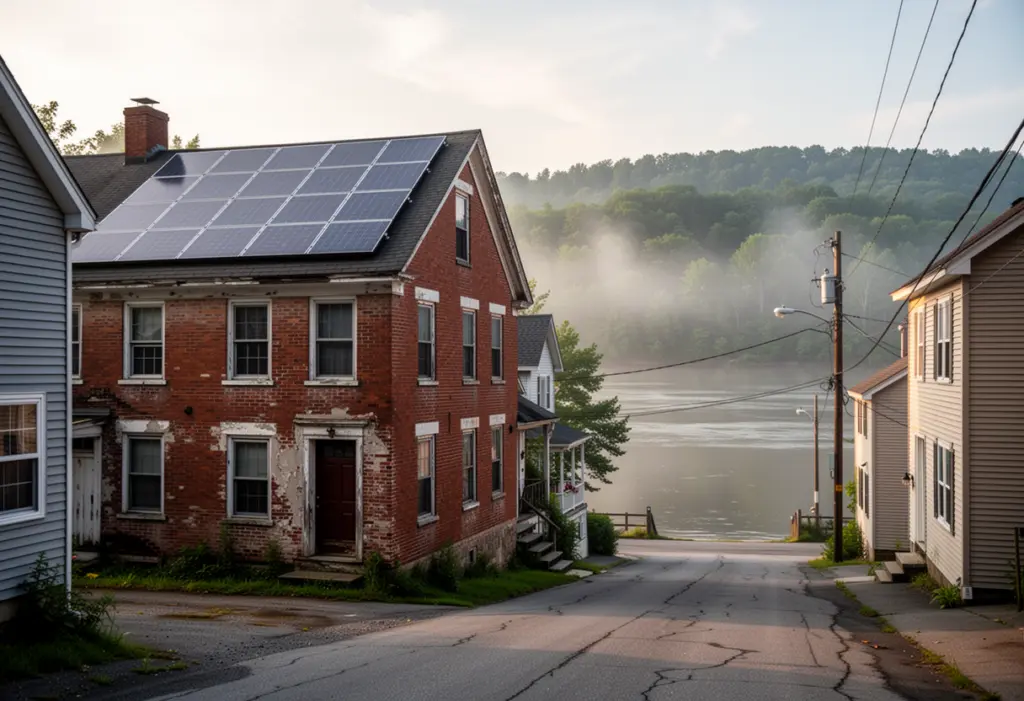
Coxsackie is a village inside the Town of Coxsackie, in Greene County, on the west bank of the Hudson River. ZIP code 12051. It is two quite different places for solar purposes: a compact old riverfront village, and open farmland inland behind it.
On the riverfront, elevation decides the layout
The low-lying parcels along the river are in mapped flood plain, and where that applies it changes where the electrical equipment may be mounted rather than whether the project happens:
- Expect the inverter, both disconnects, the production meter and any battery to be pushed above a specified elevation — onto a different wall, higher up the same one, or inside the building rather than into the obvious spot beside the meter.
- The basement stops being an option for a battery on a riverfront parcel, whatever it would have saved.
- Fix the positions at design stage: an inspector who rejects a mounting height turns a finished job into a return visit.
Put the question to the town before anything is drawn: is this parcel mapped, and what elevation does the code require? An installer whose usual work is inland will not necessarily think to ask it for you.
Inland, the ground mount is a serious option
Behind the village the land opens into farm country, and on a parcel with space a ground mount is a genuine choice rather than a fallback. Tilt and orientation are selected instead of inherited from whatever the roof happens to do, the roof-age question disappears completely, and clearing snow happens at ground level.
Ask early about setbacks and site plan review, foundation depth below the frost line, the trenching distance back to the house, and how much clearance sits beneath the lowest row. An array set too low is buried by drifted snow for weeks, and that is a design decision rather than bad luck.
Village or town
The Village of Coxsackie and the Town of Coxsackie are separate authorities with their own building departments, and the village sits inside the town. Neighbouring Athens and New Baltimore are separate towns again. Establish which covers your address before an installer files anything, since fee schedules and turnarounds differ. On the older village streets, where architectural review applies it comes ahead of the building permit, so a rear plane with all-black flush-mounted modules and concealed conduit is what typically gets approved.
Older village housing
The village housing is old enough that three checks are worth making before signing. The roof comes first: with under about ten years of shingle left, replacing it now is cheaper than lifting the array off later to do the same job. The framing comes second, because older structures need an engineer’s sign-off far more often than a modern truss roof does. The service comes third: 100 amp panels are widespread here, and where the busbar will not accept a solar breaker, the upgrade or the line-side tap belongs in the contract price.
Standing-seam metal appears on plenty of older buildings here and is the best case anywhere in the county, because racking clamps to the seams with no penetrations at all.
Central Hudson has the highest solar charge in New York
Anyone who interconnected on or after 1 January 2022 owes the Customer Benefit Contribution, worked out each month from the DC size of the array rather than from what it generates. At Central Hudson’s 2026 residential rate of $1.67 per kW-month, the highest residential rate charged by any utility in the state, the sizes this open land makes possible come out like this:
- A 12 kW ground mount: $20.04 a month, about $240 a year.
- A 15 kW ground mount: $25.05 a month, about $301 a year.
Charged on capacity regardless of production and recalculated annually, which is worth weighing when open land tempts you into a larger array than the house needs. Greene County borders National Grid territory at $0.97, and parts of the region are NYSEG at $1.19, where that 15 kW array pays $14.55 or $17.85 a month instead, about $175 or $214 a year.
Take the utility from the bill rather than from the county. Where a household is served by a municipal electric system — New York has roughly fifty of them, none under Public Service Commission jurisdiction — state net metering, this charge and the standardised interconnection process all fall away, and the terms have to come from that utility instead.
What offsets it is Phase One net metering, which pays full retail for every exported kilowatt-hour and keeps that structure for 20 years from the date you connect.
2026 incentives
There is no federal residential credit on a 2026 job. Section 25D was terminated for expenditures made after 31 December 2025, with the expenditure dated to the completion of the original installation. Any quote still carrying that line is materially wrong.
Which puts a ceiling in the way of exactly the design this land invites. New York’s 25% credit stops at $5,000 on Form IT-255 no matter how large the system, so qualified expenditure beyond roughly $20,000 earns nothing further — and a ground mount, with its foundations, trenching and site work, reaches that figure sooner than a roof array of the same output does. Two consequences worth planning around before the design is fixed:
- Past the ceiling, the state credit is a fixed sum rather than a percentage. A proposal that prints 25% against the whole ground-mount price is describing money you will not receive.
- The charge above keeps rising after the credit stops. Every extra kilowatt adds $1.67 a month on Central Hudson and nothing at all to the credit, so size the array to the consumption you actually have.
The credit also requires a principal residence, is limited by your actual New York State tax liability, reaches leases and power purchase agreements of ten years or more, and carries any unused balance forward for up to five years. Alongside it: the state sales tax exemption; and RPTL 487, a 15-year exemption on the added value where the village, the town, Greene County and your school district have each not opted out. Check all of them separately, and check the current position before signing. NY-Sun, the per-watt incentive once taken off the price by the contractor according to system size and region, and its Affordable Solar incentive at or below 80% of area median income are not available to a home. As of September 2026 NYSERDA has no open NY-Sun block for homes in any utility territory; check NYSERDA’s NY-Sun dashboard for a new one.
Frequently Asked Questions
Does the Hudson River flood plain affect solar in Coxsackie?
On the low riverfront parcels, yes. The inverter, disconnects, meter and any battery usually have to be mounted above a specified elevation, so a basement battery is frequently the wrong answer even where it is the cheapest place to put one.
Is a ground mount practical outside the village?
On a parcel with open land, frequently yes. Tilt and orientation are chosen rather than inherited and the roof-age question disappears. Ask about setbacks, site plan review, frost line depth, trenching distance and clearance beneath the lowest row.
Does a bigger ground mount earn a bigger state credit?
No. The New York credit is 25% of qualified expenditure but stops at $5,000, so beyond roughly $20,000 of qualified cost it adds nothing, while the monthly utility charge keeps rising at $1.67 per kW on Central Hudson. Size the array to your consumption.
What does Central Hudson charge a Coxsackie solar customer?
The Customer Benefit Contribution at $1.67 per kW-month of DC system size for 2026, the highest residential rate in the state: about $240 a year on a 12 kW ground mount and $301 on 15 kW. Neighbouring territory is National Grid at $0.97 or NYSEG at $1.19, so read your bill.
This article is general information, not tax, legal or financial advice. Incentive amounts, eligibility rules and deadlines change and depend on your utility, your tax situation and your property. Confirm current terms with NYSERDA, your utility and a qualified tax professional before making a decision.
NY Solar Incentives
Independent New York solar research. We summarise NYSERDA, NY-Sun and federal programme rules from published sources and state plainly when a figure is an estimate. We are not a government agency and do not sell equipment.
Run the arithmetic on your own system
Check the dated program table and your arrangement before counting an incentive. Standard residential NY-Sun blocks are closed; Long Island Affordable Solar has a conditional income-verification route. The NY credit depends on qualified costs and tax liability, while the NYC abatement reduces future property-tax bills. The estimator keeps those timings separate.