Solar Incentives in Great Neck, NY
The Great Neck peninsula is a cluster of separate incorporated villages, which makes the property tax exemption a four-part question rather than one.
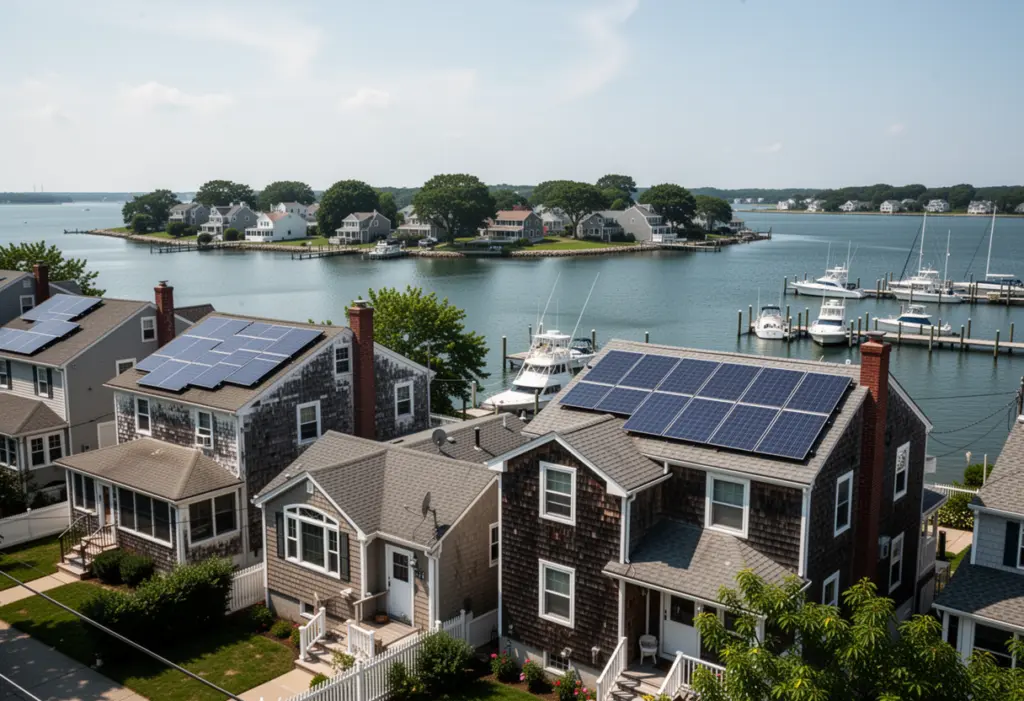
Great Neck is a peninsula in the Town of North Hempstead, Nassau County, ZIP codes 11021, 11023 and 11024. It is not one municipality. Several separate incorporated villages sit on it, among them Great Neck, Great Neck Estates, Great Neck Plaza, Kensington, Kings Point, Lake Success, Russell Gardens, Saddle Rock and Thomaston, with unincorporated pockets permitted by the town. That structure is what makes the incentive picture here different from a generic New York guide.
Does the state credit actually reach your house?
Begin with that question rather than with the percentage, because on this peninsula it is the condition that most often fails. New York’s solar energy system equipment credit is 25% of qualified expenditure capped at $5,000 and claimed on Form IT-255, and it is available only for equipment installed and used at the taxpayer’s principal residence in New York State.
A house held as a second home, occupied seasonally, or let to a tenant fails that line — and with the federal residential credit gone, this is now the largest tax benefit a buyer can lose to a single condition. Waterfront and near-waterfront property that is not its owner’s main address is not unusual here, so settle which category the house falls into before a proposal is built on a credit that cannot be claimed, and settle it with your own accountant rather than with a salesperson.
Two mechanics then decide what it is worth. The credit cannot exceed your actual New York State tax liability for the year, with the unused balance carried forward for up to five years. And it reaches leases of at least ten years and power purchase agreements of at least ten years as well as outright purchases, the ten-year floor applying to the lease every bit as much as to the PPA.
The property tax exemption is a four-part question
Ask about RPTL 487 four times on this peninsula, because four bodies decide independently whether the 15-year exemption on the added value applies to your parcel. A county, city, town or village opts out by local law; a school district opts out by resolution.
- Your village — boundaries here sit close together, so a neighbour’s answer is not your answer.
- The Town of North Hempstead.
- Nassau County.
- Your school district, worth asking first, because school taxes are the largest single line on a Nassau bill.
Section 487 reaches only systems constructed before 1 January 2030, so it is not open ended. Whichever village you are in also issues your building permit through its own department, with its own fee schedule and turnaround.
NY-Sun and its adder: no open block for homes
NY-Sun was applied by the contractor as a reduction in the price rather than claimed by you on a form. It is not available to a Great Neck home now: on Long Island the last residential NY-Sun block closed on 17 April 2016, and as of September 2026 NYSERDA has no open NY-Sun block for homes in any utility territory; check NYSERDA’s NY-Sun dashboard for a new one. If a proposal still shows a NY-Sun reduction, ask which open block it relies on.
Affordable Solar, NYSERDA’s income-qualified version of the incentive, was also applied by the contractor. It has no open block for homes either, so there is nothing to ask for on a quote today.
New York’s sales tax exemption on residential solar equipment also applies, and localities elect separately on their own share, so the total exemption differs by county and city.
What does the utility charge for the privilege?
One line runs the other way. Any system interconnected on or after 1 January 2022 carries a Customer Benefit Contribution, a monthly charge set against DC capacity rather than production. At PSEG Long Island’s 2026 residential rate of $1.13 per kW-month, a 13 kW array on one of the larger houses here costs $14.69 a month, about $176 over a year, in a bright summer and a grey one alike. The rate is re-set each year rather than fixed when you connect. Community solar subscribers sit outside the charge entirely and pay none of it, which is worth weighing where a wooded lot or a rented apartment rules a rooftop out.
Read the utility name off your own bill. Most of Nassau is served by PSEG Long Island, operator of the LIPA system, while Freeport and Rockville Centre run their own municipal electric utilities and sit outside Public Service Commission jurisdiction, with no state net metering, no Customer Benefit Contribution and no standardised interconnection process.
What is no longer available
The 30% federal residential credit is gone. It closed under section 25D to any expenditure made after 31 December 2025, an expenditure being dated to completion of the original installation rather than to the day the system starts running. Check any quote handed to you for that line before you read anything else on it, because a proposal still showing 30% federal is materially wrong.
What survives on the residential side is the state credit at a principal residence, the sales tax exemption and RPTL 487, alongside Phase One net metering, which credits exports at the full retail rate and holds for 20 years from interconnection. NY-Sun and Affordable Solar belong under this heading too: neither has an open block for homes. Every one of them can be amended by the body that administers it, so take the live position from NYSERDA and the NY Department of Taxation and Finance before signing.
Frequently Asked Questions
Which authorities can opt out of the solar property tax exemption here?
Four, separately: your Great Neck village, the Town of North Hempstead, Nassau County and your school district. Check the school district first, because school taxes are the largest single line on a Nassau tax bill.
Does a second home on the peninsula qualify for the state credit?
No. New York's 25% credit capped at $5,000 on Form IT-255 requires the equipment to be installed and used at the taxpayer's principal residence in New York State. A seasonal, second or let property fails that condition.
Does the state credit reach a solar lease?
Yes, but only a lease of at least ten years, and the same ten-year floor applies to a power purchase agreement. A shorter lease does not qualify however it is marketed.
Is the federal 30% credit still available in 2026?
No. Section 25D was terminated for expenditures made after 31 December 2025, with an expenditure treated as made when the original installation is completed. Any 2026 proposal still showing a 30% federal line is materially wrong.
This article is general information, not tax, legal or financial advice. Incentive amounts, eligibility rules and deadlines change and depend on your utility, your tax situation and your property. Confirm current terms with NYSERDA, your utility and a qualified tax professional before making a decision.
NY Solar Incentives
Independent New York solar research. We summarise NYSERDA, NY-Sun and federal programme rules from published sources and state plainly when a figure is an estimate. We are not a government agency and do not sell equipment.
Run the arithmetic on your own system
Check the dated program table and your arrangement before counting an incentive. Standard residential NY-Sun blocks are closed; Long Island Affordable Solar has a conditional income-verification route. The NY credit depends on qualified costs and tax liability, while the NYC abatement reduces future property-tax bills. The estimator keeps those timings separate.