Solar Incentives in Southampton, NY
In Southampton the first incentive question is not how much, but whether the house is your principal residence. On a second home the state credit is worth nothing at all.
On this page 9 sections
- 01The principal residence test decides everything
- 02And where it does apply, the cap binds
- 03Seven villages, seven building departments
- 04The property tax exemption needs three separate checks
- 05The two your contractor used to apply
- 06What PSEG Long Island charges
- 07Coastal constraints that no incentive covers
- 08Settle the residency question before anything else
- 09Frequently Asked Questions
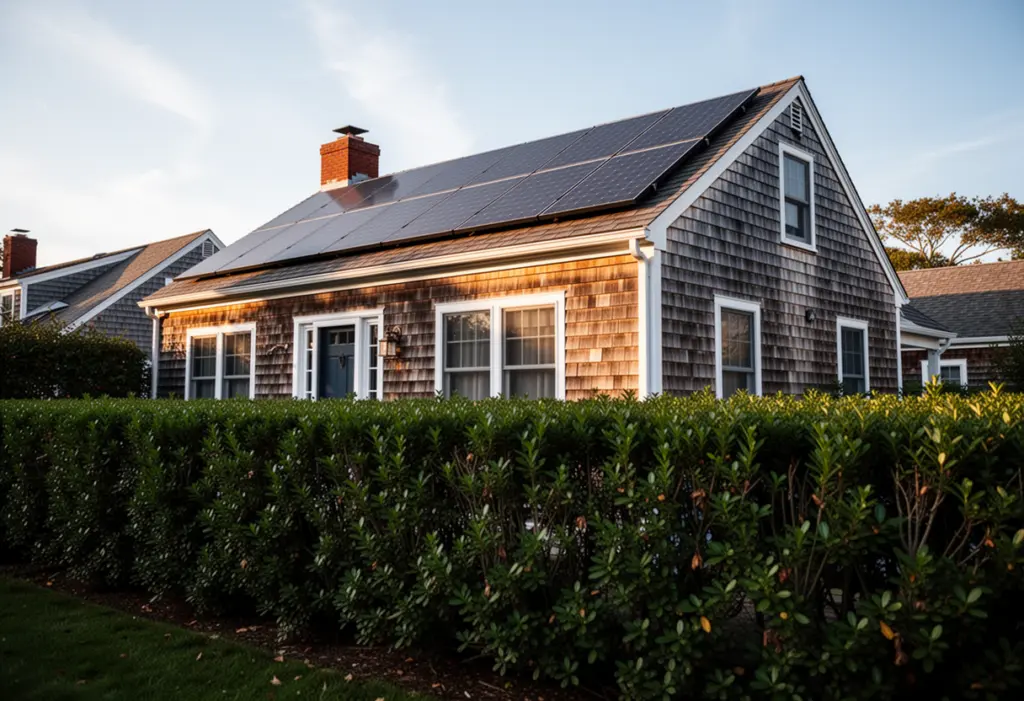
Southampton is a town in Suffolk County on the South Fork, running from Eastport and Remsenburg out through Hampton Bays and Water Mill to Sagaponack. ZIP codes include 11968, 11946, 11932, 11976, 11962, 11942, 11959, 11978, 11977 and 11960. The incentive position here is unusually binary, and the reason is the housing.
The principal residence test decides everything
New York’s 25% credit on Form IT-255 requires the system to be installed and used at your principal residence in New York. A seasonal, second or rental property does not qualify.
Southampton has a very high share of seasonal and second homes, so for a large number of houses here the largest remaining incentive in the state is simply unavailable. That is not a detail to discover after signing. Establish it first, because it changes the entire case:
- If the house is your principal residence, the credit is 25% of qualified expenditure, capped at $5,000, and limited by your actual New York State tax liability.
- If it is not, that line is zero, and any payback figure that includes it is wrong by up to $5,000.
Third-party arrangements are included as well, but only long ones. A lease or a power purchase agreement qualifies at ten years or more, and that floor governs the lease exactly as it governs the PPA — anything shorter falls outside the credit however the brochure describes it.
And where it does apply, the cap binds
Houses here are large, so arrays are large, and $5,000 is a ceiling rather than a rate. On a 12 or 18 kW system the credit covers a considerably smaller share of the cost than the headline 25% suggests. If a proposal shows 25% of the whole project as a state benefit, ask for it to be recalculated against the cap.
Note also that the 30% federal residential credit is gone. Section 25D was terminated for anything spent after 31 December 2025, and the date that governs is when the original installation was finished, not when the system was switched on. A 2026 proposal still showing a federal line is materially wrong.
Seven villages, seven building departments
Suffolk towns are large and each issues its own permits, and Southampton is divided among seven incorporated villages as well as the town itself. The Villages of Southampton, Sag Harbor, Westhampton Beach, Westhampton Dunes, Quogue, North Haven and Sagaponack each run their own building department alongside the Town of Southampton.
Establish which covers your address before an installer files anything. Several of the villages also apply architectural review ahead of the building permit, and that review can restrict street-visible placement. Where it applies, design for approval rather than arguing after refusal:
- A rear or secondary roof plane not visible from the public way.
- All-black modules with black frames rather than silver.
- Flush mounting following the roof plane, not tilted racking.
- Conduit concealed internally or painted where it is exposed.
Ask when the board meets, because a missed monthly deadline costs four weeks.
The property tax exemption needs three separate checks
RPTL 487 gives a 15-year exemption on the value the system adds to your assessment, available only where the municipality, the county and the school district have each not opted out. Here that means the Town of Southampton or your village, then Suffolk County, then your school district — Southampton, Westhampton Beach, Hampton Bays, Bridgehampton and Sag Harbor districts all serve parts of the town and each decides by its own resolution.
Ask your assessor about your specific parcel. The income tax credit’s principal residence test does not automatically carry across to other programmes, so ask how the exemption applies to your property rather than assuming either way. Section 487 also requires construction before 1 January 2030.
The two your contractor used to apply
NY-Sun was applied by the contractor as a reduction on the price rather than claimed by you, and Affordable Solar, NYSERDA’s income-qualified version of it, worked the same way. Neither is open to homes now: on Long Island the last residential NY-Sun block closed on 17 April 2016, and as of September 2026 NYSERDA has no open NY-Sun block for homes in any utility territory; check NYSERDA’s NY-Sun dashboard for a new one. If a quote still shows either as a reduction, ask which open block it relies on. New York also exempts residential solar equipment from state sales tax.
What PSEG Long Island charges
East End system sizes make the utility’s own standing charge visible. Interconnect from 1 January 2022 onward and the Customer Benefit Contribution applies — $1.13 for every kilowatt of DC capacity, every month, on PSEG Long Island’s 2026 residential schedule:
- A 14 kW system: $15.82 a month, about $190 a year.
- An 18 kW system: $20.34 a month, about $244 a year.
Charged on capacity regardless of production and recalculated annually. Exports are credited at the full retail rate under Phase One net metering for 20 years from interconnection, and community solar subscribers pay none of the contribution at all. The utility here is PSEG Long Island, but the name on your own bill is the only thing that proves it — the Village of Greenport and Fishers Island, across the bay in the Town of Southold, run municipal electric utilities whose customers sit outside Public Service Commission jurisdiction.
Coastal constraints that no incentive covers
Dune districts, coastal erosion hazard areas and mapped flood zones all bear on where equipment may be mounted, and near the ocean the inverter, disconnects, meter and any battery frequently have to sit above a specified elevation. Ask what wind load the racking and attachments are specified for, what the fixings are made of, and what enclosure rating the outdoor equipment carries. Salt is not a theoretical problem on this coast.
Settle the residency question before anything else
Everything above sorts into two piles, and which pile you are in is decided by one question. If Southampton is where you actually live, you have a state credit worth up to $5,000, the sales tax exemption and the property tax exemption, and the arithmetic looks much as it does anywhere else in New York with the federal line removed.
If it is a second or seasonal house, the credit line is zero and so is the federal line, and the case rests entirely on the sales tax exemption, RPTL 487 and the electricity itself. That is a legitimate case — but it is a different one, and it should be built that way from the start rather than corrected at tax time by an accountant who was never shown the proposal. Ask any installer to state, in writing, which of the two they have assumed.
One last caution before any of it goes into a spreadsheet: these programmes get amended, and the contribution rate is republished every year. Check both against NYSERDA and the New York State Department of Taxation and Finance on the day you sign.
Frequently Asked Questions
Can I claim the New York solar credit on a Southampton second home?
No. Form IT-255 requires the system to be installed and used at your principal residence in New York, so a seasonal, second or rental property does not qualify. Establish this before any proposal is built around the credit.
Is the 25% credit really 25% on a large East End system?
Not in practice. It is capped at $5,000 regardless of system size, so on a 12 or 18 kW array the cap binds and the credit covers a much smaller share than 25% of the whole project.
Which authority issues my permit in Southampton?
The Town of Southampton, or one of seven incorporated villages — Southampton, Sag Harbor, Westhampton Beach, Westhampton Dunes, Quogue, North Haven and Sagaponack — each with its own building department. Several also apply architectural review ahead of the permit.
What does PSEG Long Island charge a Southampton solar customer?
The Customer Benefit Contribution at $1.13 per kW-month of DC system size for 2026 — about $190 a year on a 14 kW system and $244 on 18 kW, charged on capacity regardless of production.
This article is general information, not tax, legal or financial advice. Incentive amounts, eligibility rules and deadlines change and depend on your utility, your tax situation and your property. Confirm current terms with NYSERDA, your utility and a qualified tax professional before making a decision.
NY Solar Incentives
Independent New York solar research. We summarise NYSERDA, NY-Sun and federal programme rules from published sources and state plainly when a figure is an estimate. We are not a government agency and do not sell equipment.
Run the arithmetic on your own system
Check the dated program table and your arrangement before counting an incentive. Standard residential NY-Sun blocks are closed; Long Island Affordable Solar has a conditional income-verification route. The NY credit depends on qualified costs and tax liability, while the NYC abatement reduces future property-tax bills. The estimator keeps those timings separate.