Solar Panel Installation in New City, NY
New City is an unincorporated hamlet in a county full of incorporated villages. That decides who issues your permit and how many authorities you have to check.
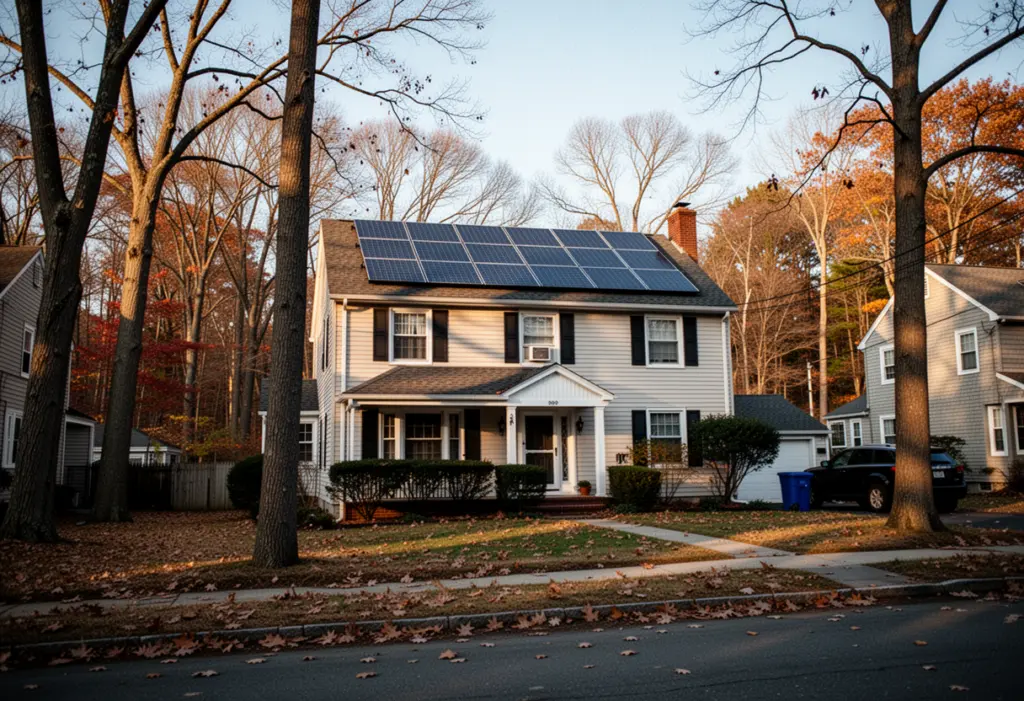
New City is the county seat of Rockland County and an unincorporated hamlet inside the Town of Clarkstown. ZIP code 10956. It is not an incorporated village, and that single fact decides who issues your permit and how many separate authorities have to agree before you can rely on the property tax exemption.
Clarkstown issues the permit
Because New City is unincorporated, the Town of Clarkstown building department is the authority having jurisdiction. Rockland packs an unusual number of incorporated villages into a small county, and each runs its own department on its own schedule and fee sheet, so a neighbour two miles away may file with an entirely different office. Settle which one covers your parcel before an installer files, because the correction is measured in weeks.
Four levels of RPTL 487, and one of them is easy to miss
The fifteen-year exemption under RPTL 487 covers the value an array adds to the parcel, and it survives only where none of the taxing authorities has opted out. In Rockland that can be four bodies deciding independently of one another: the village, if your parcel sits inside one, which is the level people forget because a mailing address reading New City tells you nothing about it; the town, which for a New City address is Clarkstown; Rockland County; and your school district, which opts out by resolution rather than by local law and for most of New City is the Clarkstown Central School District. Three yes answers and one no still leaves part of the added value taxable, so ask for the position on your specific parcel rather than a general statement about New York. Construction also has to be complete before 1 January 2030, which is a real date on a project that slips a year.
Orange and Rockland, and the monthly charge
Rockland County is Orange & Rockland territory; confirm the name on your own bill anyway. The Customer Benefit Contribution is a monthly charge on the DC size of the system, payable by anyone interconnecting on or after 1 January 2022, billed on capacity regardless of what the array produces and recalculated annually rather than locked in at interconnection. At the 2026 residential rate of $1.00 per kW-month, an 8 kW system costs $8.00 a month, about $96 a year, and a 13 kW system costs $13.00 a month, about $156. Against it, Phase One net metering credits your exported kilowatt-hours at the full retail rate and holds that structure for twenty years from the day you interconnect.
Post-war subdivisions: roof, panel and canopy
Much of New City was built in the decades after the Tappan Zee Bridge opened in 1955, and three features of that vintage decide the design. The trees come first and usually matter most: these are wooded streets with a canopy old enough to overtop a two-storey house, and a low December sun turns a branch that is harmless in July into a measurable loss in the month a net metering credit bank is being spent down. Insist on an on-site assessment rather than a satellite estimate, and have the installer show December and January separately from the annual figure. Second is the electrical service, because a house of this age often carries a 100 amp board with no room left on the busbar; where that is so, the upgrade or the line-side tap goes into the signed price rather than into a change order afterwards. Third is the roof, and a shingle roof with less than a decade left should be replaced before an array goes up, since lifting an existing array off and refitting it is labour paid for twice.
What is left in 2026, and where the $5,000 stops
The state credit is the largest single item still available to a buyer, and on the houses here it is also the one most often overstated. It is 25% of qualified expenditure but capped at $5,000, which means it behaves like a percentage only up to $20,000 of qualified expenditure and like a flat sum above that: a large system on a large roof receives exactly what a system a third of the size receives, and the effective rate falls with every panel added. It is claimed on Form IT-255, needs the equipment installed and used at your principal residence in New York State, and is limited by your actual state tax liability in any one year. It is not refundable, but unused credit carries forward for up to five years, so a first-year shortfall is deferred rather than lost. It also reaches leases and power purchase agreements, though only where the agreement runs ten years or more.
Alongside it: the state sales tax exemption on residential solar equipment, and RPTL 487 where all four levels above have declined to opt out. NY-Sun and its Affordable Solar incentive for households at or below 80% of area median income, both once delivered as a reduction on the contractor’s price rather than claimed by you, are not on that list. As of September 2026 NYSERDA has no open NY-Sun block for homes in any utility territory; check NYSERDA’s NY-Sun dashboard for a new one.
Nothing federal remains for a 2026 purchase. Section 25D was terminated for expenditures made after 31 December 2025, and an expenditure counts as made when the original installation is completed, so a job finished in December 2025 still qualifies even if the meter was not swapped until January, while a job finished this year does not. One exception runs the other way: where the work forms part of constructing or reconstructing a structure, the expenditure is treated as made when your original use of that structure begins, so panels fitted to a new house first occupied in 2026 fall outside as well. Any proposal still carrying a 30% federal line is materially wrong. Incentive programmes move, so check the current position yourself before you sign anything.
Frequently Asked Questions
Who issues a solar permit for a New City address?
The Town of Clarkstown building department, because New City is an unincorporated hamlet rather than a village. Rockland has many incorporated villages that run their own departments, so confirm your address is not inside one before anything is filed.
How many authorities have to allow the RPTL 487 exemption?
Up to four, each deciding separately: the village if you are in one, the town, Rockland County, and your school district. The village level is the one most often forgotten, and one opt-out out of four still leaves part of the added value taxable.
What does Orange and Rockland charge a New City solar customer?
The Customer Benefit Contribution at $1.00 per kW-month of DC system size for 2026 — $8.00 a month on an 8 kW system, about $96 a year, or $13.00 a month on 13 kW. It is billed on capacity, not production, and recalculated annually.
Does a bigger system earn a bigger state credit?
Only up to the cap. The credit is 25% of qualified expenditure but stops at $5,000, so above roughly $20,000 of qualified expenditure it behaves as a flat sum and the effective rate falls with every panel added. Unused credit does carry forward for five years.
This article is general information, not tax, legal or financial advice. Incentive amounts, eligibility rules and deadlines change and depend on your utility, your tax situation and your property. Confirm current terms with NYSERDA, your utility and a qualified tax professional before making a decision.
NY Solar Incentives
Independent New York solar research. We summarise NYSERDA, NY-Sun and federal programme rules from published sources and state plainly when a figure is an estimate. We are not a government agency and do not sell equipment.
Run the arithmetic on your own system
Check the dated program table and your arrangement before counting an incentive. Standard residential NY-Sun blocks are closed; Long Island Affordable Solar has a conditional income-verification route. The NY credit depends on qualified costs and tax liability, while the NYC abatement reduces future property-tax bills. The estimator keeps those timings separate.