Solar Incentives in Westfield, NY
The village of Westfield runs its own electric utility, so half of what is written about New York solar incentives does not describe a village address at all.
On this page 7 sections
- 01The village runs its own electric department
- 02Which incentives do not care who sells you electricity
- 03The one to confirm in writing before it is priced in
- 04Open land, larger arrays, and where the $5,000 cap starts to bite
- 05What a town address pays that a village address does not
- 06The escarpment, the lake, and one credit that ended
- 07Frequently Asked Questions
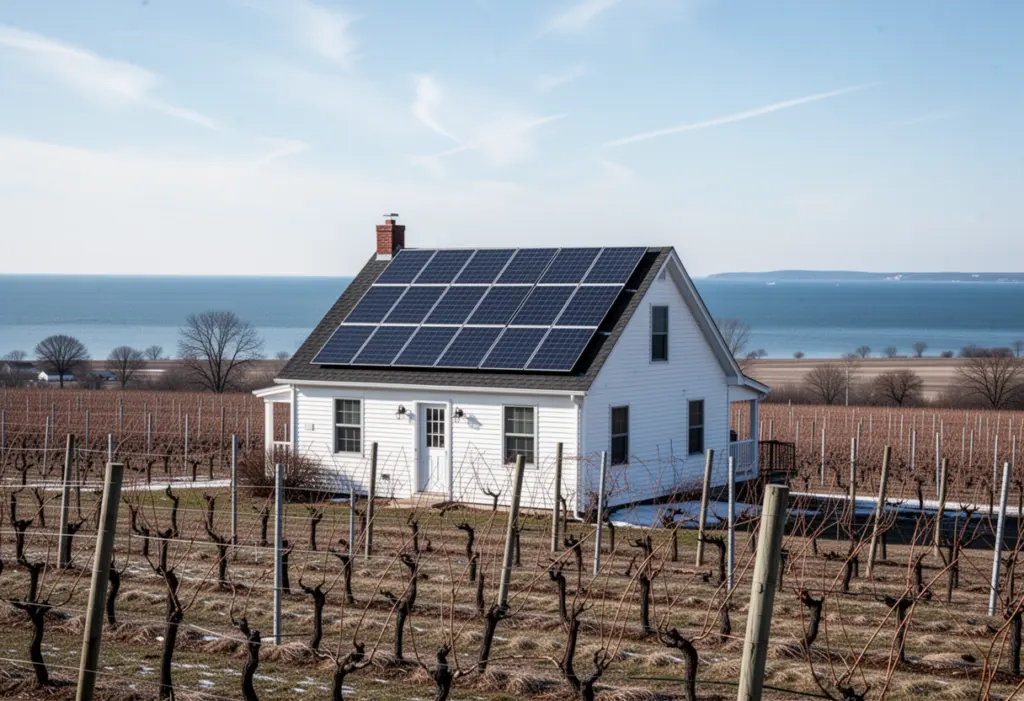
Westfield is a village in Chautauqua County, inside the Town of Westfield, on the Lake Erie grape belt between the shore and the escarpment. ZIP code 14787. Which incentives reach a Westfield address depends first on a question most guidance never asks, and second on how large the array is.
The village runs its own electric department
Westfield is one of New York’s municipal electric communities, which places a village customer outside Public Service Commission jurisdiction. It is worth reading as a gain and a loss rather than as bad news. What you lose: the Phase One net metering structure that credits exports at the full retail rate and holds for twenty years is a Commission construct rather than a commitment the village utility has made, and the standardised state interconnection process — its application, its timetable, its fees — is replaced by whatever the village has set. What you gain: the Customer Benefit Contribution is not levied on you at all. That last point has a practical edge, because a proposal generated from a statewide template can still carry the charge as a line item, so read the quote and check whether yours does.
Ask the utility directly, in writing, whether exports are credited and at what rate against what you pay, whether credits roll forward or expire at a true-up, what interconnection costs and how long it takes, and whether the system size you may install is capped against your own usage. Your bill names the utility; addresses in the surrounding town outside the village line may be on an investor-owned utility, where every state rule above does apply.
Which incentives do not care who sells you electricity
The New York State credit is a tax matter, so it is unaffected: 25% of qualified expenditure capped at $5,000, claimed on Form IT-255, for equipment installed and used at your principal residence in this state, reaching purchases and also leases and power purchase agreements of ten years or more, and limited by your actual state tax liability with unused credit carrying forward for five years. The state sales tax exemption on residential solar equipment applies too, with localities free to elect separately on their own share. And RPTL 487 exempts the added value of the system from real property tax for fifteen years, subject to four independent decisions — the Village of Westfield, the Town of Westfield, Chautauqua County, and your school district, which opts out by resolution rather than local law — and to construction completed before 1 January 2030.
The one to confirm in writing before it is priced in
NY-Sun is a NYSERDA programme that was delivered as a reduction on your contractor’s price, and the Affordable Solar incentive for households at or below 80% of area median income worked the same way. As of September 2026 NYSERDA has no open NY-Sun block for homes in any utility territory; check NYSERDA’s NY-Sun dashboard for a new one. If one opens, do not assume a municipal electric address is inside it: get written confirmation from the contractor that it is available at your address before a proposal is built on it. Until then, ask any contractor whose proposal shows a NY-Sun or Affordable Solar deduction to name the open block it relies on, in writing.
Open land, larger arrays, and where the $5,000 cap starts to bite
The grape belt is agricultural country, and on a parcel with room a ground mount is a genuine choice rather than a fallback: orientation and tilt are selected instead of inherited, the roof-age question disappears, and snow clearing happens at standing height. Ask early about setbacks, site plan review, foundation depth relative to frost, clearance beneath the lowest row, and the trench run back to the house, and weigh the value of the land the array takes out of production.
Size is where the state credit changes character. Because it is capped at $5,000 it covers 25% of a $20,000 job and about 14% of a $35,000 one, so on a large ground mount the cap binds long before the percentage does, and a proposal presenting “25% back from the state” on a big array is describing a rate you will not receive. Weigh that against what the array is actually for, because an array behind a farm business meter is not equipment at your principal residence and Form IT-255 is not the instrument for it. The same distinction reaches the running charge: the 2026 Customer Benefit Contribution rates for small commercial accounts are not the residential ones, and on NYSEG the small commercial rate of $1.14 per kW-month is below the $1.19 residential figure, while on National Grid it is higher, at $1.38 against $0.97.
What a town address pays that a village address does not
Outside the village on an investor-owned utility, the Customer Benefit Contribution is charged monthly on DC system size for anyone interconnecting on or after 1 January 2022, on capacity rather than output, and recalculated annually. A 9 kW system pays $8.73 a month on National Grid and $10.71 on NYSEG, about $105 and $129 a year. A 14 kW ground mount pays $13.58 and $16.66, roughly $163 and $200 a year. Community solar subscribers pay nothing at all under this heading, and community solar needs no roof, which matters on a shaded lot or a rented property.
The escarpment, the lake, and one credit that ended
Wind exposure on the open lake plain is real, so ask what design wind speed and exposure category the racking is certified to, and ask separately about ground snow load, because the higher ground of the escarpment takes heavy lake-effect accumulation. Snow guards belong wherever an array can shed onto a door or a path, and the production estimate should state what snow-cover assumption it used.
Finally, the federal credit. Section 25D was terminated for expenditures made after 31 December 2025, and the statute treats the expenditure as made when the original installation is completed, not when the system is inspected, approved or switched on. A homeowner buying in 2026 therefore claims nothing federally, and any 2026 proposal still carrying a 30% federal line is materially wrong. Every programme above can change, so verify the current position before you commit.
Frequently Asked Questions
Is the Customer Benefit Contribution charged on a village of Westfield address?
No. The village runs its own electric department and municipal customers sit outside Public Service Commission jurisdiction, so the charge is not levied. A quote generated from a statewide template can still show it, so check the line items.
Which solar incentives still reach a Westfield homeowner?
The New York credit of 25% capped at $5,000 on Form IT-255 is a tax matter and does not depend on your utility, as is the state sales tax exemption. RPTL 487 depends on the village, town, county and school district each separately not having opted out.
Is NY-Sun available on a municipal electric address?
Not for a home at present, whatever the utility. As of September 2026 NYSERDA has no open NY-Sun block for homes in any utility territory; check NYSERDA’s NY-Sun dashboard for a new one. If one opens, do not assume a municipal electric address is inside it, and get written confirmation that it is available at your address before a proposal is priced around it.
Does the state credit still return 25% on a large ground mount?
No. The $5,000 cap binds above roughly $20,000 of qualified expenditure, so a $35,000 array receives about 14% rather than 25%. An array behind a farm business meter is outside Form IT-255 altogether, and small commercial utility rates differ from residential ones.
This article is general information, not tax, legal or financial advice. Incentive amounts, eligibility rules and deadlines change and depend on your utility, your tax situation and your property. Confirm current terms with NYSERDA, your utility and a qualified tax professional before making a decision.
NY Solar Incentives
Independent New York solar research. We summarise NYSERDA, NY-Sun and federal programme rules from published sources and state plainly when a figure is an estimate. We are not a government agency and do not sell equipment.
Run the arithmetic on your own system
Check the dated program table and your arrangement before counting an incentive. Standard residential NY-Sun blocks are closed; Long Island Affordable Solar has a conditional income-verification route. The NY credit depends on qualified costs and tax liability, while the NYC abatement reduces future property-tax bills. The estimator keeps those timings separate.