Solar Panel Installation in Salamanca, NY
Two things make Salamanca unlike anywhere else in New York for a solar project: a municipal electric utility, and land tenure that is not the standard arrangement.
On this page 6 sections
- 01First assumption: that the Public Service Commission sets your terms
- 02Second assumption: that the land under the house is held the usual way
- 03What a neighbour on an investor-owned utility pays
- 04Permits, ridges and snow
- 052026 incentives, and the ten-year rule that catches third-party offers
- 06Frequently Asked Questions
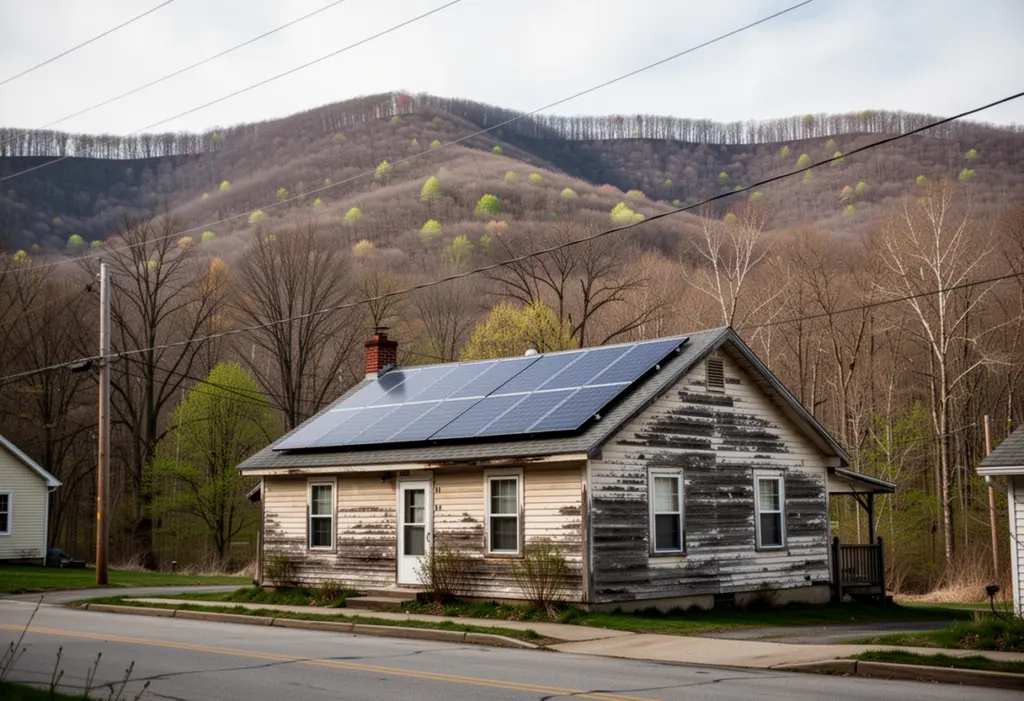
Salamanca is a city in Cattaraugus County on the Allegheny River beside Allegany State Park. ZIP code 14779. Two assumptions sitting underneath almost every article about New York solar are untrue at this address, so the order of the questions has to change.
First assumption: that the Public Service Commission sets your terms
It does not, because Salamanca is served by its own municipal electric utility, and municipal utilities sit outside Commission jurisdiction. Three questions make the shape of it clear. Is the twenty-year Phase One net metering structure, which credits exports at the full retail rate, available to you? No, because that is a Commission construct. Do you pay the monthly Customer Benefit Contribution on the DC size of your array? No, because that charge reaches investor-owned utility customers rather than municipal ones. Does the standardised state interconnection process, with its published timetable and fees, apply? No; the application, the cost and the elapsed time are whatever the city utility has set.
So the terms are local, and the source for them is the utility rather than an installer working from a statewide script. Get answers in writing on whether exports are credited and at what rate against the rate you pay, whether credits roll forward or expire at an annual true-up, what the interconnection application costs and how long it really takes, whether system size is capped against your own consumption, and whether a generating customer picks up a standby or minimum charge. Your own bill proves which utility you are on: Little Valley nearby is municipal too, while addresses elsewhere in the county are on National Grid or NYSEG, where the state rules do apply.
Second assumption: that the land under the house is held the usual way
Salamanca lies within the Allegany Territory of the Seneca Nation, and land tenure in the city is not the arrangement a homeowner elsewhere in New York would recognise, with a great many properties held under lease. This site does not attempt to tell you what governs your particular parcel, and neither should an installer working from a template. Confirm requirements locally and get the answers in writing before you sign an installation contract. Worth putting: which authority actually approves the work at your address and in what order, including the Nation’s own offices alongside the city; whether anyone besides you has to consent before a fixed improvement is attached; how a permanent improvement is treated at the end of a lease term, against a system with a design life measured in decades; and how the state tax credit and the RPTL 487 exemption interact with your form of tenure, which is a question for a tax professional familiar with the territory rather than for a salesperson. None of this argues against solar here. It argues against running the standard sequence and hoping.
What a neighbour on an investor-owned utility pays
Elsewhere in Cattaraugus County the Customer Benefit Contribution is billed monthly against DC system size for anyone interconnecting on or after 1 January 2022, on capacity rather than output, and reset each year. A modest 4 kW array costs $3.88 a month at National Grid’s 2026 residential rate of $0.97 per kW-month, about $47 a year, and $4.76 at NYSEG’s $1.19, about $57. A 10 kW array costs $9.70 and $11.90 a month, roughly $116 and $143 a year. Community solar subscribers pay none of it wherever they live, because those projects sit in front of the meter.
Permits, ridges and snow
The City of Salamanca and the separate Town of Salamanca run their own building departments, so establish which covers your parcel — alongside the tenure question above, not instead of it. The forested Allegany ridges close in on the southern side of the valley, and a ridge line removes production in exactly the months a credit balance is being spent down, so insist on an on-site assessment that measures the horizon rather than a satellite estimate, and ask for monthly figures rather than an annual total. This is snow country at elevation as well: ask what ground snow load the racking, the attachments and the roof structure are rated for, whether a structural letter is required, whether snow guards are needed where the array discharges over a door or a path, and what snow-cover assumption sits inside the production estimate. On a rural parcel a ground mount is a real option, with clearance under the lowest row and a frost-depth foundation among the first things to price.
2026 incentives, and the ten-year rule that catches third-party offers
Where tenure is unusual, third-party ownership gets pitched hard: a lease or a power purchase agreement, with the panels owned by someone else. New York’s credit does reach those arrangements, which the dead federal credit never did, but the conditions are exact. The agreement has to run for at least ten years, and that minimum applies to a lease just as it applies to a PPA, so a five- or seven-year lease earns nothing. On an agreement running beyond fifteen years, no credit is allowed after the fifteenth year even if the $5,000 has not been exhausted. The $5,000 is a lifetime ceiling for the agreement rather than an annual figure, and IT-255 makes you subtract what you claimed for it in earlier years. The annual mechanic differs too: on a PPA the credit is 25% of that year’s payments, while on a lease it is the payments made that year capped by 25% of the total contracted payments or $5,000, whichever is less. A flat “25% back” describes the PPA and not the lease. In every case the equipment has to serve your principal residence in New York State.
Alongside it: the state sales tax exemption on residential solar equipment, and RPTL 487’s fifteen-year exemption on the added value, which needs the city or town, Cattaraugus County and your school district each separately not to have opted out and construction complete before 1 January 2030. NY-Sun and its Affordable Solar incentive for households at or below 80% of area median income used to be applied by the contractor as well. As of September 2026 NYSERDA has no open NY-Sun block for homes in any utility territory; check NYSERDA’s NY-Sun dashboard for a new one. If one opens, and in municipal electric territory above all, hold written confirmation that it is available at your address before a proposal is priced around it.
Federally there is nothing. Section 25D was terminated for expenditures made after 31 December 2025, with the expenditure treated as made when the original installation is completed, so a 2026 buyer claims no federal credit at all. What survives is the business-side credit belonging to whoever owns a leased or PPA system, which is one reason those offers still look the way they do. Programmes change, so check the current position before you sign.
Frequently Asked Questions
Who sets the export credit rate in Salamanca?
The city's own municipal electric utility, because municipal utilities sit outside Public Service Commission jurisdiction. Phase One net metering, the Customer Benefit Contribution and the standardised state interconnection process all belong to the investor-owned side. Ask the utility in writing for its own terms.
Does land tenure affect a solar project in Salamanca?
It can, and it is not the standard New York arrangement. The city sits within the Allegany Territory of the Seneca Nation and many properties are held under lease. Confirm locally which approvals apply, who must consent, and how a fixed improvement is treated at the end of a term.
Does a solar lease or PPA qualify for the New York credit?
Only where the agreement runs ten years or more, and the $5,000 is a lifetime ceiling for that agreement rather than an annual figure. Beyond fifteen years no credit is allowed after the fifteenth year. On a lease the annual amount is the payments made that year, capped by 25% of total contracted payments or $5,000, whichever is less.
What do the hills do to production?
The forested Allegany ridges sit close to the south side of the valley, and the low December sun means a ridge can cut output in the months a credit balance is being drawn down. Insist on an on-site horizon measurement and monthly figures rather than an annual total.
This article is general information, not tax, legal or financial advice. Incentive amounts, eligibility rules and deadlines change and depend on your utility, your tax situation and your property. Confirm current terms with NYSERDA, your utility and a qualified tax professional before making a decision.
NY Solar Incentives
Independent New York solar research. We summarise NYSERDA, NY-Sun and federal programme rules from published sources and state plainly when a figure is an estimate. We are not a government agency and do not sell equipment.
Run the arithmetic on your own system
Check the dated program table and your arrangement before counting an incentive. Standard residential NY-Sun blocks are closed; Long Island Affordable Solar has a conditional income-verification route. The NY credit depends on qualified costs and tax liability, while the NYC abatement reduces future property-tax bills. The estimator keeps those timings separate.