Solar Panel Installation in Lake Placid, NY
Lake Placid has its own municipal electric utility and sits inside the Adirondack Park, so two of the rules every general New York solar guide relies on do not apply here.
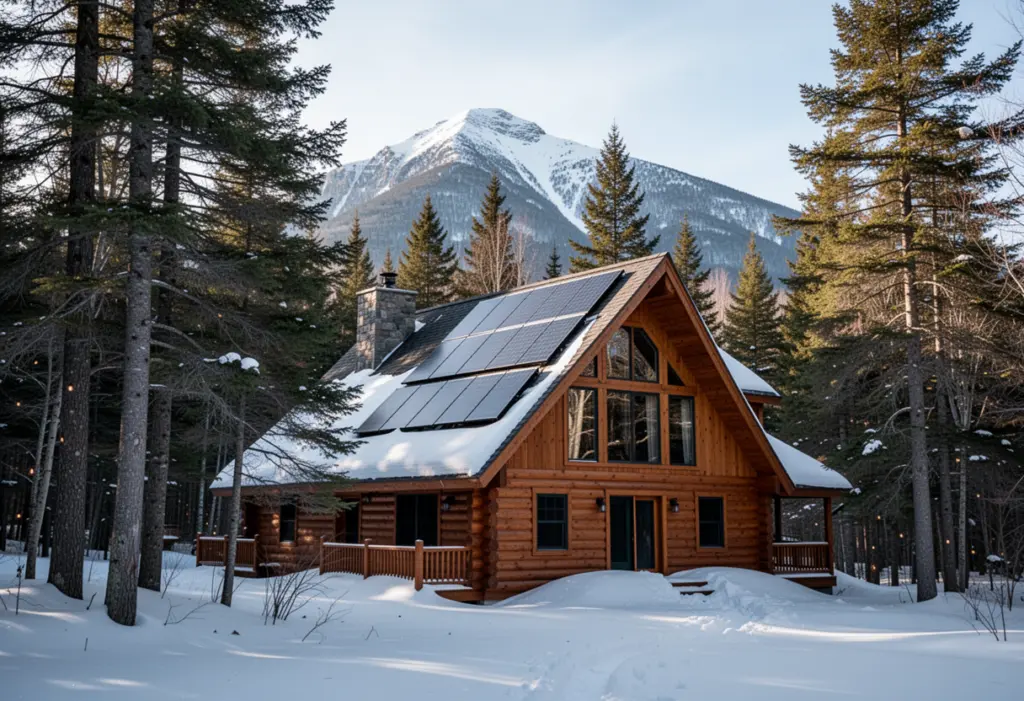
Lake Placid is a village in the Town of North Elba, Essex County, in the high peaks of the Adirondack Park. ZIP code 12946. Two local facts govern a solar project here, and a quote that does not deal with both of them was written for somewhere else.
The village supplies its own electricity
Lake Placid Municipal Electric serves the village, rather than one of the seven investor-owned utilities that New York’s net metering and Customer Benefit Contribution rules were drafted around. A municipal system sits outside Public Service Commission jurisdiction, and the practical effect is that three of the things a general New York solar page states as fact are, on your account, open questions.
Export credit is the first. Phase One net metering — full retail value for exports, held for 20 years from interconnection — exists because the Commission created it, so what a municipal utility pays for the kilowatt-hours you send back is set by the utility and by nobody else. The Customer Benefit Contribution is the second: that monthly per-kW charge belongs to the seven large utilities and forms no part of a municipal tariff. Interconnection is the third, and usually the one that moves a schedule — the application, the fee, the equipment requirements, any size limit and the timeline are all the department’s own rather than a standardised state process.
Put those questions to the utility in writing, then check that the quote in front of you was built on the answers rather than on a template. Confirm from your own bill too: a municipal boundary is not a postal one, property beyond the village line can be on a different supplier, nearby Tupper Lake is also municipal, and the surrounding territory mixes National Grid and NYSEG, whose 2026 residential Customer Benefit Contributions are $0.97 and $1.19 per kW-month respectively.
The number you are not paying
Knowing what a National Grid neighbour pays tells you which lines on a borrowed proposal have nothing to do with your house. The 2026 residential Customer Benefit Contribution on National Grid is $0.97 per kW-month of DC capacity, the lowest residential figure published in New York for the year — $9.22 a month on a 9.5 kW system, about $111 a year, and $13.58 on 14 kW, about $163. A municipal customer sits outside that charge. If a proposal for a Lake Placid address carries a CBC line, whoever wrote it did not check the supplier, which is fair grounds to ask what else was assumed.
Inside the Park
The Adirondack Park Agency has jurisdiction alongside the Village of Lake Placid and the Town of North Elba. For a flush rooftop array on an existing house this is an ordinary process rather than an obstacle, but it is a real step with a real calendar, and installers from outside the region routinely leave it out of a schedule.
The reason that can cost money rather than patience: incentives end on set dates, so a project held past one can be completed on different terms from the ones it was quoted on. The federal credit ended at exactly such a boundary on 31 December 2025, and RPTL 487 reaches only systems constructed before 1 January 2030. NY-Sun, which used to step down as regional capacity blocks filled, has no block open for homes at all as of September 2026. Ask for the Agency step to appear in the written schedule and ask how many projects the installer has finished inside the Park. Ground mounts and tree clearing draw more scrutiny than a flush roof array, so raise either at the first conversation.
Snow load in the high peaks
This is among the coldest and snowiest places in New York, and the array has to be specified for that rather than adapted to it afterwards.
- Get the ground snow load rating in pounds per square foot for the racking, the attachments and the roof structure. Equipment chosen for a generic New York installation may not reach it here.
- Expect a structural engineer’s letter more often than elsewhere in the state, and put it in the budget from the start.
- Treat snow guards as safety hardware. Panels are slicker than shingle and a full array releases as a slab; over an entrance, a porch roof or a parking area that is a hazard, and the steep Adirondack rooflines common here make a release more likely rather than less.
- Interrogate the snow-cover assumption in the production estimate. A forecast that ignores the weeks an array spends buried will not survive contact with a January in the high peaks.
- Ask where the inverter and any battery will live and what the manufacturer’s low-temperature specification says about it.
Terrain, trees and seasonal use
The high peaks cut the southern horizon far earlier in the afternoon than flat-country modelling assumes, and mature pines finish the job. Insist on an on-site shading assessment rather than a satellite estimate, and ask what the model returns for December and January specifically instead of only the annual total.
Seasonal use matters as well. Second homes and short-term rentals are common in a resort village, and New York’s credit on Form IT-255 requires your principal residence in the state — a seasonal or second property does not qualify. Establish that before a proposal is built around the credit.
2026: the ten-year rule, if you are not buying outright
Because the federal credit that used to reward outright purchase has ended, third-party arrangements look more attractive in 2026 than they did — and New York’s credit does reach them, but only on specific terms. It applies to a lease of at least ten years and to a written agreement of at least ten years to buy the power generated by equipment you do not own. The ten-year minimum governs the lease exactly as it governs the power purchase agreement, so a five-year or seven-year lease qualifies for nothing at all, however the paperwork is presented.
Three mechanics sit behind that. On an agreement running beyond 15 years, no credit is allowed after the fifteenth year even if the $5,000 has not been exhausted. The $5,000 is a lifetime ceiling for the agreement rather than an annual allowance. And the annual calculation differs: on a PPA it is 25% of that year’s payments, while on a lease it is the payments made that year, capped by 25% of the total contracted payments or by $5,000, whichever is smaller.
The remaining measures are tax and NYSERDA rules rather than utility rules, so a municipal supply does not decide them — confirm each for your own address rather than assuming. NY-Sun and its income-tested Affordable Solar incentive used to be applied by the contractor as a price reduction. As of September 2026 NYSERDA has no open NY-Sun block for homes in any utility territory; check NYSERDA’s NY-Sun dashboard for a new one. The state sales tax exemption covers residential solar equipment. RPTL 487 exempts added property value for 15 years where the village, the Town of North Elba, Essex County and your school district have each separately declined to opt out, for systems constructed before 1 January 2030.
The federal credit is not partially available and it is not coming back. Section 25D was terminated for expenditures made after 31 December 2025, and completion of the original installation is what determines when an expenditure was made, so a 2026 proposal showing 30% is wrong by the whole of that line. Confirm the live position with NYSERDA and the New York State Department of Taxation and Finance before you sign.
Frequently Asked Questions
Does New York net metering apply in Lake Placid?
No. The village is served by a municipal electric utility outside Public Service Commission jurisdiction, so Phase One net metering does not govern it. What you receive for exported power is set by the utility and has to be obtained from it directly.
Do I pay the Customer Benefit Contribution here?
No. It belongs to the seven investor-owned utilities and forms no part of a municipal tariff. For comparison, a National Grid neighbour pays $0.97 per kW-month for 2026, about $111 a year on a 9.5 kW system.
Does the Park Agency slow a rooftop project down?
It adds a step with a real calendar. The review itself is ordinary for a flush array on an existing house, but out-of-region installers routinely leave it out of the schedule, and a project held past a deadline can finish on different terms, as the end of the federal credit on 31 December 2025 showed.
Does a solar lease qualify for the New York credit?
Only at ten years or longer, and the same minimum applies to a power purchase agreement. Beyond fifteen years no credit is allowed after the fifteenth year, and the $5,000 is a lifetime ceiling for that agreement rather than an annual allowance.
This article is general information, not tax, legal or financial advice. Incentive amounts, eligibility rules and deadlines change and depend on your utility, your tax situation and your property. Confirm current terms with NYSERDA, your utility and a qualified tax professional before making a decision.
NY Solar Incentives
Independent New York solar research. We summarise NYSERDA, NY-Sun and federal programme rules from published sources and state plainly when a figure is an estimate. We are not a government agency and do not sell equipment.
Run the arithmetic on your own system
Check the dated program table and your arrangement before counting an incentive. Standard residential NY-Sun blocks are closed; Long Island Affordable Solar has a conditional income-verification route. The NY credit depends on qualified costs and tax liability, while the NYC abatement reduces future property-tax bills. The estimator keeps those timings separate.