Solar Incentives in Saranac Lake, NY
Saranac Lake sits inside the Adirondack Park, where seasonal and second-home property is common, and both facts decide which 2026 incentives a household can actually use.
On this page 7 sections
- 01Is the house the one you actually live in?
- 02Park review, and why timing is an incentive question
- 03Which municipality, which county, which district
- 04What survives in 2026
- 05What the utility does and does not charge
- 06Two design questions that belong in the same conversation
- 07Frequently Asked Questions
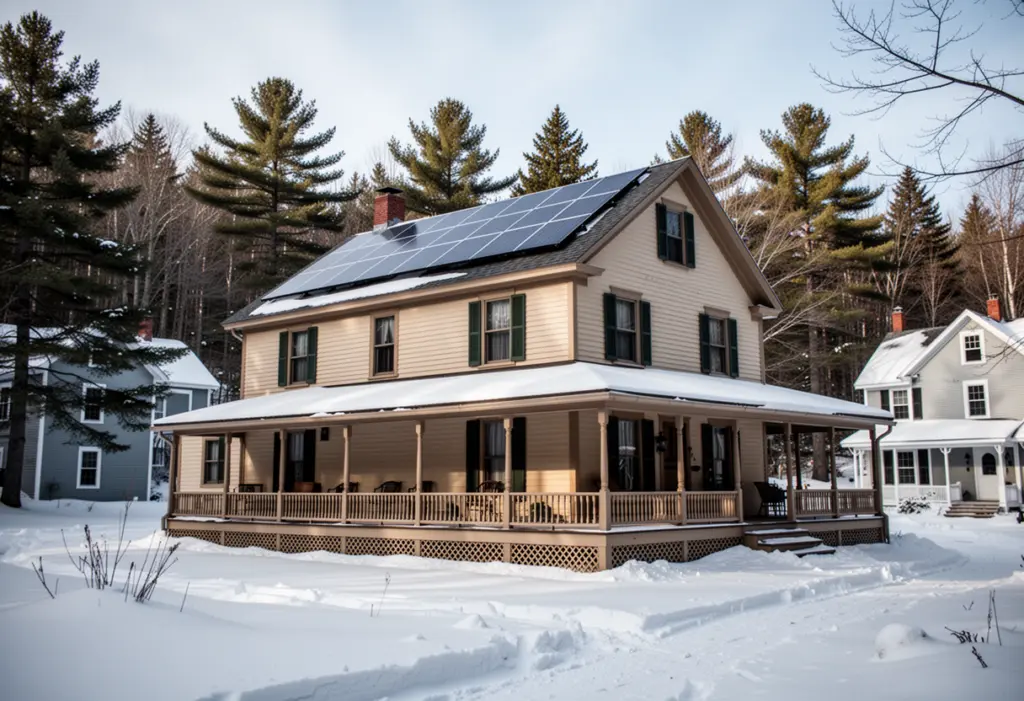
Saranac Lake is a village in the Adirondack Park, and it is unusual even by North Country standards: it straddles Franklin and Essex Counties and lies across the towns of Harrietstown, St Armand and North Elba. ZIP code 12983. That geography is not trivia. It decides which authorities you deal with and, in one important case, which incentives you can claim at all.
Is the house the one you actually live in?
New York’s 25% solar credit, capped at $5,000 on Form IT-255, requires the equipment to be installed and used at the taxpayer’s principal residence in New York State. A seasonal camp, a second home or a rental does not qualify — and in a village where a substantial part of the housing stock is exactly that, this is the most consequential sentence on the page.
Three things follow from it:
- If the property is not where you live, the state credit is simply not in your arithmetic. A proposal that shows it anyway has not asked the question, which is a reason to look hard at everything else on the same document.
- Even on a principal residence, the usable amount is a question about your tax return. The credit is bounded by your actual New York State tax liability and it is not refundable, though unused amounts carry forward for up to five years — that changes the timing of the benefit rather than removing it.
- It reaches leases and power purchase agreements of at least ten years as well as purchases. The ten-year minimum applies to a lease exactly as it does to a PPA.
If the house is a camp or a second home, the useful conversation is about the other measures on this page, several of which do not turn on residency at all.
Park review, and why timing is an incentive question
Saranac Lake lies inside the Adirondack Park, so the Adirondack Park Agency has jurisdiction alongside the village and the town. For a rooftop array on an existing house the process is ordinary. The risk it carries is schedule, and schedule is where incentives are lost.
NY-Sun ran as regional megawatt blocks: each region had capacity blocks and the per-watt incentive stepped down as each one filled, by design, because the programme was meant to phase out as the market matured. For homes it has now run out. As of September 2026 NYSERDA has no open NY-Sun block for homes in any utility territory; check NYSERDA’s NY-Sun dashboard for a new one. Timing still matters for what is left. Add a review that an out-of-region installer never planned for and a project quoted under one set of conditions can be finished under another. The federal credit died at exactly such a boundary — section 25D was terminated for expenditures made after 31 December 2025, with the expenditure treated as made when the original installation is completed. Nothing about a delay in this village is neutral. Ask the installer to put the Agency step into the written schedule, and ask how many projects they have completed inside the Park.
Which municipality, which county, which district
RPTL 487 exempts the added property value of a solar system for 15 years, but only where the municipality, the county and the school district have each separately declined to opt out — a county, city, town or village opts out by local law, a school district by resolution. Because this village spans two counties and three towns, the first job is not checking the exemption but establishing which set of bodies your parcel actually answers to. Do that from the tax bill, then check all three. Section 487 also requires the system to be constructed before 1 January 2030.
What survives in 2026
Any 2026 proposal still carrying a 30% federal line is materially wrong, and the net cost it presents does not exist. What is genuinely available:
- New York’s 25% credit, capped at $5,000, on Form IT-255 — principal residence only, bounded by your state tax liability.
- The sales tax exemption: no 4% state sales tax is added on residential solar equipment. Whether local sales tax is added depends on the county your parcel is in: Essex County exempts its share, while Franklin County still charges its own 4% (Publication 718-S).
- RPTL 487, subject to the three separate opt-out checks above.
Not on that list: NY-Sun. Its per-watt incentive and the income-tested Affordable Solar addition used to reach you through the contractor as a reduction on the price. The last standard upstate residential block (Block 14, $0.15/W, NYSEG, RG&E and National Grid territories) closed on 17 December 2025, and the upstate Affordable Solar block for income-qualified households closed on 9 March 2026. As of September 2026 NYSERDA has no open NY-Sun block for homes in any utility territory.
What the utility does and does not charge
Most of the area around the village is served by National Grid, but confirm it from your own bill. Franklin and Essex Counties both contain NYSEG territory, whose 2026 residential Customer Benefit Contribution is $1.19 per kW-month against National Grid’s $0.97, and neighbouring Lake Placid and Tupper Lake each run a municipal electric utility. A municipal customer is outside state net metering, outside the Customer Benefit Contribution and outside the standardised state interconnection process, and has to obtain terms from the utility directly.
On a National Grid account the figure is $0.97 per kW-month of DC capacity for 2026, the smallest residential number on this year’s table. That is $4.85 a month for a 5 kW system, roughly $58 across a year, and $8.25 for 8.5 kW, roughly $99. It reaches anything interconnected from 1 January 2022 onward, it is reset each year rather than locked at interconnection, and it sits against Phase One net metering, which values exports at the full retail rate for two decades.
Two design questions that belong in the same conversation
No incentive survives a badly specified array. Ask what ground snow load the racking, attachments and roof structure are rated for — this is among the snowiest parts of New York and a structural engineer’s letter is common here — and ask where a loaded array would release, because the deep-porched older houses in this village frequently put a doorway directly beneath the eave, which is what snow guards exist for.
Then ask what the production model assumes about the surrounding ridges and pines. They cut the southern horizon far earlier in the afternoon than a satellite estimate suggests, and the afternoons they take are winter ones. Incentive programmes move as well, so confirm the current position with NYSERDA and the New York State Department of Taxation and Finance before you sign anything.
Frequently Asked Questions
Can I claim the New York credit on a camp or second home?
No. Form IT-255 requires the equipment to be installed and used at your principal residence in New York State, so a seasonal camp, a second home or a rental does not qualify. A proposal showing the credit on such a property has not asked the question.
Does the Adirondack Park Agency have to approve rooftop solar?
It has jurisdiction alongside the village and town, and for a rooftop array on an existing house the process is ordinary. The exposure is schedule: out-of-region installers routinely fail to plan for it, and a delay can carry a project past a deadline, as the end of the federal credit on 31 December 2025 showed.
How do I check the property tax exemption here?
First establish which bodies your parcel answers to, since the village spans Franklin and Essex Counties and three towns. Then check the municipality, the county and the school district separately, because any of them can have opted out of RPTL 487.
Does a ten-year lease qualify for the state credit?
Yes. The ten-year minimum applies to a lease exactly as it does to a power purchase agreement, so an agreement of at least ten years qualifies and a shorter one does not, whatever a sales document says.
This article is general information, not tax, legal or financial advice. Incentive amounts, eligibility rules and deadlines change and depend on your utility, your tax situation and your property. Confirm current terms with NYSERDA, your utility and a qualified tax professional before making a decision.
NY Solar Incentives
Independent New York solar research. We summarise NYSERDA, NY-Sun and federal programme rules from published sources and state plainly when a figure is an estimate. We are not a government agency and do not sell equipment.
Run the arithmetic on your own system
Check the dated program table and your arrangement before counting an incentive. Standard residential NY-Sun blocks are closed; Long Island Affordable Solar has a conditional income-verification route. The NY credit depends on qualified costs and tax liability, while the NYC abatement reduces future property-tax bills. The estimator keeps those timings separate.