Solar Panel Installation in Potsdam, NY
Potsdam is a college village with a large rented housing stock, which makes the meter question decisive before anything about panels is worth discussing.
On this page 7 sections
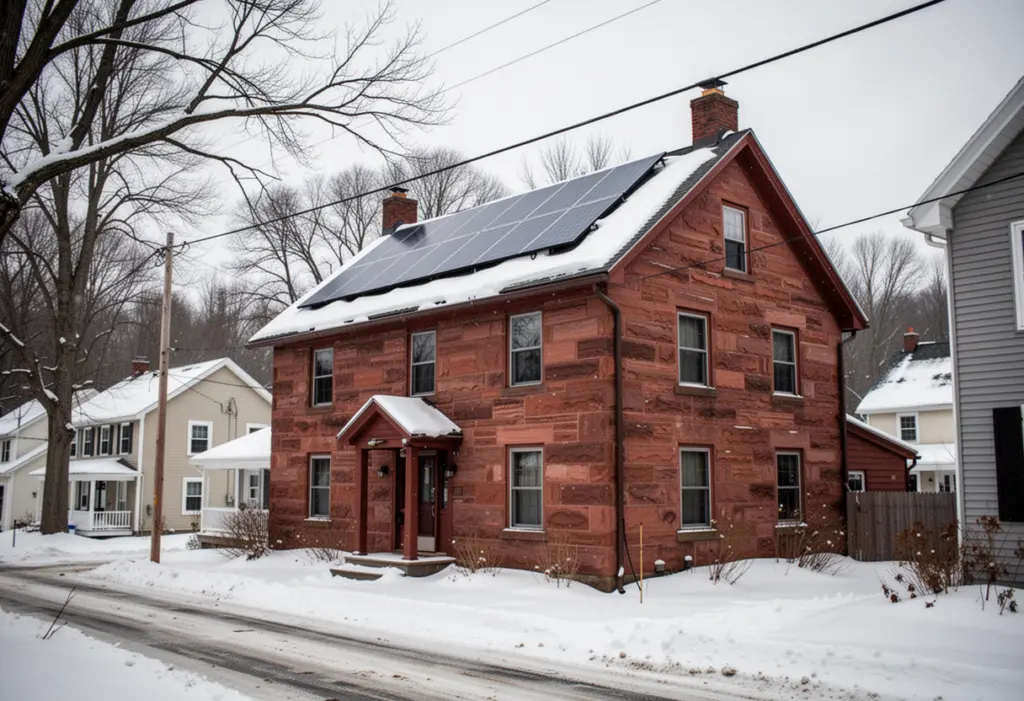
Potsdam is a village inside the Town of Potsdam, in St Lawrence County, on the Raquette River. ZIP code 13676. SUNY Potsdam and Clarkson University are both here, and the housing stock a college village produces decides more about a solar project than the roof pitch ever will.
Which meter is the array behind?
Rented, converted and multi-unit housing is ordinary here, and in that housing everything turns on one rule: a system reduces the consumption recorded by the meter it is wired behind, and no other. Three consequences follow from it.
- An array on a landlord’s meter offsets the landlord’s electricity — stair lighting, the boiler, the common areas — while an apartment sitting directly under the panels keeps billing exactly as it did before.
- On a converted house with separate meters, the design has to choose which meter the array serves, and reversing that choice later means re-wiring rather than re-configuring.
- If the property is not where you actually live, New York’s credit on Form IT-255 does not reach it: the equipment must be installed and used at your principal residence in New York State.
Settle those before a roof is measured, because none of them is a detail that can be fixed afterwards.
Village or town, and the sandstone streets
The Village of Potsdam and the Town of Potsdam permit separately and the village lies inside the town. Establish which office issues your building permit before anything is filed, and ask separately about the electrical inspection route.
Potsdam has a notable stock of local red sandstone buildings, and on those streets architectural review may run ahead of the building permit. Where it does, design for approval instead of appealing a refusal: keep the array off the elevation the public sees, choose all-black modules with black frames, mount flush to the roof plane rather than on tilted racking, and run conduit internally or paint what has to be exposed. Ask when the board sits, because a monthly meeting turns one missed deadline into four extra weeks.
Snow load, specified rather than assumed
This is one of the snowiest parts of New York. Ask what ground snow load the racking, the attachments and the roof structure are rated for and expect a figure rather than a reassurance; a structural engineer’s letter is called for more often here than in most of the state, so budget for one. Ask where the array releases, since panels shed as a slab and a porch, a doorway or a path underneath needs snow guards. And ask what snow-cover assumption is inside the production estimate — a model built on a downstate profile overstates a Potsdam winter, and the gap only shows up as a shortfall in your second February.
Roofs and service panels
Village housing runs old. Under roughly ten years of remaining shingle life, re-roof first, because removing and reinstalling a system later costs considerably more than mounting on bare deck. Standing-seam metal appears on the older houses and outbuildings and is the best case available anywhere: the racking clamps to the seams, nothing penetrates the covering, and the roof will usually outlast the modules. 100 amp service is common, where a solar breaker can require a panel upgrade or a line-side tap; have it priced in the quote rather than raised as a change order.
National Grid, and the utility check
Most of this area is served by National Grid, but confirm it from your own bill, because St Lawrence County also contains Massena, which runs a municipal electric utility whose customers are outside state net metering, outside the Customer Benefit Contribution and outside the standardised state interconnection process.
A National Grid account carries the Customer Benefit Contribution: $0.97 per kW-month of DC capacity for 2026, which is the cheapest residential rate in the state. Six kilowatts of array costs $5.82 a month, near enough $70 over a year, and nine kilowatts $8.73, near enough $105. Anything interconnected from 1 January 2022 onward pays it, the bill follows capacity rather than output, and the rate is republished each year. Phase One net metering is the counterweight — full retail value on exports, held for 20 years from interconnection.
2026: for most people in this village, community solar is the answer
A large share of the households here rent, or occupy a converted house whose roof belongs to someone else, or hold a meter the array could never be wired behind. For every one of them, the incentive that actually lands is community solar: a subscription to a share of an off-site array, credited against your own utility bill. There is no roof to qualify, no up-front cost, no landlord conversation and no roof-age question — and because community solar is a front-of-the-meter project, subscribers are outside the Customer Benefit Contribution entirely. For a student household or a tenant, it is the only route on this page that reaches the person who actually pays for the electricity.
If you own and occupy the house, the rest applies as normal: New York’s 25% credit capped at $5,000 on Form IT-255, which also reaches leases and power purchase agreements of at least ten years, limited by your state tax liability and carried forward up to five years; the state sales tax exemption; and RPTL 487, a 15-year exemption on added property value where the village, the town, St Lawrence County and your school district have each separately declined to opt out, for systems constructed before 1 January 2030. The exception is NY-Sun and its Affordable Solar incentive, which your contractor used to apply to the price. As of September 2026 NYSERDA has no open NY-Sun block for homes in any utility territory; check NYSERDA’s NY-Sun dashboard for a new one.
Nothing federal survives for a 2026 buyer. The 30% residential credit under section 25D reaches no expenditure made after 31 December 2025, with completion of the original installation as the operative date, so a quote carrying a federal line has not been rebuilt since the rule changed. Confirm the current position with NYSERDA before you sign, because these programmes move.
Frequently Asked Questions
I rent in Potsdam. Is solar available to me?
Not on the roof, in practice, because a system reduces the consumption on the meter it is wired behind and a landlord's array does not reach a tenant's apartment. Community solar credits the bill of whoever holds the account, needs no roof and no up-front cost, and carries no Customer Benefit Contribution.
Can I claim the state credit on a rental property I own here?
No. Form IT-255 requires the equipment to be installed and used at your principal residence in New York State, so a rental, seasonal or second property falls outside it whatever the system costs.
Village or Town of Potsdam for the permit?
They permit separately and the village lies inside the town, so establish which office holds your address before anything is filed. Ask about the electrical inspection route as a separate step, and about architectural review on the sandstone streets.
What does National Grid add to a Potsdam bill?
The Customer Benefit Contribution on DC capacity at $0.97 per kW-month for 2026 — $5.82 a month on 6 kW, about $70 a year, and $8.73 on 9 kW, about $105. Check your bill first, since Massena in the same county is municipal.
This article is general information, not tax, legal or financial advice. Incentive amounts, eligibility rules and deadlines change and depend on your utility, your tax situation and your property. Confirm current terms with NYSERDA, your utility and a qualified tax professional before making a decision.
NY Solar Incentives
Independent New York solar research. We summarise NYSERDA, NY-Sun and federal programme rules from published sources and state plainly when a figure is an estimate. We are not a government agency and do not sell equipment.
Run the arithmetic on your own system
Check the dated program table and your arrangement before counting an incentive. Standard residential NY-Sun blocks are closed; Long Island Affordable Solar has a conditional income-verification route. The NY credit depends on qualified costs and tax liability, while the NYC abatement reduces future property-tax bills. The estimator keeps those timings separate.