Solar Panel Installation in Massena, NY
Massena runs its own municipal electric utility, which puts it outside the state rules almost every New York solar guide is written about. That is the first thing to establish here.
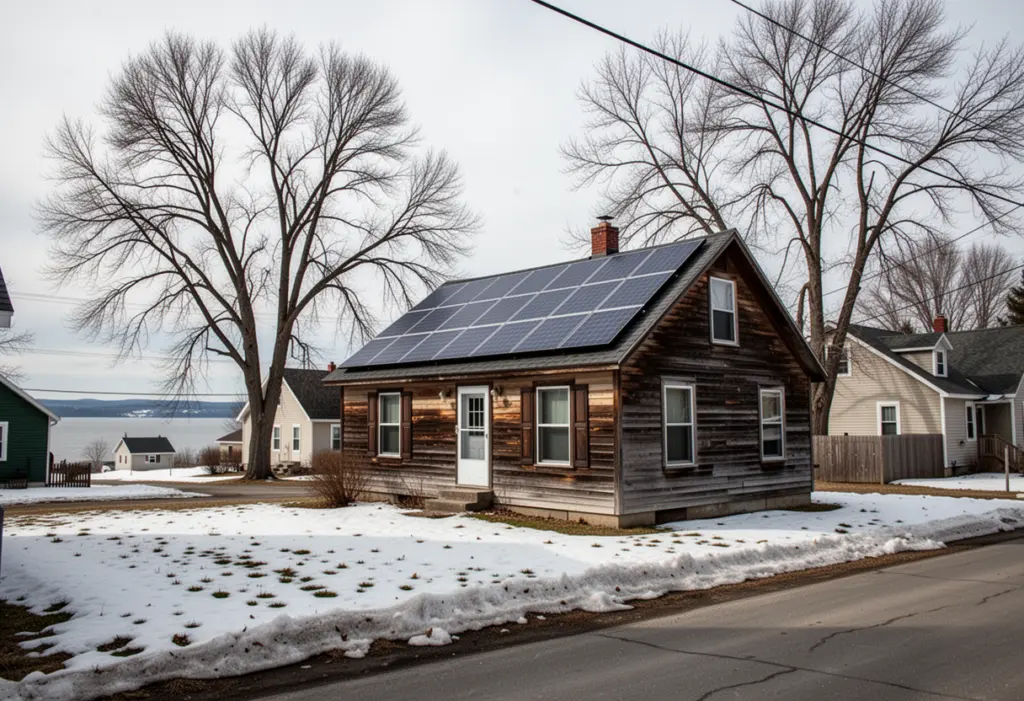
Massena is a village inside the Town of Massena, in St Lawrence County, on the south bank of the St Lawrence River. ZIP code 13662. Before any conversation about panels, roofs or payback, one local fact settles which body of rules governs your project at all.
Massena Electric Department is your utility
Power here comes from the Massena Electric Department, a municipal system, rather than from one of the seven investor-owned utilities that New York’s net metering and Customer Benefit Contribution rules were written around. Municipal utilities are outside Public Service Commission jurisdiction, and three of the assumptions a general New York solar guide makes therefore do not hold on your account:
- Export credit is a local decision, not a state one. Phase One net metering — retail-rate credit, locked for 20 years — is a PSC construct. What a municipal system pays for the kilowatt-hours you send back is whatever it has decided to pay.
- There is no Customer Benefit Contribution on your bill. That monthly per-kW charge is levied by the seven large utilities, and it is not part of a municipal tariff.
- Interconnection follows the department’s own procedure. The form, the fee, the equipment requirements, any size limit and the timeline all belong to the utility rather than to a statewide process.
None of that is bad news in itself. It means the terms have to be obtained rather than assumed, and that an installer whose experience is mostly in National Grid territory may hand you a model built on rules that do not govern your meter. Ask in writing what the department credits for exports, whether it caps system size, what the interconnection application requires and how long it takes — then check that the quote you have was built on those four answers.
Why a map will not answer this for you
Municipal service areas do not follow the lines a map draws. Elsewhere in the North Country, Tupper Lake, Rouses Point, Plattsburgh and Lake Placid all run systems of their own while most of the surrounding territory is National Grid, and property just beyond a village line can be on a different supplier from property just inside it. The name printed on your own bill is the only evidence worth relying on.
The charge you are not paying
It is worth knowing the figure you avoid, because it identifies which lines on a neighbour’s proposal have nothing to do with you. National Grid’s 2026 residential Customer Benefit Contribution is $0.97 per kW-month of DC capacity, the smallest residential number on this year’s table: $7.76 a month on an 8 kW system, roughly $93 a year, and $11.64 on 12 kW, roughly $140. A municipal customer sits outside that charge completely. If a proposal for a Massena address carries a CBC line, whoever prepared it never checked your supplier, and it is entirely fair to ask what else they assumed.
Village or town
The Village of Massena and the Town of Massena are separate permitting authorities. Find out which one issues the building permit for your address before an installer files, and treat the electrical inspection as its own step to be confirmed, since in most North Country municipalities it is handled separately from the building permit.
Cold is a hardware specification
This is among the coldest and snowiest corners of the state, and two different things follow from that. The structure has to be rated: ask what ground snow load the racking, the attachments and the roof itself are specified for, ask where a loaded array will release, since an array sheds as a slab and a doorway or walkway underneath needs snow guards, and ask what the production model assumes about snow cover. Then the electronics: ask where the inverter and any battery will be mounted and what the manufacturer’s low-temperature specification says, because an unheated garage in January is a real operating environment rather than a hypothetical one.
Distance, and old roofs
There are fewer installers up here than in the rest of New York, and a crew driving from Syracuse or Plattsburgh carries that travel inside its price. Ask where they are based, how many systems they have interconnected on a municipal utility, and what a warranty visit in January involves.
Roof age is the usual gate on the village housing stock: below roughly ten years of remaining shingle life, re-roof before the array goes on, because removing and reinstalling a system later costs considerably more than mounting on bare deck. 100 amp service is common, and fitting a solar breaker can require a panel upgrade or a line-side tap — get that priced inside the quote rather than after contract.
2026: RPTL 487 has four gates here
The state incentives are tax and NYSERDA rules rather than utility rules, so a municipal supply does not by itself decide any of them. The one that most deserves a specific enquiry in Massena is the property tax exemption, because of how the local government is layered.
RPTL 487 exempts the added value a solar system brings to a property from real property tax for 15 years. The exemption can be opted out of by a county, city, town or village by local law and by a school district by resolution — which for a village address here means four separate decisions to establish: the Village of Massena, the Town of Massena, St Lawrence County and your school district. Any one of them can have opted out, and none of them will tell you about the others. Section 487 also reaches only systems constructed before 1 January 2030.
The rest of the package: New York’s 25% credit capped at $5,000 on Form IT-255, for equipment at your principal residence in the state, reaching purchases as well as leases and power purchase agreements of at least ten years, limited by your state tax liability and carried forward for up to five years; and the state sales tax exemption on residential solar equipment. NY-Sun and its Affordable Solar incentive, which used to come off the contractor’s price, are not part of it for a home now. As of September 2026 NYSERDA has no open NY-Sun block for homes in any utility territory; check NYSERDA’s NY-Sun dashboard for a new one. If your proposal already contains a NY-Sun line, ask which open block it comes from.
There is no federal credit left for a homeowner buying a system, on any tariff. Congress closed section 25D to expenditures made after 31 December 2025, and the statute pins the date of an expenditure to the completion of the original installation rather than to the day the department changes your meter. Check the live position with NYSERDA and the New York State Department of Taxation and Finance before signing anything.
Frequently Asked Questions
Does New York net metering apply in Massena?
No. Power here comes from the Massena Electric Department, a municipal system outside Public Service Commission jurisdiction, so state Phase One net metering does not govern it. What you receive for exported kilowatt-hours is the department's own decision and has to be asked for.
Do I pay the Customer Benefit Contribution here?
No. That monthly per-kW charge is levied by the seven investor-owned utilities and is not part of a municipal tariff. A proposal for a Massena address showing a CBC line was written without checking who supplies you.
How do I establish which utility serves my address?
By reading the supplier name on your own bill. Municipal service areas do not follow the lines a map draws, and property just beyond a village boundary can be on a different supplier from property just inside it.
How many bodies have to be checked for the property tax exemption?
Four, for a village address: the Village of Massena, the Town of Massena, St Lawrence County and your school district. A county, city, town or village can opt out of RPTL 487 by local law and a school district by resolution.
This article is general information, not tax, legal or financial advice. Incentive amounts, eligibility rules and deadlines change and depend on your utility, your tax situation and your property. Confirm current terms with NYSERDA, your utility and a qualified tax professional before making a decision.
NY Solar Incentives
Independent New York solar research. We summarise NYSERDA, NY-Sun and federal programme rules from published sources and state plainly when a figure is an estimate. We are not a government agency and do not sell equipment.
Run the arithmetic on your own system
Check the dated program table and your arrangement before counting an incentive. Standard residential NY-Sun blocks are closed; Long Island Affordable Solar has a conditional income-verification route. The NY credit depends on qualified costs and tax liability, while the NYC abatement reduces future property-tax bills. The estimator keeps those timings separate.