Solar Panel Installation in Amsterdam, NY
Amsterdam is a dense hillside city on both banks of the Mohawk, with a great deal of two-family and rented housing. The meter question decides more here than the roof does.
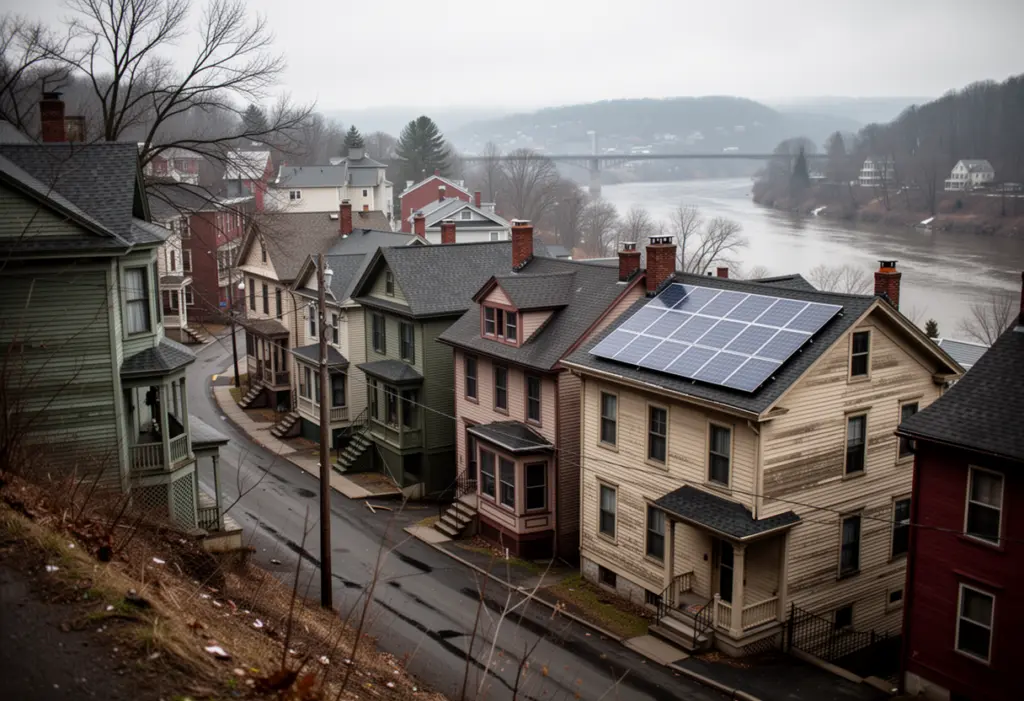
Amsterdam is a city in Montgomery County, built up the slopes on both banks of the Mohawk River, with a separate Town of Amsterdam around it. ZIP code 12010. The housing is dense, tall and largely from the mill era, and a great deal of it is two-family or rented. Those facts, rather than anything about sunshine, are what shape a solar project here.
Whose meter is the array behind?
A solar system reduces the consumption recorded by one meter and no other. On a two-family or rented property that single sentence decides the project, and it should be settled before anybody climbs a ladder.
Wire an array to the owner’s meter and it offsets the owner’s usage — hallway lighting, a shared boiler, the common areas — while a tenant’s apartment directly beneath the panels goes on billing exactly as before. Where the tenants hold their own meters, a roof array does nothing for their bills and nothing for the argument that solar lets the unit rent higher. Splitting production between two meters is not a wiring tweak, either; ask what it would actually take on your building before you assume it is on the table.
City or town
The City of Amsterdam and the Town of Amsterdam permit separately. City parcels are small, steep and old; town properties are frequently larger, flatter and open enough to make a ground mount a genuine option rather than a fallback. Establish which authority holds your address before anything is filed, and ask whether it works from New York’s Unified Solar Permit, the standardised residential form for systems of 25 kW DC and under.
Slopes, the river and the creek
Two pieces of geography matter. The slope comes first: a house cut into the hillside presents different heights front and back, which complicates access and staging, and a property below the crest of a ridge loses the low winter sun earlier in the afternoon than a level lot would.
Then the low ground along the river and the Chuctanunda Creek corridor, where mapped flood plain can apply. There the array is not the issue; the inverter, the disconnects, the meter and any battery are, because each normally has to clear a specified elevation. That commonly removes the basement as a battery location even when it is by far the most convenient place for one. Ask the building department what applies to your parcel before a layout is drawn.
Dense, tall, older housing
Closely built streets have three consequences worth naming separately.
First, a neighbour’s roofline can shade yours at the December sun angle even where nothing shades it in July. Insist on an on-site assessment and ask what the model returns for December and January.
Second, steep, tall, cut-up roofs are more expensive to work on and offer less usable plane than they appear to. Once fire-access pathways and setbacks are taken out of a small roof, the remainder can be what limits your system rather than your consumption does — ask which of the two is doing the limiting, because that changes how you should read the price.
Third, older construction raises the familiar three. Shingle with under roughly ten years left means re-roof first; older wood frame draws a structural engineer’s letter more often; and 100 amp service is common, where a solar breaker can force a panel upgrade or a line-side tap. Get all three answered inside the quote rather than after it.
National Grid, once you have confirmed it
Most of this area is National Grid, but the name on your own bill is the only evidence that matters. Municipal electric utilities are scattered through the Mohawk Valley and the counties around it — Ilion, Mohawk and Frankfort to the west, Richmondville down in Schoharie County — and their customers are outside Public Service Commission jurisdiction, which means no state net metering, no Customer Benefit Contribution and no standardised state interconnection process.
On a National Grid account the Customer Benefit Contribution applies to systems interconnected on or after 1 January 2022 at the 2026 residential rate of $0.97 per kW-month of DC capacity, the lowest residential rate in New York. A 4 kW array on a narrow city roof pays $3.88 a month, about $47 a year; a 9 kW array on a town property pays $8.73 a month, about $105. It is billed on capacity rather than production and recalculated annually, and Phase One net metering credits exports at the full retail rate for 20 years from interconnection.
2026: community solar is the answer this city needs most
Because so many roofs here are rented, shaded by the house next door or attached to a meter the occupant does not hold, the incentive that reaches the most Amsterdam households is the one that needs no roof at all. Community solar puts a subscriber on a share of an off-site array and credits their own utility bill. There is nothing to mount, nothing to pay up front, no roof-age question and no landlord conversation — and because these are front-of-the-meter projects, subscribers pay no Customer Benefit Contribution whatsoever. For a tenant, and for an owner whose tenants hold the meters, it is the route that actually reaches the person paying the bill.
If you do own and occupy the property, the rest of the package still applies: New York’s 25% credit capped at $5,000 on Form IT-255, which requires your principal residence in the state — a rental or second property is excluded even though the equipment is identical — and which reaches leases and power purchase agreements of at least ten years; the state sales tax exemption; and RPTL 487, a 15-year exemption on added property value where the city or town, Montgomery County and your school district have each declined to opt out, for systems constructed before 1 January 2030, claimed by filing form RP-487 with the assessor by the taxable status date. NY-Sun and its Affordable Solar block for lower-income households are no longer on the list: as of September 2026 NYSERDA has no open NY-Sun block for homes in any utility territory; check NYSERDA’s NY-Sun dashboard for a new one.
Ask any 2026 proposal where its federal line comes from, because there is not one. Section 25D stopped at expenditures made after 31 December 2025, with completion of the original installation as the operative date. These programmes are not permanent either: NYSERDA publishes the live NY-Sun position and the Department of Taxation and Finance publishes the credit rules, so read both before you commit to anything.
Frequently Asked Questions
I own a two-family here. Will solar cut my tenants' bills?
Only if the array sits behind their meter. A system reduces the consumption recorded by one meter, so an owner-side array covers hallways, a shared boiler and common areas while the apartment under the panels bills exactly as before.
What can a tenant in Amsterdam actually do?
Subscribe to community solar. It credits the bill of whoever holds the account, needs no roof and no money up front, and because these are front-of-the-meter projects subscribers pay no Customer Benefit Contribution at all.
City of Amsterdam or Town of Amsterdam?
They permit separately. City parcels tend to be small, steep and old; town properties are often flat and open enough for a ground mount to be worth pricing. Confirm which authority holds your address before anything is filed.
Can I claim the New York credit on a rental property?
No. The state credit reaches only equipment installed and used at the home you actually live in, so a property you let out, a second house or a seasonal place earns nothing on Form IT-255 even though the panels are identical.
This article is general information, not tax, legal or financial advice. Incentive amounts, eligibility rules and deadlines change and depend on your utility, your tax situation and your property. Confirm current terms with NYSERDA, your utility and a qualified tax professional before making a decision.
NY Solar Incentives
Independent New York solar research. We summarise NYSERDA, NY-Sun and federal programme rules from published sources and state plainly when a figure is an estimate. We are not a government agency and do not sell equipment.
Run the arithmetic on your own system
Check the dated program table and your arrangement before counting an incentive. Standard residential NY-Sun blocks are closed; Long Island Affordable Solar has a conditional income-verification route. The NY credit depends on qualified costs and tax liability, while the NYC abatement reduces future property-tax bills. The estimator keeps those timings separate.