Solar Panel Cost in Little Falls, NY
Little Falls is built on steep ground above the Mohawk, on housing that is often more than a century old. Both of those show up as real line items in a quote.
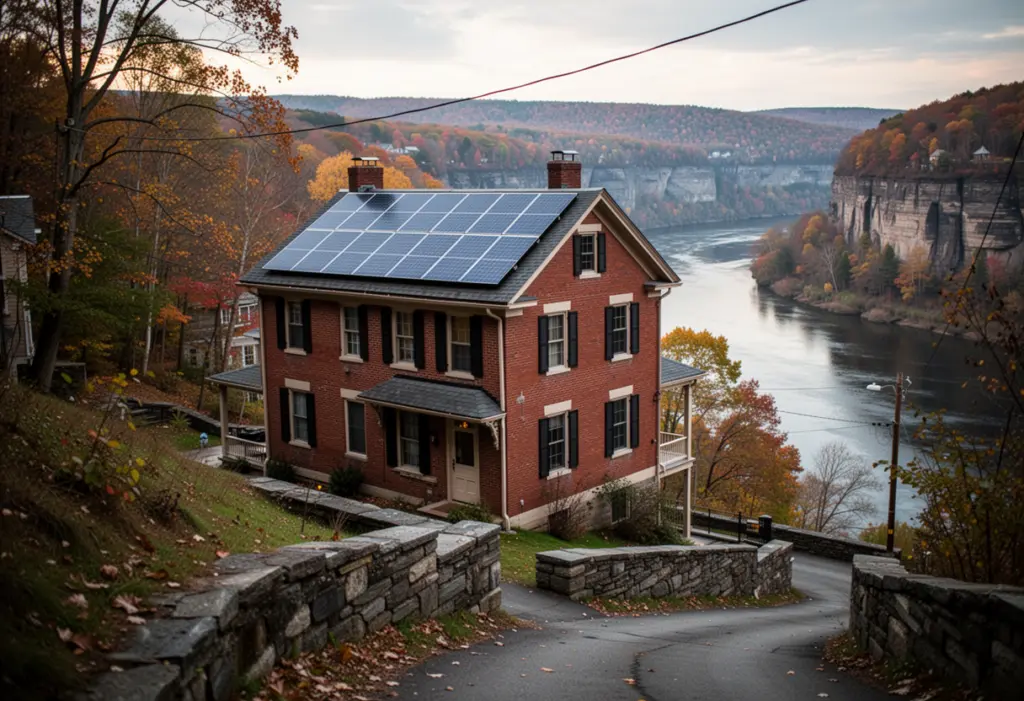
Little Falls is a small city in Herkimer County, built on the steep ground either side of the Mohawk River gorge. ZIP code 13365. Two local facts drive what an installation costs here, and neither appears in a statewide estimate: the ground the city stands on, and the age of the buildings standing on it.
What the terrain adds
- Access and staging. A house cut into a slope can show two storeys at the front and one at the back. Ladders, staging and fall protection all become more involved, and labour hours follow.
- Material handling. Short, steep or shared driveways mean racking and modules take longer to reach the roof than they would on a level lot.
- No room for the cheaper alternative. A ground mount wants flat open land and inside the city there is very little of it. Outside the city there is, and on a parcel with space a ground array can be better value across the life of the system.
A company that has never stood on your street is guessing at exactly the part of this job that varies most. Ask how many Little Falls roofs they have quoted, and treat any proposal produced without a site visit as provisional.
The ridge decides December
Terrain sets production as well as price. A house below a ridge loses the low winter sun earlier in the afternoon than the same roof would on level ground, and the afternoons it loses fall in the months when the net metering bank is being spent rather than filled. Two quotes for one roof that disagree sharply on annual output usually differ because one of them modelled the horizon and the other did not. Ask for an on-site assessment, then ask what the model returns for December and January specifically instead of accepting the yearly figure.
Century-old buildings, priced honestly
Slate. A slate roof does not rule solar out, but it adds specialist hardware and skilled hours to the invoice, and a firm that has not worked on it will either price defensively or damage the covering. Ask them to name two slate jobs they have finished.
Standing-seam metal. The one old roof that pulls the price down. Seam clamps need no fixings driven through the covering, which removes the flashing labour and the leak liability with it, and you are unlikely to face a re-roof inside the working life of the array.
Asphalt with under ten years left. Re-roof first. Removing an array and reinstalling it later costs far more than mounting on a bare deck, so this is a question of when you pay rather than whether.
Structure and service. Old wood frame in a valley that takes real snow draws an engineer’s letter more often than newer construction, and 100 amp panels are common enough here that a solar breaker may require an upgrade or a line-side tap. Both are legitimate costs. Both belong on the page before signature rather than in a change order afterwards.
Two quotes may not be pricing the same electricity
Before you set proposals side by side, look at the supplier named on your bill. Ilion, Mohawk and Frankfort each run a municipal electric utility, and a municipal account sits outside Public Service Commission jurisdiction altogether — no state net metering, no Customer Benefit Contribution, no standardised interconnection process, and terms set by the utility rather than by the state. A price built on the state rules and a price built on a village tariff are not the same product. The figures below belong to a National Grid account.
The monthly charge, and the cap that binds
National Grid’s 2026 residential Customer Benefit Contribution is $0.97 per kW-month of DC capacity, the lowest residential rate in New York, charged to anyone interconnected on or after 1 January 2022 and recalculated each year. A 6 kW system comes to $5.82 a month, near enough $70 a year; a 12 kW system to $11.64 a month, about $140. Phase One net metering, meanwhile, credits exports at the full retail rate for 20 years from interconnection.
On the incentive side of the sum, New York’s credit is 25% capped at $5,000. On a modest Little Falls system that ceiling may never come into play; on a larger one it does, and the credit then covers a smaller share of the total than a flat 25% implies. It is limited by your New York State tax liability as well, with unused amounts carrying forward for up to five years.
2026, and the tax line that is easiest to forget
Most of what a Little Falls household pays in property tax is the school levy, which is why RPTL 487 deserves a specific question rather than a general reassurance. The section exempts the added value of a solar system from real property tax for 15 years, but a school district may opt out by resolution independently of the city and independently of Herkimer County. Ask the district directly. A yes from City Hall tells you nothing about the largest line on your bill, and in any case the exemption reaches only systems constructed before 1 January 2030 and has to be claimed by filing form RP-487 with the assessor by the taxable status date.
Two further measures are live in 2026. The state sales tax exemption covers residential solar energy systems equipment. And Form IT-255 carries the state credit — a quarter of qualified expenditure up to $5,000, at the home you actually live in, on a purchase, on a lease of ten years or more, or on a power purchase agreement of the same length. NY-Sun and its income-tested Affordable Solar component, which the contractor used to hand you as a lower price, are no longer live: as of September 2026 NYSERDA has no open NY-Sun block for homes in any utility territory; check NYSERDA’s NY-Sun dashboard for a new one.
The 30% federal residential credit no longer exists. The credit died with the calendar: section 25D reaches no expenditure made after 31 December 2025, and the statute fixes the date of an expenditure at completion of the original installation. On a project of this size that is a large absolute number, so a quote still showing it is not a quote to negotiate from. Check the current position with NYSERDA and the New York State Department of Taxation and Finance yourself before you commit.
Frequently Asked Questions
Why is a Little Falls quote higher than one for a flat lot nearby?
Hillside access and staging add labour hours, material handling off a steep driveway takes longer, and century-old buildings raise slate mounting, engineer's letters, roof replacement timing and 100 amp service upgrades. Each is a real cost that should be visible before signature.
Is the New York credit really a quarter of what I pay?
It is 25% until it reaches $5,000, and no further. It is also limited by your New York State tax liability, with unused amounts carrying forward for up to five years, so a large system collects a smaller proportional credit than a small one.
Does the hillside cut how much the system makes?
It can. A house below a ridge loses the low sun earlier in the afternoon, and those afternoons fall in the months when the net metering bank is being spent. Ask for an on-site assessment and for the December and January output, not just the annual number.
Do I need to ask my school district about the property tax exemption?
Yes. A school district can opt out of RPTL 487 by resolution independently of the city and the county, and the school levy is the largest part of most bills here, so a municipal answer does not settle it.
This article is general information, not tax, legal or financial advice. Incentive amounts, eligibility rules and deadlines change and depend on your utility, your tax situation and your property. Confirm current terms with NYSERDA, your utility and a qualified tax professional before making a decision.
NY Solar Incentives
Independent New York solar research. We summarise NYSERDA, NY-Sun and federal programme rules from published sources and state plainly when a figure is an estimate. We are not a government agency and do not sell equipment.
Run the arithmetic on your own system
Check the dated program table and your arrangement before counting an incentive. Standard residential NY-Sun blocks are closed; Long Island Affordable Solar has a conditional income-verification route. The NY credit depends on qualified costs and tax liability, while the NYC abatement reduces future property-tax bills. The estimator keeps those timings separate.