Solar Incentives in Windsor, NY: What Applies in 2026
Windsor keeps a state credit, a contractor-applied price reduction and a fifteen-year property tax exemption that four separate bodies can each cancel. The federal credit is gone.
On this page 9 sections
- 01What is gone
- 02The state credit, and the question a rural address has to answer first
- 03NY-Sun, Affordable Solar, and the loans beside them
- 04RPTL 487: four bodies, checked separately
- 05Where the incentives meet the terrain
- 06Village or town, and older rural housing
- 07The charge that runs the other way
- 08Confirm the supply before you rely on the figures
- 09Frequently Asked Questions
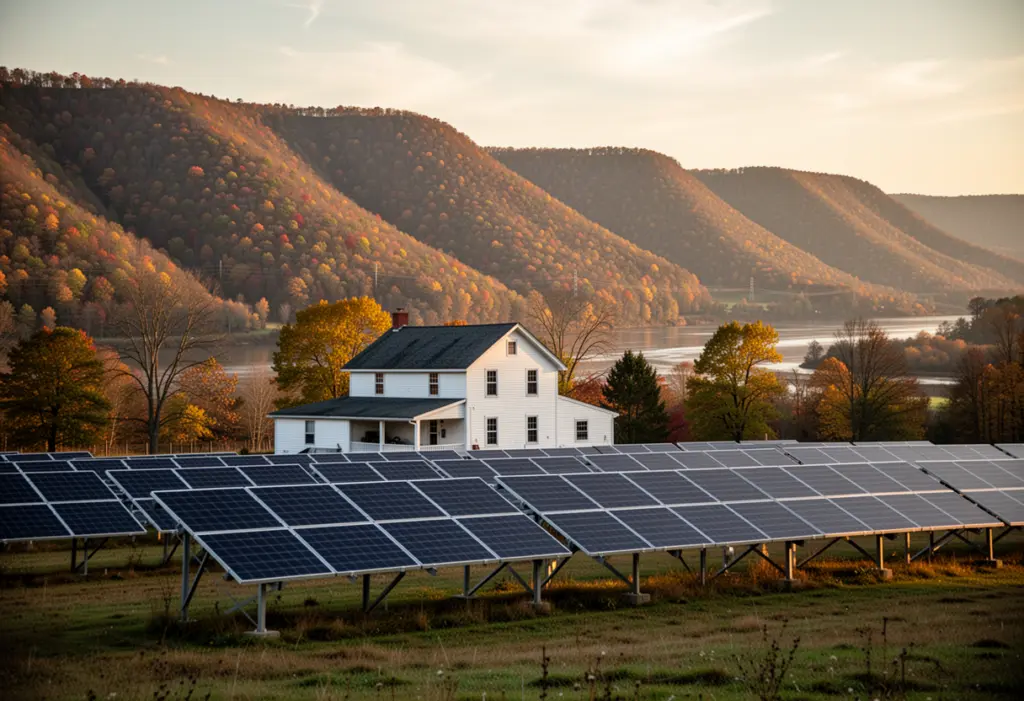
Windsor is an incorporated village inside the Town of Windsor, in Broome County, on the Susquehanna south-east of Binghamton. ZIP code 13865. It is rural, hilly and wooded, and that geography interacts with the incentive list in ways a general New York guide never covers.
What is gone
Nothing federal remains for a 2026 homeowner purchase. The termination of section 25D covers expenditures made after 31 December 2025, and the statute dates an expenditure to completion of the original installation. Where a proposal still shows that credit, ask for the quote to be rebuilt rather than for the one line to be struck out.
One federal credit does continue, but not for you. A company that owns the equipment under a lease or a power purchase agreement claims it on the business side, which is how a third-party offer can still be priced around a tax benefit that never reaches the household living under the panels.
The state credit, and the question a rural address has to answer first
New York’s solar energy system equipment credit is 25% of qualified expenditure, capped at $5,000, on Form IT-255. Before any of the mechanics matter, one test decides whether it is available at all: the system must be installed and used at your principal residence in New York.
That is worth stopping on in a town like this one. The hills south-east of Binghamton carry a genuine stock of camps, cabins, inherited farmhouses and weekend places, and a system on any of them earns no state credit whatsoever. Nor does one on a property you let out. The test is the use of the building, not the ownership of the panels, so a family with a year-round house in the village and a camp up the hill can claim on one and not the other, and an installer quoting both will not necessarily say so.
Where the residence test is satisfied, the rest follows. The credit reaches a purchase, a lease of ten years or more, or a power purchase agreement of ten years or more, the ten-year minimum applying to the lease as well as the agreement. It is limited by your actual New York State tax liability and is not refundable, though unused credit carries forward for up to five years. And nobody applies it for you: it is a filing you make.
NY-Sun, Affordable Solar, and the loans beside them
NY-Sun came off the quoted price rather than arriving on a tax return, and the per-watt amount stepped down as each regional capacity block filled; the last standard upstate residential block (Block 14, $0.15/W, NYSEG, RG&E and National Grid territories) closed on 17 December 2025. Affordable Solar, NYSERDA’s higher per-watt block for lower-income households, was applied the same way and ran upstate from 18 December 2025 to 9 March 2026. As of September 2026 NYSERDA has no open NY-Sun block for homes in any utility territory; check NYSERDA’s NY-Sun dashboard for a new one. Do not rely on a NY-Sun figure from an older proposal.
With the federal credit removed, the financing question has become part of the incentive question on the larger systems this terrain encourages. NYSERDA’s Energy Finance Solutions offers an On-Bill Recovery Loan, repaid through the utility bill itself, and a Smart Energy Loan. Ask your contractor which of them your project can use and on what terms, and compare that against whatever finance the installer offers in-house.
RPTL 487: four bodies, checked separately
RPTL 487 exempts the added value of the system from real property tax for 15 years, but only where the taxing bodies have not opted out, and that right belongs separately to a county, city, town or village by local law and to a school district by resolution. For a village address here that is the Village of Windsor, the Town of Windsor, Broome County and your school district. Ask about each by name, and file form RP-487 with the assessor by the taxable status date. Section 487 also requires construction before 1 January 2030, so it is not open-ended. The state sales tax exemption on residential solar equipment applies as well, with localities electing separately on their local share.
Where the incentives meet the terrain
The valley here is narrow with steep wooded slopes, so the southern horizon changes sharply over short distances: one property loses the winter sun to a ridge while another a few hundred metres away has open sky. December is when it bites, because that is when the sun is lowest and the net metering credit bank is being drawn down. Insist on an on-site shading assessment and ask what the model says about December and January, not only the annual total.
That is also the argument for a ground mount on rural parcels, where land lets you put the array where the sky is open rather than where the roof happens to face. It removes the roof-age question and keeps snow clearing at ground level. Ask about setbacks, site plan review, frost-line foundation depth and clearance beneath the lowest row. On low ground near the Susquehanna, mapped flood plain also governs where the inverter, disconnects, meter and any battery may be mounted, and a basement battery is frequently the wrong answer on those parcels.
Village or town, and older rural housing
The Village of Windsor and the Town of Windsor are separate authorities with their own building departments, so establish which covers your address before anything is filed. Older farmhouse and village stock brings the familiar three: roof age, where under roughly ten years of shingle life left means re-roof first; structural letters, needed more often on older wood frame; and 100 amp service, where fitting a solar breaker can require a panel upgrade or a line-side tap.
The charge that runs the other way
Running the other way is a charge that arrives every month. Systems interconnected on or after 1 January 2022 pay the Customer Benefit Contribution on their DC rating, and the NYSEG residential rate for 2026 is $1.19 per kW-month:
- A 15 kW ground mount: $17.85 a month, about $214 a year.
- A 20 kW ground mount: $23.80 a month, about $286 a year.
The figure follows the rating on the array, never the output, and it is recalculated each year. Phase One net metering runs the opposite way, valuing exported kilowatt-hours at the full retail rate for two decades from interconnection. And a community solar subscription escapes the contribution entirely, being a front-of-the-meter project, which is worth weighing wherever a ridge or a wooded slope makes a rooftop array marginal.
Confirm the supply before you rely on the figures
Rural service territory is drawn around lines and substations rather than around town boundaries, so the only reliable statement about who serves a Windsor address is the name printed on that household’s bill. The reason it matters beyond curiosity is that New York also contains villages owning their electric systems outright, and a municipal utility customer sits outside Public Service Commission jurisdiction. For them there is no PSC net metering, no Customer Benefit Contribution and no standardised state interconnection process, and every one of those terms is instead set by the utility and available only on request.
None of this is static. NY-Sun has no residential block open, the monthly contribution is repriced every year, and the property tax exemption closes to systems built after 2029. Take the current numbers from NYSERDA and from the New York Department of Taxation and Finance rather than from any page, this one included, before you commit money.
Frequently Asked Questions
Can I still claim a federal solar credit in Windsor in 2026?
No. Section 25D was terminated for expenditures made after 31 December 2025, and an expenditure counts as made when the original installation is completed. A 2026 proposal showing a 30% federal line is materially wrong.
Does my camp or second place in the Town of Windsor qualify for the state credit?
No. New York's 25% credit capped at $5,000 on Form IT-255 requires the system to be installed and used at your principal residence in New York, so a camp, a seasonal cabin, a second home or a property you let out earns nothing.
How is a rural ground mount financed now the federal credit has gone?
Ask about NYSERDA's Energy Finance Solutions, which offers an On-Bill Recovery Loan repaid through the utility bill and a Smart Energy Loan, and compare the terms against whatever finance the installer offers in-house.
Who can cancel the property tax exemption on my system?
Any of four bodies acting separately: the Village of Windsor, the Town of Windsor, Broome County and your school district. RPTL 487 gives 15 years on the added value only where none of the relevant ones has opted out, and construction must be before 1 January 2030.
This article is general information, not tax, legal or financial advice. Incentive amounts, eligibility rules and deadlines change and depend on your utility, your tax situation and your property. Confirm current terms with NYSERDA, your utility and a qualified tax professional before making a decision.
NY Solar Incentives
Independent New York solar research. We summarise NYSERDA, NY-Sun and federal programme rules from published sources and state plainly when a figure is an estimate. We are not a government agency and do not sell equipment.
Run the arithmetic on your own system
Check the dated program table and your arrangement before counting an incentive. Standard residential NY-Sun blocks are closed; Long Island Affordable Solar has a conditional income-verification route. The NY credit depends on qualified costs and tax liability, while the NYC abatement reduces future property-tax bills. The estimator keeps those timings separate.