Solar Panel Installation in Endicott, NY
Endicott is a village with its own building department inside the Town of Union, and a dense stock of industrial-era houses. Both change what a solar quote should contain.
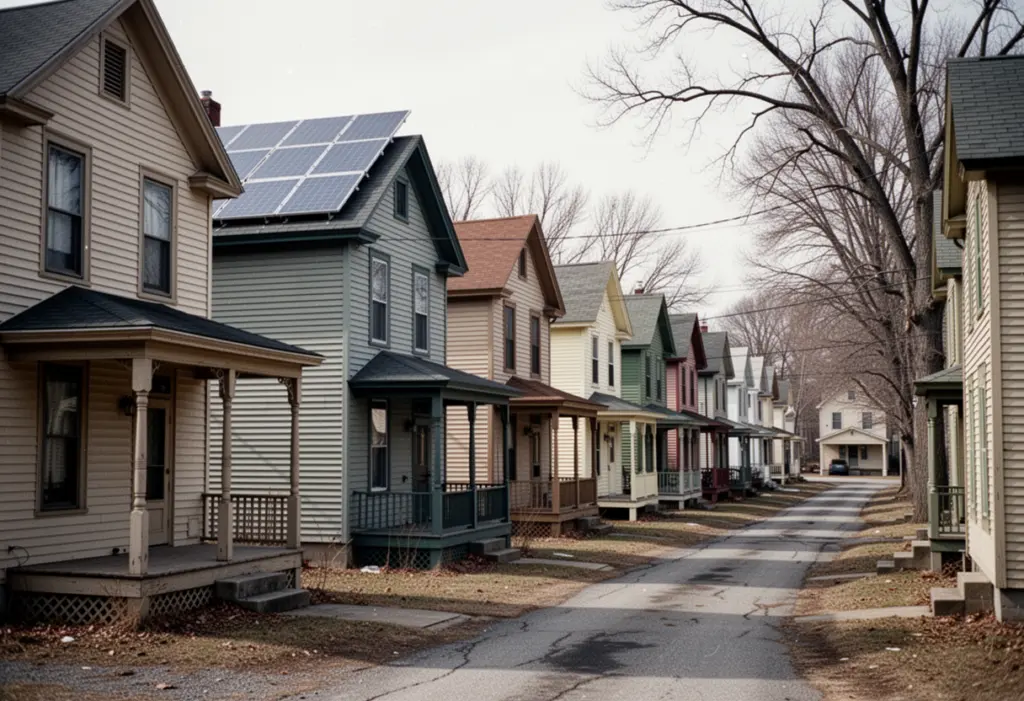
Endicott is an incorporated village in the Town of Union, Broome County, on the north bank of the Susquehanna. ZIP code 13760, which it shares with the hamlet of Endwell next door. Its housing was largely built for an industrial workforce in the first half of the twentieth century, and that history sets most of the practical questions here.
Village, not town
The Village of Endicott and the Town of Union are separate authorities with their own building departments, and the village sits inside the town. Establish which one covers your address before an installer files anything, because a permit lodged with the wrong department is time lost rather than a small correction, and fee schedules and turnarounds differ between them.
Where an authority has adopted the NYS Unified Solar Permit, residential systems of 25 kW DC and under go through a standardised process. Ask which form your address falls under and how long the department is currently taking.
Industrial-era housing: three checks
The compact houses that make up much of the village raise questions a modern subdivision does not.
Service capacity. 100 amp service is common in housing of this age, and fitting a solar breaker can require a panel upgrade or a line-side tap. This is the most frequent cost surprise on installations in this part of Broome County. Ask what your service is and whether the busbar has room, and get it priced in the quote rather than discovered as a change order.
Roof age and structure. The gate is whether the shingles have roughly ten years of life left. If not, re-roof first, because removing and reinstalling an array later costs considerably more than mounting on a bare roof. Older wood-frame roofs also draw a structural engineer’s letter more often than newer construction, and that belongs in the budget rather than being discovered after contract.
Usable roof area. Small roofs on narrow lots give less plane than they appear to. Code fire-access pathways and setbacks take proportionally more of a modest roof, and a single chimney or vent stack removes a meaningful fraction of the capacity. Ask what is limiting your system size, because if the answer is roof area rather than your consumption, that is worth knowing before you judge the quote.
The river and the mounting height
Endicott sits on the Susquehanna, and low ground near the water is mapped flood plain. What that governs is not whether you can have solar but where the electrical equipment is allowed to live: inverter, AC and DC disconnects, production meter and any battery all have to clear a stated elevation. On a compact house that usually means giving up the obvious wall beside the meter and finding height somewhere less convenient, and it usually means storage cannot go in the basement at all. Put two questions to the village before a design is drawn, namely whether this parcel is in a mapped zone and what elevation applies, because the answer changes the drawing rather than the price list, and redrawing after an inspection is the expensive route to the same result.
NYSEG and the Customer Benefit Contribution
Every system interconnected on or after 1 January 2022 carries the Customer Benefit Contribution, a monthly amount worked out from nameplate DC capacity. For NYSEG residential customers the 2026 figure is $1.19 per kW-month:
- A 4 kW system: $4.76 a month, about $57 a year.
- A 7 kW system: $8.33 a month, about $100 a year.
Note what it is not: a charge on the electricity you use or send out. It follows the nameplate rating, and the figure is revisited each year rather than frozen on the day you connect. Because roof area caps most systems in the village, the sum stays modest in absolute terms. Under Phase One net metering an exported unit is still credited at the full retail rate, and that structure runs 20 years from interconnection.
The utility name on the bill is the one that counts
Before any of the arithmetic above applies to you, look at the top of your own electricity bill and read the name printed there. Two separate things can make an assumption wrong. Investor-owned service territory does not follow municipal boundaries in this part of the state, and beyond that, some New York villages own their electric systems outright. A municipal electric utility falls outside Public Service Commission jurisdiction, which means state net metering, the Customer Benefit Contribution and the standardised state interconnection process do not reach its customers at all. Export credit, interconnection terms and any local charge are set by that utility and have to be requested from it directly.
2026 incentives, and the one that closed
There is nothing federal left for a homeowner buying a system in 2026. Section 25D was terminated for expenditures made after 31 December 2025, and the statute counts the expenditure from completion of the original installation. If a 30% line is still printed on your quote, the whole bottom half of that page needs redoing before it is compared with anything.
On a modest installation in housing of this kind, the incentive that used to decide whether the project happened at all was Affordable Solar, NYSERDA’s higher NY-Sun incentive for lower-income households, applied by the contractor as a reduction in price rather than claimed by you on a tax form. The upstate Affordable Solar block ran from 18 December 2025 to 9 March 2026 and is closed, and the regular upstate residential NY-Sun block closed on 17 December 2025. As of September 2026 NYSERDA has no open NY-Sun block for homes in any utility territory; check NYSERDA’s NY-Sun dashboard for a new one. If a quote still shows either line, ask which open block it comes from.
What is left: the state’s 25% credit capped at $5,000 on Form IT-255 for a principal residence, reaching leases and power purchase agreements of ten years or more, and limited by your actual state tax liability; the state sales tax exemption, which in Broome County covers the local sales tax too (Tax Department Publication 718-S); and RPTL 487, a 15-year exemption on the added property value where the Village of Endicott, the Town of Union, Broome County and your school district have each not opted out, for construction before 1 January 2030, provided you file form RP-487 with each assessor by the taxable status date. Where a roof is too small or too shaded to be worth it, community solar needs no roof and no up-front cost. Programme terms change, so confirm the current position with NYSERDA before signing.
Frequently Asked Questions
Village of Endicott or Town of Union, who issues the permit?
They are separate authorities with their own building departments, and the village sits inside the town. Establish which covers your address before an installer files anything, since fee schedules and turnarounds differ.
Will an older Endicott house need an electrical upgrade for solar?
Often. 100 amp service is common in housing of this age, and fitting a solar breaker can require a panel upgrade or a line-side tap. Ask what your service is and whether the busbar has room, and get it priced in the quote rather than as a later change order.
Can an Endicott household still get Affordable Solar?
Not as of September 2026. NYSERDA’s upstate Affordable Solar block for lower-income households closed on 9 March 2026, and NYSERDA has no open NY-Sun block for homes in any utility territory; check NYSERDA’s NY-Sun dashboard for a new one. The state credit, the sales tax exemption and RPTL 487 still apply.
What does NYSEG charge an Endicott solar customer?
The Customer Benefit Contribution at $1.19 per kW-month of DC system size for 2026: $4.76 a month on 4 kW, about $57 a year, and $8.33 on 7 kW, about $100, billed on capacity regardless of production.
This article is general information, not tax, legal or financial advice. Incentive amounts, eligibility rules and deadlines change and depend on your utility, your tax situation and your property. Confirm current terms with NYSERDA, your utility and a qualified tax professional before making a decision.
NY Solar Incentives
Independent New York solar research. We summarise NYSERDA, NY-Sun and federal programme rules from published sources and state plainly when a figure is an estimate. We are not a government agency and do not sell equipment.
Run the arithmetic on your own system
Check the dated program table and your arrangement before counting an incentive. Standard residential NY-Sun blocks are closed; Long Island Affordable Solar has a conditional income-verification route. The NY credit depends on qualified costs and tax liability, while the NYC abatement reduces future property-tax bills. The estimator keeps those timings separate.