Solar Panel Installation in Solvay, NY
Solvay runs its own municipal electric utility. That single fact changes more about a solar project here than anything else, and almost no New York solar guide says so.
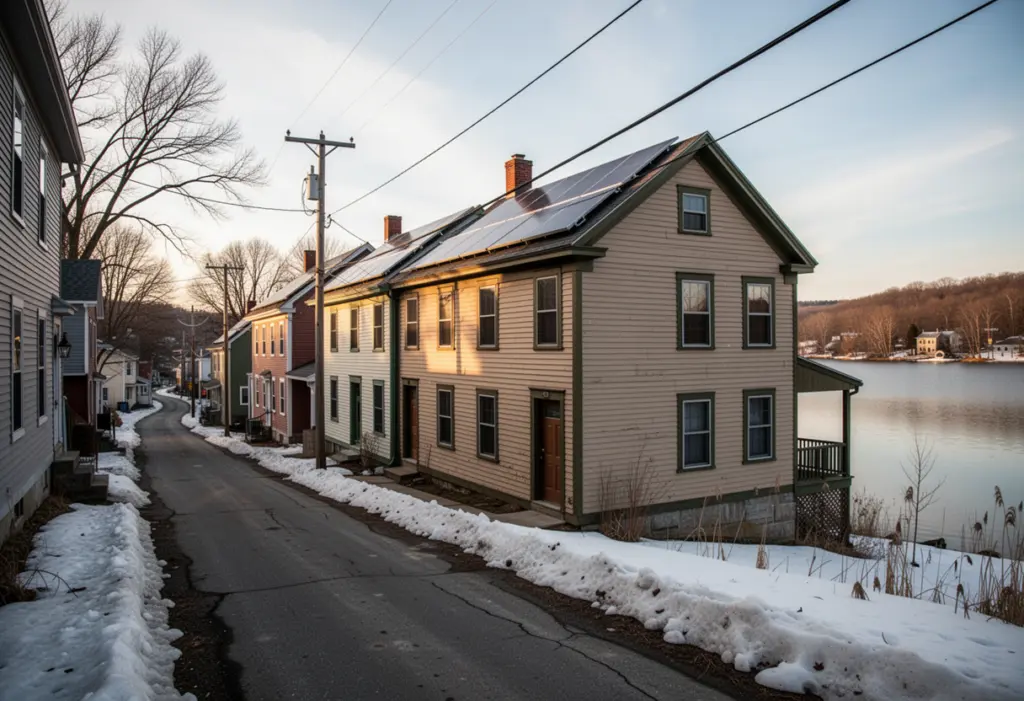
Solvay runs its own municipal electric utility. That single fact changes more about a solar project here than anything else on this page, and almost no general New York solar guide will tell you.
Solvay is a village in the Town of Geddes, Onondaga County, on the western side of Onondaga Lake. ZIP code 13209. If your electricity comes from the village rather than from an investor-owned utility, most of what is written about New York solar simply does not describe your project.
Why a municipal utility changes the rules
New York has roughly fifty municipal electric utilities. They sit outside Public Service Commission jurisdiction, and three concrete consequences follow:
- State net metering does not apply. Phase One net metering, which credits exported kilowatt-hours at the full retail rate and holds that structure for 20 years from interconnection, is a PSC arrangement for investor-owned utility customers. Whether the village credits exports at all, at what rate and for how long is the village’s decision.
- The Customer Benefit Contribution does not apply. The monthly charge on DC system size that investor-owned utility customers pay is not a municipal charge. Whether any local equivalent exists is a question for the village.
- The standardised state interconnection process does not apply. The application, the timeline, the fee and the technical requirements are the utility’s own.
Confirm your utility from your own bill before acting on any of this. A village mailing address is not proof of a municipal account, and service boundaries and municipal boundaries are not the same line. Solvay is not alone in this county either: Skaneateles also runs a municipal electric department, and the same reasoning applies to its customers.
What to ask the village electric department, in writing
Get these answered before you accept any proposal, because an installer working from investor-owned utility assumptions will produce a savings model that does not describe your account:
- Does it offer net metering or any export credit, and at what rate: retail, wholesale, or something else?
- Is there a cap on system size, in kW or as a share of your annual consumption?
- What does the interconnection application involve, what does it cost, and how long does it take?
- Is there any monthly charge tied to system size, or to having generation on the account at all?
- What happens to unused export credit at the end of a year: carried forward, paid out, or forfeited?
- What equipment, metering and inspection requirements apply, and who signs them off?
Hand the written answers to every installer you ask for a quote. The error you are guarding against is not a small one, and it hides inside the production and savings model rather than anywhere obvious on the price page.
The arithmetic you are not paying
A household a short distance outside the village, on National Grid, pays the Customer Benefit Contribution on the DC size of the system at $0.97 per kW-month for 2026, the lowest residential rate of the seven utilities on the statewide table:
- 3 kW: $2.91 a month, about $35 a year.
- 5 kW: $4.85 a month, about $58 a year.
A municipal customer does not pay that. But the absence of a charge is not by itself a saving worth counting: what matters is whether the village’s export credit and interconnection terms are better or worse than the whole National Grid package, and only the village can tell you. Do not let an installer present a missing charge as a benefit without first establishing what an exported kilowatt-hour is actually worth on your account.
What does not change: state tax law
These are tax provisions rather than utility rules, so they do not depend on who sells you electricity:
- New York’s 25% credit capped at $5,000 on Form IT-255, for a system at your principal residence in New York. It reaches leases and power purchase agreements of ten years or more as well as purchases, the ten-year minimum applying to the lease as well as the agreement, and it is limited by your actual state tax liability.
- The state sales tax exemption on residential solar energy system equipment, with localities able to elect separately on their own share.
- RPTL 487, a 15-year exemption on the added value, where each taxing body has not opted out. In Solvay that is four separate checks: the Village of Solvay, the Town of Geddes, Onondaga County and your school district. Section 487 also requires construction before 1 January 2030.
The federal answer is the same on every account, municipal or not: the 30% residential credit no longer exists. Section 25D closed for expenditures made after 31 December 2025, and the operative test is when the original installation is completed, not when a meter is set. Being a village electric customer changes nothing about it either way.
One thing not to assume is a NY-Sun or Affordable Solar line on your quote. As of September 2026 NYSERDA has no open NY-Sun block for homes in any utility territory; check NYSERDA’s NY-Sun dashboard for a new one. If one opens, ask your contractor in writing whether it is available on a municipal utility account before it appears as a line on your quote.
Village housing and the snow
Solvay is compact early twentieth century housing on small lots, built around the industry that gave the village its name, and roof area rather than consumption usually sets the system size. Fire-access pathways and setbacks take proportionally more of a small roof, a dormer or chimney removes a meaningful fraction of the plane, and a neighbouring roofline can shade yours at the low December sun angle because the buildings sit close together. Housing of that age frequently runs 100 amp service, where fitting a solar breaker can require a panel upgrade or a line-side tap, and the usual roof gate applies: under roughly ten years of shingle life left means re-roof first. On snow, ask what ground snow load the racking, attachments and roof structure are specified for, whether guards are needed where the array sheds over a door or a narrow passage between houses, and what snow-cover assumption sits in the production estimate.
Frequently Asked Questions
Does New York net metering apply in Solvay?
Not automatically. Solvay runs a municipal electric utility, which sits outside Public Service Commission jurisdiction, so Phase One net metering is not the governing arrangement. Ask the village electric department what export credit it offers, at what rate, and for how long.
Do I pay the Customer Benefit Contribution in Solvay?
The CBC is an investor-owned utility charge and does not reach a municipal account. A neighbour on National Grid pays $0.97 per kW-month for 2026, about $35 a year on 3 kW and $58 on 5 kW. Ask the village whether it has any equivalent charge of its own.
Can I still claim the New York State solar tax credit?
Yes. The 25% credit capped at $5,000 on Form IT-255 is tax law rather than a utility rule, so it does not depend on who sells you electricity. It requires your principal residence in New York and is limited by your actual state tax liability.
How do I know whether I am a Solvay Electric customer?
Read the utility name printed on your own bill. Service boundaries and village boundaries are not the same line, so a Solvay mailing address proves nothing either way. Skaneateles is the other municipal electric utility in Onondaga County.
This article is general information, not tax, legal or financial advice. Incentive amounts, eligibility rules and deadlines change and depend on your utility, your tax situation and your property. Confirm current terms with NYSERDA, your utility and a qualified tax professional before making a decision.
NY Solar Incentives
Independent New York solar research. We summarise NYSERDA, NY-Sun and federal programme rules from published sources and state plainly when a figure is an estimate. We are not a government agency and do not sell equipment.
Run the arithmetic on your own system
Check the dated program table and your arrangement before counting an incentive. Standard residential NY-Sun blocks are closed; Long Island Affordable Solar has a conditional income-verification route. The NY credit depends on qualified costs and tax liability, while the NYC abatement reduces future property-tax bills. The estimator keeps those timings separate.