Solar Panel Installation in DeWitt, NY
DeWitt borders the city but is not in it, and that changes the property tax exemption. It also contains a village with its own building department.
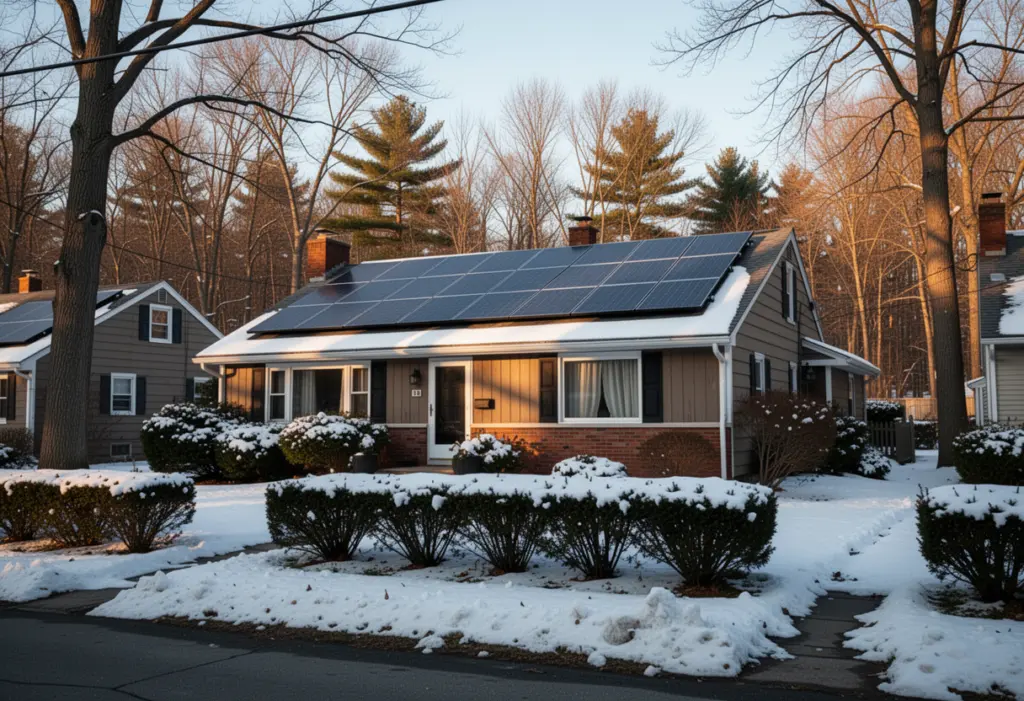
DeWitt is a town in Onondaga County immediately east of the City of Syracuse, and it contains the Village of East Syracuse. ZIP codes 13214 and 13057. Two things here are worth settling before anything else: which of two building departments holds your parcel, and the fact that a school tax question applies in DeWitt that does not apply one street away inside the city.
Town or village
The Town of DeWitt and the Village of East Syracuse run separate building departments, with the village inside the town. Fee schedules and turnarounds are not the same, and a file in the wrong queue costs weeks rather than a correction. Nothing about a mailing address settles which applies, so get the authority identified and written into the proposal before a submission is made.
The exemption check the city does not have to make
RPTL 487 exempts the added value of a solar system from real property tax for 15 years, but only where the taxing body has not opted out, and that right belongs separately to a county, city, town or village by local law and to a school district by resolution.
Inside the City of Syracuse there is no school question to ask. The Syracuse City School District is one of New York’s five fiscally dependent big-city districts, which levy no separate property tax at all, so a city homeowner has one fewer body to chase. DeWitt is not in the city. Your parcel carries a school levy of its own, from a district that can opt out of section 487 by its own resolution without telling anyone who is selling you panels. Where the school line is the largest item on the tax bill, that single check is worth more than any other question on this page.
So ask three bodies by name, the town or the village, Onondaga County and your school district, and take the answers from the assessor rather than from a sales summary. Note also that section 487 requires construction before 1 January 2030, which is a real constraint on a project that keeps being deferred.
The rise in the south of the town
South of the suburban belt, around Jamesville, the land climbs onto the limestone escarpment at the northern edge of the Allegheny Plateau, and a house at the foot of that rise can lose its southern sky to landform rather than to trees. Ask for an on-site horizon assessment instead of a satellite figure, and for December and January production separately from the annual total. A wide gap between two installers on the same roof usually means only one of them visited it.
Butternut Creek
Butternut Creek runs through the town and low parcels along it can be in mapped flood plain, which sets a minimum elevation for the inverter, the AC and DC disconnects, the production meter and any battery, and generally takes the basement off the table for storage. Ask whether your parcel is affected before a design is drawn, because equipment is slow and expensive to move once it is mounted and inspected.
Mid-century housing: two checks
Service capacity. Much of DeWitt went up between the 1950s and the 1970s, and 100 amp service is common in the older parts, where a solar breaker can require a panel upgrade or a line-side tap. Ask what your service is and whether the busbar has room, and have it priced before contract rather than raised afterwards.
Roof geometry. Beyond the usual ten-year shingle-life gate, split-level and ranch rooflines with dormers give less usable plane than they appear to, and fire-access clearances take proportionally more of a modest roof. Ask what is limiting your system size, because if the answer is roof area rather than your consumption that changes how the quote should be read. On snow, ask what ground snow load the racking, attachments and structure are specified for, whether guards are needed where the array sheds over a door or walkway, and what snow-cover assumption sits in the production model.
National Grid
Most of the county is National Grid, and your bill is the only proof of it. The Customer Benefit Contribution applies to systems interconnected on or after 1 January 2022, follows DC system size, and is $0.97 per kW-month for 2026, the lowest residential rate of the seven utilities on the statewide table.
- 9 kW: $8.73 a month, about $105 a year.
- 13 kW: $12.61 a month, about $151 a year.
Charged on capacity rather than output and recalculated annually. Phase One net metering credits exports at the full retail rate and holds for 20 years from interconnection.
2026 incentives
The 30% federal residential credit is gone. Section 25D was terminated for expenditures made after 31 December 2025, with an expenditure treated as made when the original installation is completed. A 2026 quote still carrying that line has not been repriced, and everything downstream of it is wrong.
What is left, for a principal residence in New York: the 25% state credit capped at $5,000 on Form IT-255, which reaches leases and power purchase agreements of ten years or more as well as purchases and is limited by your actual state tax liability; the state sales tax exemption (Onondaga County’s 4% local sales tax still applies, per the Tax Department’s Publication 718-S); and the 15-year property tax exemption set out above, whose value here turns on the answer your school district gives and which you claim by filing form RP-487 with each assessor by the taxable status date. NY-Sun and its Affordable Solar blocks are not on the list. As of September 2026 NYSERDA has no open NY-Sun block for homes in any utility territory; check NYSERDA’s NY-Sun dashboard for a new one. Confirm the current position with NYSERDA and the New York State Department of Taxation and Finance before you sign.
Frequently Asked Questions
Who issues a solar permit in DeWitt?
The Town of DeWitt and the Village of East Syracuse run separate building departments, with the village inside the town. Fee schedules and turnarounds differ, so establish which holds your parcel before anything is filed.
Do I have to check my school district for the property tax exemption?
In DeWitt, yes, and it is the check worth making first. Inside the City of Syracuse the school district is fiscally dependent and levies no separate property tax. DeWitt is not in the city, so its district carries its own levy and can opt out of RPTL 487 by resolution.
Why is my southern horizon a problem near Jamesville?
The land climbs onto the limestone escarpment in the south of the town, so the obstruction can be landform rather than trees. Ask for an on-site horizon assessment and for December and January production separately from the annual total.
What does National Grid charge a DeWitt solar customer?
The Customer Benefit Contribution at $0.97 per kW-month of DC system size for 2026: $8.73 a month on 9 kW, about $105 a year, and $12.61 on 13 kW, about $151.
This article is general information, not tax, legal or financial advice. Incentive amounts, eligibility rules and deadlines change and depend on your utility, your tax situation and your property. Confirm current terms with NYSERDA, your utility and a qualified tax professional before making a decision.
NY Solar Incentives
Independent New York solar research. We summarise NYSERDA, NY-Sun and federal programme rules from published sources and state plainly when a figure is an estimate. We are not a government agency and do not sell equipment.
Run the arithmetic on your own system
Check the dated program table and your arrangement before counting an incentive. Standard residential NY-Sun blocks are closed; Long Island Affordable Solar has a conditional income-verification route. The NY credit depends on qualified costs and tax liability, while the NYC abatement reduces future property-tax bills. The estimator keeps those timings separate.