Solar Panel Installation in Cicero, NY
Part of the Village of North Syracuse sits inside the Town of Cicero, so settle the permit authority first. The ground and the weather decide the rest.
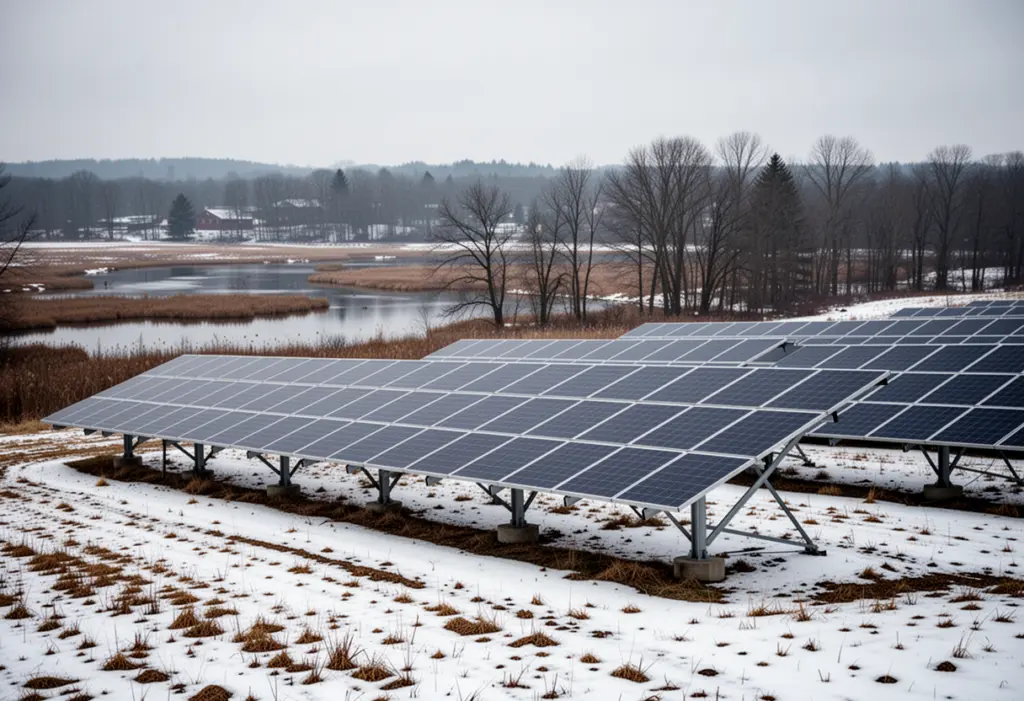
Cicero is a town in northern Onondaga County, between Syracuse and Oneida Lake. ZIP code 13039. One building department covers most of it, the ground under a good deal of it is wet, and the snow arrives off two lakes rather than one. Those three facts do more to a quote here than any choice of panel.
Mostly the town, but not always
The Town of Cicero building department covers the great majority of the town. The exception is the south-western corner, where the Village of North Syracuse straddles the Cicero and Clay town line and runs its own codes office, so a Cicero postal address is not proof that the town holds the parcel. Confirm which authority does before anything is filed and have it named on the proposal. The same list comes back for the tax exemption, where the town, Onondaga County and your school district each decide separately, four bodies if your parcel sits inside the village, and where the school district acts by resolution rather than by local law.
Snow off two lakes
Lake Ontario supplies the county’s lake-effect snow, and Oneida Lake along Cicero’s northern edge generates bands of its own. That is design input rather than scenery:
- Ground snow load. What are the racking, attachments and roof structure rated to carry? Equipment specified for a generic New York job may not meet it, and an engineer’s letter is needed here more often than downstate.
- Discharge path. A loaded array lets go in one sheet rather than melting away gradually, so anything parked, walked or opened underneath the eave needs guards fitted above it.
- Model assumptions. What snow-cover profile sits inside the production estimate? A downstate one overstates a Cicero winter and makes the savings figure wrong.
Steepening a roof array to shed faster is not the fix. It raises wind load, which is already significant on open ground here, complicates the mounting and usually costs more annual production than the snow it clears.
Wet ground, and the foundation question
Cicero has large parcels and extensive wetland, including the Cicero Swamp on the eastern side of the town, which makes a ground mount both attractive and easy to underprice. Orientation and tilt are chosen rather than inherited, roof age stops mattering and snow clearing happens at ground level, but the foundation is where quotes diverge and where the cheap answer is often the wrong one.
- What does the soil investigation say, and which foundation type follows from it: driven pile, ballast, helical or poured?
- What frost depth is the foundation designed to? Freeze and thaw cycling is what fails an under-specified footing here.
- Are there wetland setbacks or a wetland permit in play? Ask before a site plan is drawn, not after one is refused.
- How much clearance sits beneath the lowest row? An array set too low is buried by drifted snow for weeks, in exactly the months the credit bank is being spent.
- Where does the trench run and at what depth? A long run across wet ground is a real cost and belongs in the quote.
Roofs and service panels
The housing is mixed. Post-war and older properties along the main roads frequently run 100 amp service, where a solar breaker can require a panel upgrade or a line-side tap, so ask what your service is and whether the busbar has room. Newer subdivision housing usually offers 200 amp service, engineered trusses and simple planes, and substitutes a covenant or homeowner association rule, which is a private agreement the building department cannot waive. On any asphalt roof, fewer than about ten years of shingle life left means re-roof first.
National Grid, and why capacity has a running cost
Most of Onondaga County is National Grid, and your own bill is the proof. The Customer Benefit Contribution applies from interconnection on or after 1 January 2022 and is charged on DC system size, at $0.97 per kW-month for 2026, the lowest residential rate on the statewide table.
- 15 kW ground mount: $14.55 a month, about $175 a year.
- 18 kW ground mount: $17.46 a month, about $210 a year.
Because it follows nameplate capacity rather than output and is reset annually, sizing a ground mount beyond what the household actually consumes carries a permanent monthly cost as well as a capital one. Phase One net metering credits exports at the full retail rate for 20 years from interconnection.
2026 incentives, and how a ground mount gets paid for
A 2026 buyer claims nothing federally. Section 25D ended for expenditures made after 31 December 2025, and an expenditure counts from the moment the original installation is completed. There is no phase-down, no transition and no carryover of a credit that was never earned, so strike that line off any proposal still showing it before you compare prices.
Losing it changes how a larger ground mount is paid for, which is why the part of NYSERDA’s programme worth asking about here is now the lending rather than the incentive. Energy Finance Solutions offers an On-Bill Recovery Loan, repaid through the utility bill itself, and a Smart Energy Loan. Ask your contractor which of them your project can use and on what terms. Do not expect a NY-Sun or Affordable Solar line applied to the price beside it. As of September 2026 NYSERDA has no open NY-Sun block for homes in any utility territory; check NYSERDA’s NY-Sun dashboard for a new one. The tax side is unchanged: the 25% state credit capped at $5,000 on Form IT-255 for a principal residence, the state sales tax exemption on residential solar equipment, and the 15-year RPTL 487 exemption on added assessed value where nobody with a levy over your parcel has opted out and construction happens before 1 January 2030. Confirm all of it with NYSERDA and the state tax department before signing.
Frequently Asked Questions
Who issues my solar permit in Cicero?
The Town of Cicero covers most of the town, but the Village of North Syracuse straddles the Cicero and Clay line and runs its own codes office. Establish which authority holds your parcel before anything is filed and have it named on the proposal.
Is a ground mount a good idea in Cicero?
Often, because parcels are large and orientation can be chosen. The foundation is the real question: ask what the soil investigation says, which foundation type follows, what frost depth it is designed to, and whether wetland setbacks or a permit apply.
How is a large ground mount financed now the federal credit has gone?
Ask about NYSERDA's Energy Finance Solutions, which offers an On-Bill Recovery Loan repaid through the utility bill and a Smart Energy Loan. Your contractor should be able to say which your project can use and on what terms.
What does National Grid charge on a Cicero ground mount?
The Customer Benefit Contribution at $0.97 per kW-month of DC system size: $14.55 a month on 15 kW, about $175 a year, and $17.46 on 18 kW, about $210. It follows nameplate capacity, so oversizing carries a permanent running cost.
This article is general information, not tax, legal or financial advice. Incentive amounts, eligibility rules and deadlines change and depend on your utility, your tax situation and your property. Confirm current terms with NYSERDA, your utility and a qualified tax professional before making a decision.
NY Solar Incentives
Independent New York solar research. We summarise NYSERDA, NY-Sun and federal programme rules from published sources and state plainly when a figure is an estimate. We are not a government agency and do not sell equipment.
Run the arithmetic on your own system
Check the dated program table and your arrangement before counting an incentive. Standard residential NY-Sun blocks are closed; Long Island Affordable Solar has a conditional income-verification route. The NY credit depends on qualified costs and tax liability, while the NYC abatement reduces future property-tax bills. The estimator keeps those timings separate.