Solar System Stopped Producing After a Storm: What to Check
When an array goes quiet after a storm the cause is almost always one of four things, and you can narrow it down from the ground in about ten minutes without going near the roof.
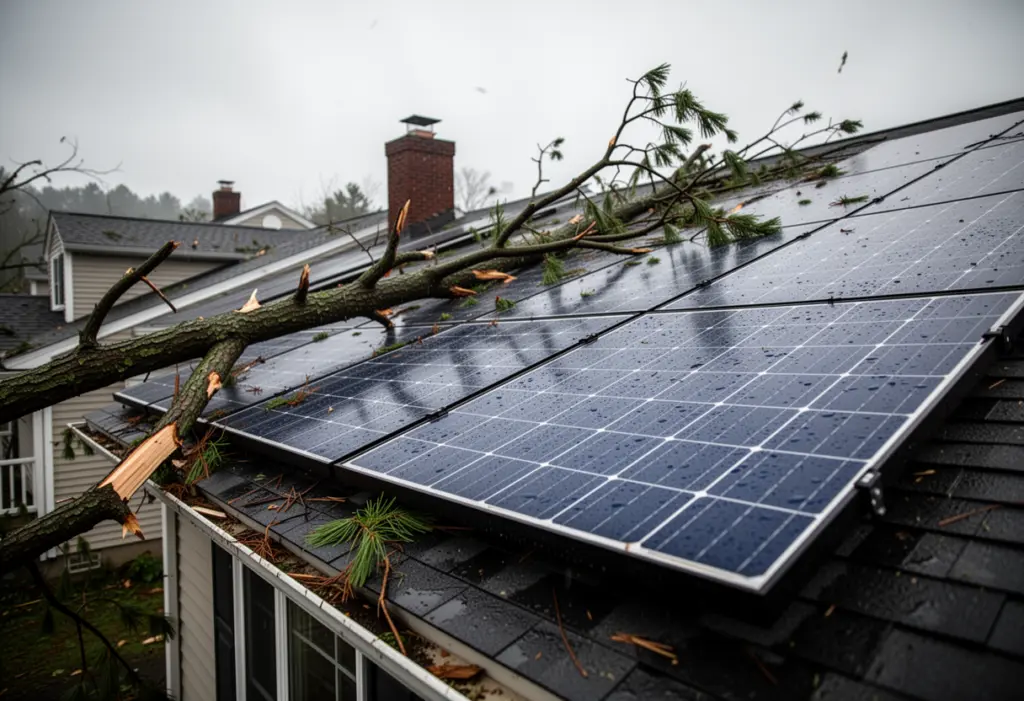
When a solar system goes quiet after a storm the cause is almost always one of four things: the grid was down and something did not restart cleanly, a breaker or disconnect tripped, the inverter has faulted and is telling you so, or there is physical damage. You can narrow it down from the ground in about ten minutes, and you should, because the wrong first phone call wastes days.
Start with the grid
A grid-tied array shuts down when the utility supply fails, and it restarts by itself once supply returns and stays stable for a waiting period. Most storm-related zero-production days are simply that. But an inverter does not always come back cleanly after a rough restoration with voltage and frequency swinging, and a system that has been sitting at zero for a day after the lights came back is no longer explaining itself with the outage.
Check whether there was an outage at all, and when it ended. Your utility’s outage information and a neighbour are both faster than the installer. Confirm the utility name from your own bill while you are at it — if you are served by a municipal electric department rather than an investor-owned utility, both the outage information and the interconnection terms come from your own village or city rather than from the state process.
The ten-minute check from the ground
- Open the monitoring. When exactly did production stop, and did it stop dead or taper away? A clean vertical drop points at a trip or an outage. A taper over days points at soiling, snow or a growing shadow.
- Look at the inverter. Almost all of them show status on a display or by the colour and pattern of a light. Write down what it shows, including any code, before touching anything.
- Check the AC disconnect and the solar breaker. A tripped breaker is common after a surge and it is visible without tools.
- Look at the array from the ground, with binoculars if you have them. A branch resting on the panels, a lifted module, a hanging conduit or obvious broken glass is all visible from a lawn.
Do not go up on a wet or storm-damaged roof to investigate. Nothing you can see up there is worth the fall, and a damaged array can be electrically live in daylight even when it is producing nothing useful.
What the monitoring tells you about which panels
If your system has microinverters or panel-level optimisers, the monitoring shows each panel, so a single failure is obvious and localised. With a plain string inverter you get one number for the whole string, and one bad connection anywhere on it can take the lot down without telling you where. That difference is why panel-level monitoring earns its place on a system you intend to keep for decades.
What storm damage actually looks like
- Cracked or shattered module glass, or a bruised patch after hail.
- A module visibly lifted, shifted on the rail, or missing a clamp.
- Conduit pulled loose, or a junction box with water in it.
- A branch or debris resting on the array, which is both a shading problem and a load problem.
- Damage at the meter or service entrance, which is the utility’s equipment and not your installer’s.
Who to call, in what order
If the meter or the service entrance is damaged, that is the utility and it comes first. Otherwise call the installer, quote the inverter status you wrote down, and report it in writing as well as by phone so there is a date on it. If there is visible storm damage, tell your insurer at the same time and photograph everything before anyone touches it. Do not have an unrelated contractor work on the array before the warranty position is clear.
What leaving it costs
A dead array is not a neutral state. The Customer Benefit Contribution is billed on the DC size of the system regardless of what it produces, so an 8 kW system on NYSEG interconnected on or after 1 January 2022 goes on paying 8 multiplied by $1.19, which is $9.52 a month and $114.24 a year, whether the inverter is running or dark. A system interconnected before that date is outside the charge entirely and pays nothing. Net metering credits, meanwhile, only accumulate while you actually export. Weeks of unnoticed downtime are therefore a pure loss on both sides of the meter.
Which leads to the single most useful thing in this article: turn on monitoring alerts the week the system is commissioned. Most homeowners discover a fault when a bill arrives, and by then it has been running for a season.
Where 2026 incentives stand
A storm repair is an insurance and warranty matter rather than an incentive one, and it is worth being clear about that before anybody suggests otherwise. The programmes attach to the installation: the state sales tax exemption on residential solar equipment, the New York credit of 25% capped at $5,000 on Form IT-255 for a principal residence, and RPTL 487, which exempts the added value of the system from property tax for 15 years where the municipality, the county and the school district have each not opted out and where construction is before 1 January 2030. NY-Sun is not among them for a home: as of September 2026 NYSERDA has no open NY-Sun block for homes in any utility territory; check NYSERDA’s NY-Sun dashboard for a new one.
The 30% federal residential credit is not available and cannot help with a repair or a replacement either: section 25D was terminated for expenditures made after 31 December 2025, with an expenditure treated as made when the original installation is completed. Where a storm forces a substantial replacement, ask your accountant how the work is treated rather than assuming an old rule still applies, and check the current position with NYSERDA and the New York State Department of Taxation and Finance.
Frequently Asked Questions
Why did my solar stop producing after a storm?
Usually one of four things: the grid went down and the system has not restarted cleanly, a breaker or disconnect tripped, the inverter has faulted, or there is physical damage. Check in that order from the ground.
Should I go on the roof to look?
No. A wet or storm-damaged roof is not worth the risk, and a damaged array can still be electrically live in daylight even when it produces nothing. Look from the ground, ideally with binoculars.
Who do I call first?
The utility if the meter or service entrance is damaged, since that is their equipment. Otherwise the installer, quoting whatever status the inverter is showing, and your insurer as well if there is visible storm damage.
Does a broken system still cost me anything?
Yes, if it was interconnected on or after 1 January 2022. The Customer Benefit Contribution is billed on DC system size regardless of production, so an 8 kW system on NYSEG pays 8 x $1.19 = $9.52 a month whether the inverter is running or dark. Systems interconnected earlier are outside the charge.
This article is general information, not tax, legal or financial advice. Incentive amounts, eligibility rules and deadlines change and depend on your utility, your tax situation and your property. Confirm current terms with NYSERDA, your utility and a qualified tax professional before making a decision.
NY Solar Incentives
Independent New York solar research. We summarise NYSERDA, NY-Sun and federal programme rules from published sources and state plainly when a figure is an estimate. We are not a government agency and do not sell equipment.
Run the arithmetic on your own system
Check the dated program table and your arrangement before counting an incentive. Standard residential NY-Sun blocks are closed; Long Island Affordable Solar has a conditional income-verification route. The NY credit depends on qualified costs and tax liability, while the NYC abatement reduces future property-tax bills. The estimator keeps those timings separate.