Solar PPA Escalator Clauses: What to Watch in New York
An escalator is the clause that raises your PPA rate every year for the whole term. It decides whether the agreement still makes sense in year twenty, and it is rarely on the page you were shown.
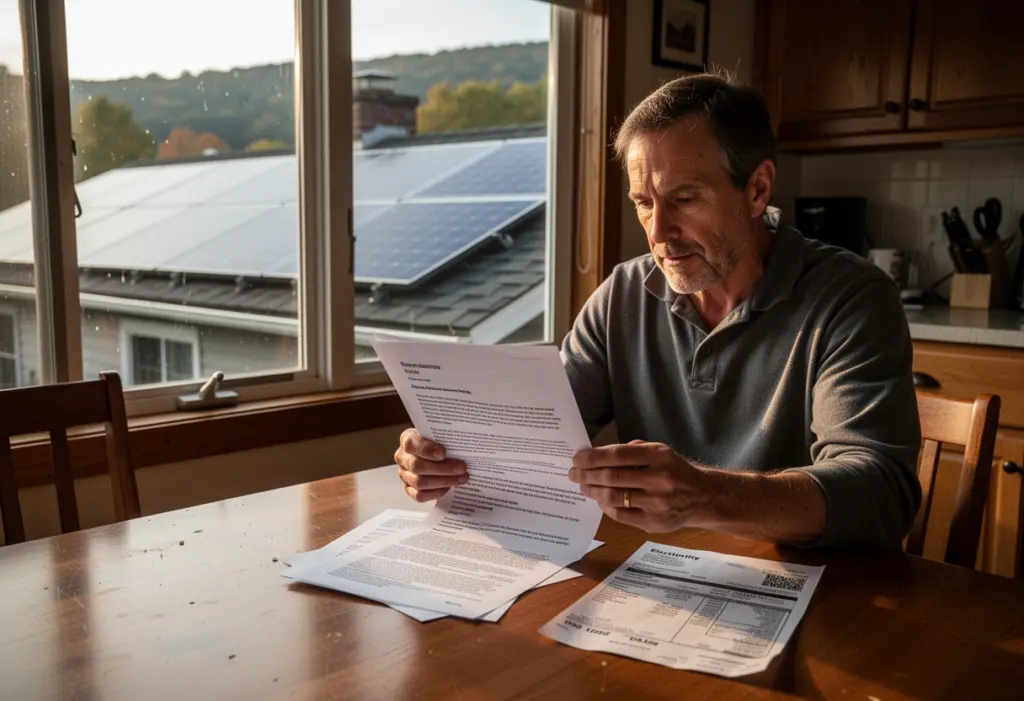
An escalator is the clause in a solar power purchase agreement that raises the price you pay per kilowatt-hour every year of the term. It is the number that decides whether the agreement still looks sensible in year twenty, and in most contracts it appears once, inside a payment schedule, a long way from the headline rate on the front page.
What the number does over a full term
Escalators compound, so a figure that reads as small on the signature page is not small at the end. On a 25 year agreement the final-year rate is the first-year rate multiplied by one plus the escalator, raised to the twenty-fourth power. A 0.9 percent escalator finishes about 1.24 times where it started. A 1.9 percent escalator finishes about 1.57 times. A 2.9 percent escalator roughly doubles, finishing about 1.99 times the opening rate.
That is the arithmetic to run before anything else. Take the starting rate the proposal quotes, apply the escalator written in the contract for the number of years in the term, and write down the final-year rate. If nobody has shown you that figure, you have been shown half the offer.
Compare it against the right line on your bill
A PPA rate replaces electricity you would otherwise buy from the utility, so the comparison is against your full delivered cost per kilowatt-hour, which is supply plus delivery plus surcharges. Divide the total amount due on a recent bill by the kilowatt-hours it covers and you have the number the agreement has to beat. Comparing a PPA rate against a supply-only rate makes almost any escalator look harmless, and that comparison is the most common way a bad escalator gets signed.
An escalator is a bet that your utility rate rises faster than the contract rate does. If it does, the agreement improves with age. If it does not, you have locked a fixed annual increase against a variable that failed to keep up, and no clause gives that back.
Five clauses to read alongside it
- Term length. The same escalator over 25 years and over 15 years are different products, because the term is what multiplies it. Read the two numbers together or neither means anything.
- Buyout points. Ask when you may buy the system, how the price is calculated, and whether that formula is written into the contract or left to a later appraisal.
- Production terms. Ask what happens in a year the array produces less than the estimate, whether you are credited, and whether the remedy is money or a rate adjustment.
- Transfer on sale. Ask whether a buyer must qualify on credit, what happens if they decline to take the agreement, and what the contract then obliges you to do.
- End of term. Removal, renewal rate and purchase price should each be named. An agreement silent about year 26 is an agreement that decides year 26 later, without you.
What New York adds to a PPA
New York is unusual in reaching third-party arrangements at all. The state solar energy system equipment credit, claimed on Form IT-255, is available on a written agreement of ten years or more to buy power from equipment you do not own, at 25 percent of that year’s payments. The same ten-year minimum applies to a lease. A shorter agreement qualifies for nothing at all.
Three limits then shape what an escalating payment stream is actually worth. The $5,000 is a lifetime ceiling for the agreement rather than an annual figure, so once cumulative qualifying payments reach $20,000 the credit is finished. On an agreement running more than fifteen years, no credit is allowed after the fifteenth year even if the ceiling has not been reached. And the equipment must serve your principal residence in New York, so a seasonal or rented property does not qualify.
Ask separately about the Customer Benefit Contribution. It is charged monthly on the DC size of the array for systems interconnected on or after 1 January 2022, and it does not care who owns the panels. At the 2026 residential rates an 8 kW array is $8.00 a month on Orange & Rockland at $1.00 per kW-month and $13.36 on Central Hudson at $1.67. Get it in writing whether the quoted rate sits above or below that charge, and remember the rates are reset annually rather than locked at interconnection.
Why the offer exists at all in 2026
The 30 percent federal residential credit is gone. Section 25D was terminated for expenditures made after 31 December 2025, and an expenditure is treated as made when the original installation is completed. A homeowner buying a system in 2026 claims nothing federally. The credit on the business side survives and is claimed by the company that owns a PPA system, which is exactly why third-party offers can still price in an incentive you will never see on your own return. If a 2026 proposal shows a 30 percent federal line for you, it is materially wrong and worth saying so out loud.
The rest of the 2026 position
Under a PPA you are not buying equipment, so the state sales tax exemption on residential solar equipment belongs to the owner rather than to you, and any NY-Sun incentive would be applied by the contractor against the project rather than paid to you, although as of September 2026 NYSERDA has no open NY-Sun block for homes in any utility territory; check NYSERDA’s NY-Sun dashboard for a new one. Ask how the RPTL 487 exemption is being handled on your assessment, since it attaches to the added value of the system on your parcel, runs fifteen years, applies only where the county, the municipality and the school district have each not opted out, and requires the system to be constructed before 1 January 2030. Programmes move, so check Form IT-255 and its instructions at tax.ny.gov, the NY-Sun pages at nyserda.ny.gov, and your own assessor before relying on any of it.
Frequently Asked Questions
What is an escalator in a solar PPA?
It is the clause that raises the price you pay per kilowatt-hour every year of the agreement. Because it compounds, a small annual figure produces a large difference by the final year of a 25-year term.
How do I judge whether an escalator is too high?
Work out the final-year rate, then compare it against your current full delivered cost per kilowatt-hour from your own bill. There is no single correct number; the question is whether your utility rate is likely to rise faster than the escalator does.
Does a PPA qualify for the New York solar credit?
Yes, where the written agreement runs ten years or more, at 25% of that year's payments on Form IT-255 for your principal residence. The $5,000 is a lifetime ceiling for that agreement, and no credit is allowed after the fifteenth year.
Can I claim the 30% federal credit on a PPA in 2026?
No. Section 25D was terminated for expenditures made after 31 December 2025. Even before that, the credit on a PPA system belonged to the company that owned it, not to the homeowner.
This article is general information, not tax, legal or financial advice. Incentive amounts, eligibility rules and deadlines change and depend on your utility, your tax situation and your property. Confirm current terms with NYSERDA, your utility and a qualified tax professional before making a decision.
NY Solar Incentives
Independent New York solar research. We summarise NYSERDA, NY-Sun and federal programme rules from published sources and state plainly when a figure is an estimate. We are not a government agency and do not sell equipment.
Run the arithmetic on your own system
Check the dated program table and your arrangement before counting an incentive. Standard residential NY-Sun blocks are closed; Long Island Affordable Solar has a conditional income-verification route. The NY credit depends on qualified costs and tax liability, while the NYC abatement reduces future property-tax bills. The estimator keeps those timings separate.