Solar Panel Installation in Tonawanda, NY
Tonawanda's older housing and modest lots make roof age and shading the two questions that decide most projects.
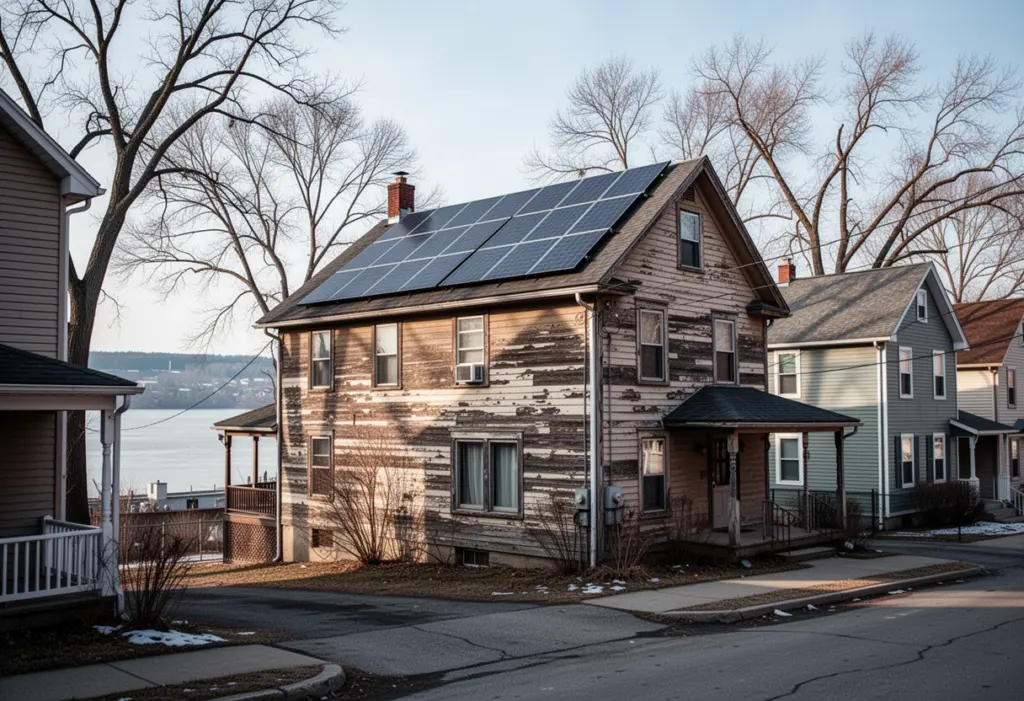
Tonawanda covers the area between Buffalo and the Niagara River, including Kenmore. ZIP codes here begin 141 and 142. It is older, denser suburban housing than the towns further out, and that sets the terms.
Roof age decides the timing
Much of Tonawanda’s housing is pre-war or immediately post-war. Solar modules last decades; asphalt shingles do not. If your shingles have under roughly ten years of life left, replace the roof before installing — removing and reinstalling an array later costs considerably more than mounting on a bare roof, and a leak under an array is a far more expensive problem than one on open shingles.
Older wood-frame roofs also draw a structural engineer’s letter more often than newer construction. Get the roof assessed by someone who is not selling you panels.
Small lots, close neighbours
Houses sit close together, so a neighbour’s roofline or a street tree removes hours of December production at the low winter sun angle even where the summer picture looks fine. Insist on an on-site shading assessment.
Usable roof area is frequently what caps the array rather than consumption, and fire-access clearances take proportionally more of a small roof. Ask what is limiting the system and how much capacity went to clearances.
Complicated roof planes
Older housing means dormers, additions and hips. An array split across planes facing different directions needs module-level electronics — microinverters or optimizers — so the orientations do not drag on each other. Ask what is proposed and why.
The sequence
- Twelve months of National Grid usage, an on-site shading assessment, roof condition and structure.
- Interconnection application to National Grid, before installation.
- Building permit — the Town of Tonawanda, the City of Tonawanda and the Village of Kenmore are separate authorities, so establish which covers your address.
- Installation, then electrical inspection.
- Certificate to National Grid, meter exchange, permission to operate.
Snow
Erie County design loads are high. Ask what the racking is specified for, whether snow guards are needed where the array discharges over a door or a drive, and what snow-cover assumption is in the production estimate.
National Grid
The Customer Benefit Contribution is $0.97 per kW-month of DC system size for 2026, the lowest of the major New York utilities — about $5.82 a month on a 6 kW system, roughly $70 a year. Billed on capacity regardless of production and recalculated annually.
2026 incentives
The 30% federal residential credit has ended — section 25D was terminated for expenditures made after 31 December 2025, with an expenditure treated as made when the original installation is completed.
Still available: New York’s 25% credit capped at $5,000 on Form IT-255, non-refundable but carried forward five years; the state sales tax exemption; and RPTL 487’s 15-year property tax exemption, claimed on form RP-487 filed with your assessor by the taxable status date, where your town, city or village, Erie County and your school district have not opted out. NY-Sun and its Affordable Solar track are not: as of September 2026 NYSERDA has no open NY-Sun block for homes in any utility territory; check NYSERDA’s NY-Sun dashboard for a new one.
Where the roof must come first, community solar needs no roof, no equipment and no up-front cost, and its subscribers pay no Customer Benefit Contribution at all.
Frequently Asked Questions
Who issues a solar permit in Tonawanda?
The Town of Tonawanda, the City of Tonawanda and the Village of Kenmore are separate authorities with their own building departments. Establish which covers your address before anything else.
Why do I need microinverters on an older Tonawanda roof?
Older housing means dormers, additions and hips, so an array is often split across planes facing different directions. Module-level electronics stop one plane or one shaded panel dragging on the rest.
What decides whether solar works here?
Usually roof age and shading. Much of the housing is pre-war or immediately post-war, so shingles with under roughly ten years left mean re-roofing first, and close-set lots mean a neighbour's roofline removes December production.
What if my roof needs replacing first?
Community solar needs no roof, no equipment and no up-front cost, and its subscribers pay no Customer Benefit Contribution. For a household facing a re-roof it is frequently the better arrangement for the next several years.
This article is general information, not tax, legal or financial advice. Incentive amounts, eligibility rules and deadlines change and depend on your utility, your tax situation and your property. Confirm current terms with NYSERDA, your utility and a qualified tax professional before making a decision.
NY Solar Incentives
Independent New York solar research. We summarise NYSERDA, NY-Sun and federal programme rules from published sources and state plainly when a figure is an estimate. We are not a government agency and do not sell equipment.
Run the arithmetic on your own system
Check the dated program table and your arrangement before counting an incentive. Standard residential NY-Sun blocks are closed; Long Island Affordable Solar has a conditional income-verification route. The NY credit depends on qualified costs and tax liability, while the NYC abatement reduces future property-tax bills. The estimator keeps those timings separate.