Solar Panel Installation in Pearl River, NY
Pearl River sits in Orangetown against the New Jersey border. Both facts change the answer: one decides the permit, the other decides the state tax credit.
Pearl River is an unincorporated hamlet in the Town of Orangetown, in southern Rockland County directly against the New Jersey line. ZIP code 10965. Two local facts shape a project here more than anything about the panels does: one decides who issues the permit, the other decides whether the state tax credit exists at all.
Orangetown issues the permit
Pearl River is unincorporated, so the Town of Orangetown building department is the authority having jurisdiction. Orangetown also contains the incorporated villages of Piermont and Grand View-on-Hudson, which run their own building departments, so the authority follows the parcel and not the postmark. Ask which department your installer intends to file with, and confirm it matches your address.
The state line is a tax line
New York’s credit — 25% of qualified expenditure capped at $5,000, claimed on Form IT-255 — requires the equipment to be installed and used at your principal residence in New York State. Living within sight of New Jersey does not soften that in either direction:
- A principal residence on the New Jersey side does not qualify for the New York credit, however short the drive.
- A second home, a seasonal property or a rental you own in New York does not qualify either. The test is where you actually live.
- The credit is limited by your actual New York State tax liability, so a proposal that simply subtracts $5,000 from the price may be describing a benefit you cannot use in a single year. It is not refundable, but unused credit carries forward for up to five years.
- It reaches a lease or a power purchase agreement as well as a purchase, but only where the agreement runs for ten years or more — that minimum applies to the lease exactly as it does to the PPA.
Three levels of RPTL 487 here, four a few miles north
The fifteen-year exemption on the added value of the system applies only where the taxing authority has not opted out. A Pearl River address has three: the Town of Orangetown, which may opt out by local law; Rockland County, separately; and your school district, which opts out by resolution and for most of the hamlet is the Pearl River School District. Buy a house a few miles north inside a village and there is a fourth, the village itself, which is the level people forget precisely because it is the smallest bill. In a county with this many incorporated villages, the honest instruction is to check the position for the specific parcel rather than repeat what applied at your last address. Construction must be complete before 1 January 2030.
Mid-century housing under a mature canopy
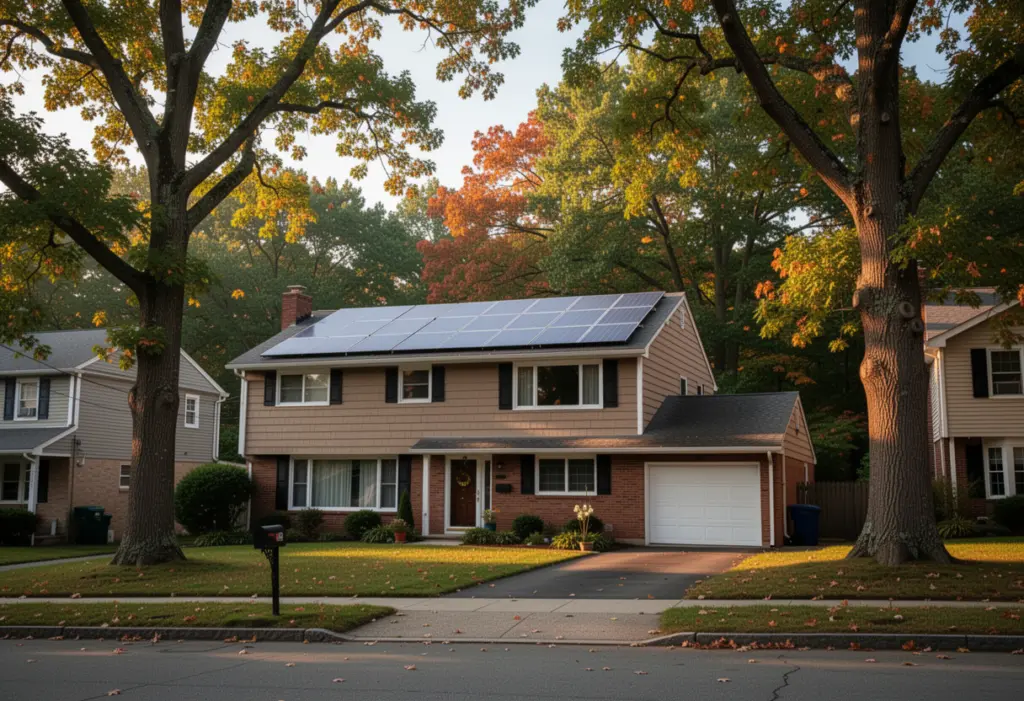
Much of Pearl River is post-war and mid-century housing on established, well-treed streets, which raises three familiar checks:
- The roof. Ten years of remaining shingle life is the usual threshold; below it the roof goes on first, because an array has to come off and go back again, and that labour is paid for twice.
- The panel. A 100 amp board is normal at this age, and the real question is whether the busbar can take a solar breaker at all. Whatever the answer costs, an upgrade or a line-side tap, belongs in the signed price.
- The trees. Canopy usually decides the numbers on these streets, and it decides them in December, when the sun is lowest and the credit bank is being spent. Ask for an on-site assessment and for the winter months broken out. Two installers who disagree sharply about the same roof are generally telling you which of them came to look at it.
Orange and Rockland
The county is served by Orange & Rockland, whose 2026 residential Customer Benefit Contribution is a flat dollar for every kilowatt of DC capacity, each month, for the life of the system. A 7 kW array is therefore $7.00 a month or about $84 a year, and a 10 kW array $10.00 a month or about $120. Systems connected from the start of 2022 onward pay it; the amount tracks the size of the array rather than what it generates, and it is restated every year. On the other side of the ledger, exports earn the full retail rate under Phase One net metering for two decades from the day of interconnection. Take the utility name off your own bill: a municipal utility customer anywhere in New York falls outside Public Service Commission jurisdiction, and none of these rules reach them.
What is left in 2026
The residency test above is the gate on the largest item, so settle it before anything else on a proposal is discussed. It is also the test most easily got wrong in this corner of the state, where a household can hold property on both sides of a border twenty minutes apart and where a house bought as a weekend place never becomes a principal residence just because panels went on it.
Past that gate the rest is straightforward. NY-Sun used to reduce the contractor’s price rather than your tax bill, and the Affordable Solar incentive did the same for households at or below 80% of area median income. As of September 2026 NYSERDA has no open NY-Sun block for homes in any utility territory; check NYSERDA’s NY-Sun dashboard for a new one. The state sales tax exemption takes the tax off residential solar equipment, each locality electing separately on its own share. And RPTL 487 holds wherever the town, the county and the school district have all declined to opt out.
What has gone is the federal residential credit. Section 25D no longer reaches expenditures made after 31 December 2025, and the statute dates an expenditure to the completion of the original installation, so a 2026 buyer claims nothing on a federal return. The credit that survives is the business-side one, held by the company that owns a leased or PPA system, which is why a third-party offer can still be priced around an incentive that never appears on yours. Programmes change, so check the current position before signing.
Frequently Asked Questions
Which building department covers Pearl River?
The Town of Orangetown, because Pearl River is an unincorporated hamlet. Orangetown also contains the villages of Piermont and Grand View-on-Hudson, which run their own departments, so the authority follows the parcel rather than the mailing address.
Does living near New Jersey affect the New York solar credit?
Only in the sense that the credit requires a principal residence in New York State. A home on the New Jersey side does not qualify for Form IT-255, and neither does a second home or a rental property you own in New York.
How many authorities do I check for the property tax exemption?
Three for a Pearl River address: the Town of Orangetown, Rockland County and your school district. Inside one of Rockland's villages there is a fourth, and the village level is the one most commonly forgotten.
What does Orange and Rockland charge here?
The Customer Benefit Contribution at $1.00 per kW-month of DC system size for 2026 — about $84 a year on a 7 kW system and $120 on 10 kW. It is charged on capacity regardless of production and recalculated each year.
This article is general information, not tax, legal or financial advice. Incentive amounts, eligibility rules and deadlines change and depend on your utility, your tax situation and your property. Confirm current terms with NYSERDA, your utility and a qualified tax professional before making a decision.
NY Solar Incentives
Independent New York solar research. We summarise NYSERDA, NY-Sun and federal programme rules from published sources and state plainly when a figure is an estimate. We are not a government agency and do not sell equipment.
Run the arithmetic on your own system
Check the dated program table and your arrangement before counting an incentive. Standard residential NY-Sun blocks are closed; Long Island Affordable Solar has a conditional income-verification route. The NY credit depends on qualified costs and tax liability, while the NYC abatement reduces future property-tax bills. The estimator keeps those timings separate.