Solar Panel Installation in Patchogue, NY: The Sequence
The equipment on a Patchogue roof is the easy part. What decides whether the project runs smoothly is the order of the paperwork and who is responsible for each step.
On this page 7 sections
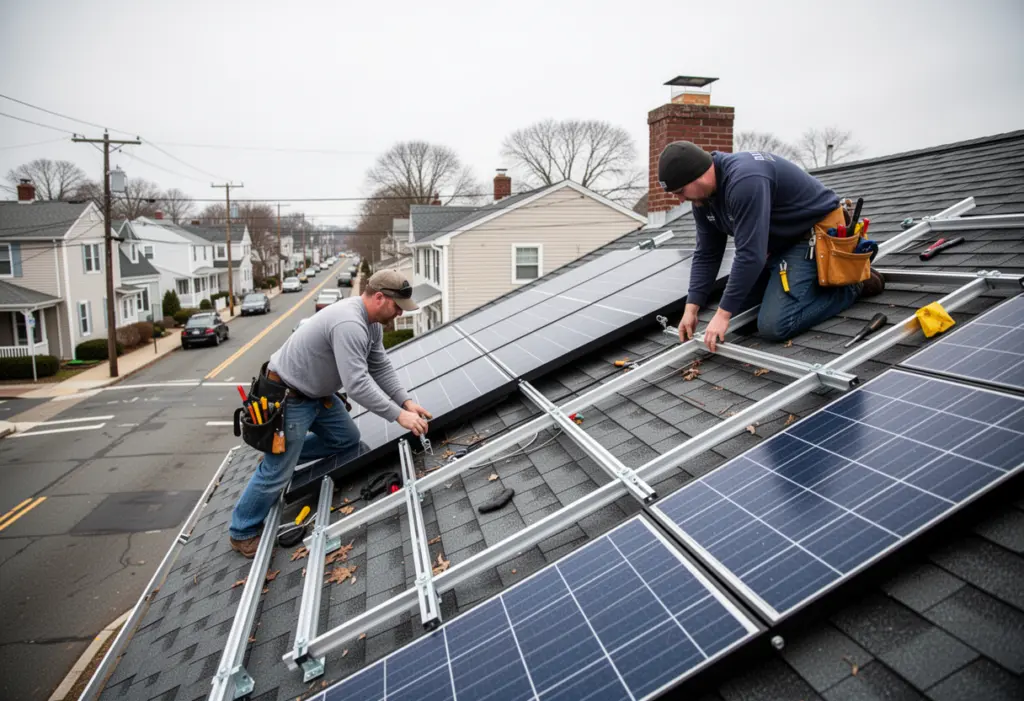
Most Patchogue solar projects that go badly do not go badly on the roof. They stall in the gaps between a permit, an inspection, an interconnection application and a utility sign-off, because nobody was clearly responsible for the next step. Knowing the sequence in advance is the single most useful thing a homeowner can bring to the first meeting.
The order things actually happen in
- Site survey. Roof, attic, service panel and shading, in person. A layout produced from aerial imagery alone is a sales tool, not a design.
- Design and production estimate. Ask for output month by month, not only an annual total.
- Interconnection application to PSEG Long Island, which operates the LIPA system serving the area.
- Building permit from whichever authority covers your address.
- Installation, including any roof work agreed beforehand.
- Electrical inspection and the certificate that follows it.
- Permission to operate from the utility. The system stays off until this lands.
Ask for that list with a named owner beside each line, and ask what happens to your deposit if a step is refused. A contractor who cannot answer the second question has not thought about the first.
Two authorities share one ZIP code
Addresses inside the incorporated village apply to the Village of Patchogue. Addresses in East Patchogue and North Patchogue, which share the 11772 ZIP but sit outside the village boundary, apply to the Town of Brookhaven. Confirm at the survey which one covers you and make sure the contractor names it in the contract. Both jurisdictions expect a complete package rather than a partial one, and an incomplete application is the most common quiet cause of a project that has not moved for a month.
The electrical inspection is not done by the building department
In New York, municipalities generally accept a certificate from an approved electrical inspection agency rather than performing the inspection themselves, and that is standard practice on Long Island. Two things follow. Ask which agency your installer uses and how they schedule it, because a certificate that arrives late holds up the utility. And ask for a copy of the certificate for your own records — you will want it when you sell the house, and the buyer’s attorney will ask for it.
What to settle before you sign, not after
- Roof age and the reset price. If the shingles under the array need replacing in a few years, agree now what removal and reinstallation will cost. Verbal reassurance is worth nothing when the roofer is on site.
- Who files what. NY-Sun, when NYSERDA has a residential block open, is applied by the contractor as a price reduction (none is open for homes as of September 2026, so it should not appear); Form IT-255 for the New York State credit is filed by you with your return, and form RP-487 for the property tax exemption is filed by you with the assessor. Neither party should assume the other is handling it.
- Financing structure. A very low advertised loan rate usually reflects a dealer fee already built into the system price. Ask for the cash price and the financed price side by side, and compare the totals rather than the monthly payments.
- Lease and PPA terms. If the offer is a lease or power purchase agreement, ask for the term length in years and what is filed against the property. New York’s credit only reaches agreements of ten years or more.
Sizing, and the charge that follows it
The Customer Benefit Contribution is billed monthly on the DC size of your array regardless of what it produces, on systems interconnected on or after 1 January 2022. At the 2026 residential rate of $1.13 per kW-month for LIPA and PSEG Long Island, a 9 kW array carries about $10.17 a month, roughly $122 a year. Rates are recalculated annually, so it is this year’s number rather than a fixed cost. The practical lesson is that capacity you do not need is not free: Phase One net metering credits exports at the full retail rate and holds for 20 years, but a credit balance you never consume still cost you panels and still costs you that monthly charge.
Where the money comes from in 2026
Do not let a proposal show you a federal credit. Section 25D was terminated for expenditures made after 31 December 2025, and an expenditure is treated as made when the original installation is completed, so a 2026 buyer claims nothing federally. What is live is New York’s 25 percent credit capped at $5,000 on Form IT-255 for a principal residence, the state sales tax exemption on residential solar equipment, and the RPTL 487 exemption on added property value for 15 years, claimed on form RP-487, where the village or town, Suffolk County and the school district have each not opted out. The NY-Sun incentive applied through your installer, and its Affordable Solar incentive for households under 80 percent of area median income, are not: PSEG Long Island’s last residential NY-Sun block closed on 17 April 2016, and as of September 2026 NYSERDA has no open NY-Sun block for homes in any utility territory; check NYSERDA’s NY-Sun dashboard for a new one. Programmes are revised regularly; confirm the current position with NYSERDA and with New York State Taxation and Finance before you commit to anything.
Frequently Asked Questions
What is the correct order for a Patchogue solar project?
Site survey, design and production estimate, interconnection application to PSEG Long Island, building permit, installation, electrical inspection and certificate, then permission to operate from the utility. The system stays off until the final step is complete.
Who does the electrical inspection?
Generally an approved electrical inspection agency rather than the building department itself, which is standard practice on Long Island. Ask which agency your installer uses, and keep a copy of the certificate — a buyer's attorney will ask for it when you sell.
Do I apply for the incentives myself?
For what is available now, yes. NY-Sun would be applied by the contractor as a reduction in the price, but as of September 2026 NYSERDA has no open NY-Sun block for homes, so it should not appear on the proposal. Form IT-255 for the New York State credit is filed by you with your own tax return, and form RP-487 for the property tax exemption is filed by you with the assessor.
Is a low interest solar loan a good deal?
Compare it against the cash price rather than against another monthly payment. A very low advertised rate usually reflects a dealer fee already built into the system price, so ask for both prices side by side and compare the totals.
This article is general information, not tax, legal or financial advice. Incentive amounts, eligibility rules and deadlines change and depend on your utility, your tax situation and your property. Confirm current terms with NYSERDA, your utility and a qualified tax professional before making a decision.
NY Solar Incentives
Independent New York solar research. We summarise NYSERDA, NY-Sun and federal programme rules from published sources and state plainly when a figure is an estimate. We are not a government agency and do not sell equipment.
Run the arithmetic on your own system
Check the dated program table and your arrangement before counting an incentive. Standard residential NY-Sun blocks are closed; Long Island Affordable Solar has a conditional income-verification route. The NY credit depends on qualified costs and tax liability, while the NYC abatement reduces future property-tax bills. The estimator keeps those timings separate.