Solar Panel Installation in Norwich, NY
Norwich is a city with a town of the same name around it, in a narrow Chenango valley where two neighbouring villages run their own electric utilities and none of the state rules reach them.
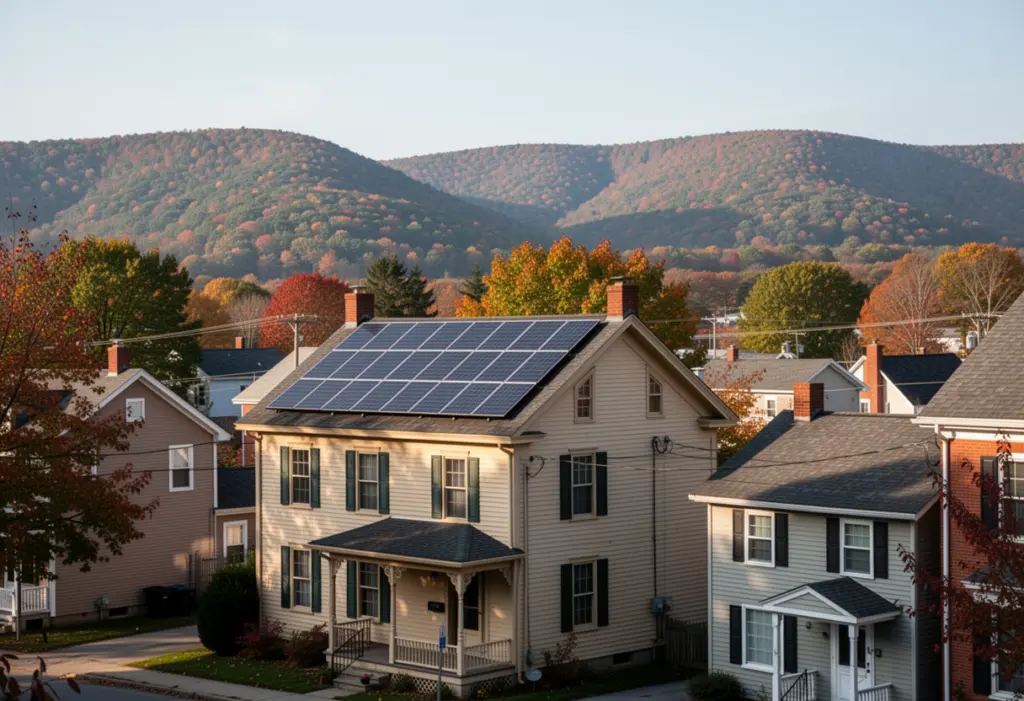
Norwich is a city in Chenango County and the county seat, sitting in the Chenango River valley with a separate Town of Norwich around it. ZIP code 13815. Three local facts shape a solar project here, and the first is the strongest differentiator on this whole site.
Two villages nearby are outside every rule on this page
Chenango County contains two municipal electric utilities: the Village of Greene runs its own electric department, and so does the Village of Sherburne. Over the hill in Cortland County, the Village of Marathon runs a third.
Municipal utilities sit outside Public Service Commission jurisdiction, and that is not a detail. It means state net metering, the Customer Benefit Contribution and the standardised state interconnection process do not apply to their customers at all. Terms are set by the utility itself and have to be asked for directly, and a proposal built on state net metering rules is simply the wrong document for one of those addresses.
So read the utility name printed on your own bill before anything else. Most of Norwich is NYSEG, but territory here does not follow municipal boundaries, and an installer covering the whole valley may be carrying assumptions from the wrong side of it.
City or town
The City of Norwich and the Town of Norwich are separate authorities with their own building departments. City lots are smaller with older housing; town properties are frequently larger, with genuine room for a ground mount. Establish which covers your address before an installer files anything, because turnarounds and fee schedules differ and a permit lodged with the wrong department is time lost. A Norwich address may also fall under the NYS Unified Solar Permit, the standardised residential route for systems of 25 kW DC and under that over 300 New York authorities have adopted.
The Chenango valley: flood plain below, ridges above
The Chenango runs through the middle of the city and the flats beside it are mapped flood plain. What that constrains is mounting height rather than the array itself. An elevation is set; the inverter, the disconnects, the production meter and any battery all have to clear it; and a cellar is consequently a poor place to plan a battery. Put the question to the city or the town before a designer starts work.
Above the flats the valley is narrow, with wooded slopes on both sides, which makes the southern horizon vary sharply over short distances. A house near the western side of the valley loses afternoon sun to the ridge, and one tucked under the eastern slope loses the morning. In December, when the sun is lowest and the net metering credit bank is being drawn down, the effect is at its largest. Insist on an on-site shading assessment and ask what the model says about December and January rather than only the annual total.
Older housing
The city’s housing stock is old by state standards, and three checks follow. Roof age: under roughly ten years of shingle life left means re-roof first, because removing and reinstalling an array later costs considerably more than mounting on a bare roof. Structure: older wood-frame roofs draw an engineer’s letter more often than newer construction, and slate and standing-seam metal both appear here, standing seam being the best case since racking clamps to the seams with no penetrations at all. Service capacity: 100 amp service is common, and fitting a solar breaker can require a panel upgrade or a line-side tap, so get it priced in the quote rather than as a change order.
NYSEG and the Customer Benefit Contribution
For NYSEG customers the Customer Benefit Contribution is a monthly charge on the DC size of the system, applying to anyone interconnecting on or after 1 January 2022. The 2026 residential rate is $1.19 per kW-month:
- An 11 kW system: $13.09 a month, about $157 a year.
- A 16 kW system: $19.04 a month, about $228 a year.
Nameplate capacity drives that bill and generation does not, and the rate is revisited every year. On the other side of the account, Phase One net metering pays the full retail rate for what you export and keeps that arrangement for 20 years. A community solar subscription escapes the contribution entirely.
2026 incentives, and the body most people forget to ask
Federally, a 2026 buyer gets nothing. Section 25D was terminated for expenditures made after 31 December 2025, with the date of the expenditure fixed at completion of the original installation. There is no phase-down and no transition, so a proposal still carrying the 30% line is wrong rather than optimistic.
Of what is left, the item that most often decides the actual value of a Norwich installation is the property tax exemption, and specifically the school district’s answer. RPTL 487 exempts the added value of the system for 15 years, but the opt-out belongs separately to a county, city, town or village by local law and to a school district by resolution. In New York the five fiscally dependent big-city districts levy no separate property tax, so their homeowners have nothing to check. Norwich is not one of them: your school district raises its own levy, usually the largest line on the bill, and it can opt out on its own without notifying anybody selling panels. Ask the assessor about the school district by name, alongside the city or town and Chenango County, file form RP-487 with the assessor by the taxable status date, and note that section 487 requires construction before 1 January 2030.
Everything else on the list is statewide and simply has to be claimed. New York’s own credit is 25% of qualified expenditure up to $5,000 on Form IT-255, at a principal residence, on a purchase or on a lease or power purchase agreement running ten years or more, and it stops at whatever state tax you actually owe, with unused credit carried forward for up to five years. Residential solar equipment is exempt from state sales tax. NY-Sun and its Affordable Solar block for lower-income households are no longer on the list: as of September 2026 NYSERDA has no open NY-Sun block for homes in any utility territory; check NYSERDA’s NY-Sun dashboard for a new one. Confirm current terms with NYSERDA before you sign.
Frequently Asked Questions
Do state solar rules apply everywhere around Norwich?
No. The Village of Greene and the Village of Sherburne run their own electric departments in Chenango County, as does Marathon over in Cortland County, and municipal utilities sit outside Public Service Commission jurisdiction. State net metering, the Customer Benefit Contribution and the standardised interconnection process do not reach their customers.
City of Norwich or Town of Norwich, who issues the permit?
They are separate authorities with their own building departments. City lots are smaller with older housing, town properties frequently larger with room for a ground mount. Establish which covers your address before anything is filed.
Why does the school district matter for my solar exemption?
Because it can opt out of RPTL 487 by its own resolution, separately from the city, the town and the county, and the school levy is usually the largest line on a Norwich tax bill. Ask the assessor about the district by name rather than accepting a general assurance.
What does NYSEG charge a Norwich solar customer?
The Customer Benefit Contribution at $1.19 per kW-month of DC system size for 2026: $13.09 a month on 11 kW, about $157 a year, and $19.04 on 16 kW, about $228, billed on capacity regardless of production.
This article is general information, not tax, legal or financial advice. Incentive amounts, eligibility rules and deadlines change and depend on your utility, your tax situation and your property. Confirm current terms with NYSERDA, your utility and a qualified tax professional before making a decision.
NY Solar Incentives
Independent New York solar research. We summarise NYSERDA, NY-Sun and federal programme rules from published sources and state plainly when a figure is an estimate. We are not a government agency and do not sell equipment.
Run the arithmetic on your own system
Check the dated program table and your arrangement before counting an incentive. Standard residential NY-Sun blocks are closed; Long Island Affordable Solar has a conditional income-verification route. The NY credit depends on qualified costs and tax liability, while the NYC abatement reduces future property-tax bills. The estimator keeps those timings separate.