Solar Panel Installation in Mineola, NY
Mineola is an incorporated village with its own building department, and a postal area that reaches past its own boundary. Establishing which side you are on comes first.
On this page 7 sections
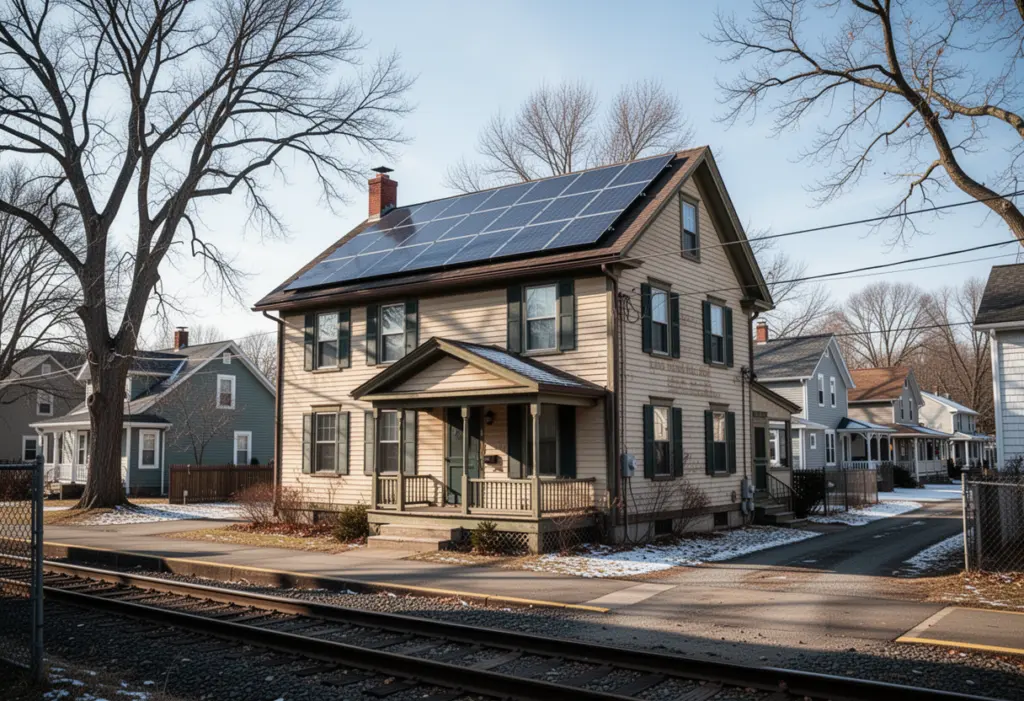
Mineola is an incorporated village in the Town of North Hempstead, Nassau County, ZIP code 11501, and the seat of Nassau County government. It is compact, walkable and built around a Long Island Rail Road station, and that shape decides most of what a solar project here looks like.
The village issues the permit — if you are in the village
The Village of Mineola runs its own building department. The Town of North Hempstead permits the unincorporated areas around it, Garden City Park among them, while neighbouring incorporated villages such as Williston Park and East Williston each run their own building department.
The 11501 postal area does not stop at the village line, so a Mineola mailing address is not by itself proof of which authority covers your parcel. Confirm it before an installer files anything — a permit lodged with the wrong department is time lost rather than a small correction, and fee schedules and turnarounds differ between them.
Small lots, close neighbours
Mineola’s housing sits close together, and three consequences follow that a large-lot specification never raises:
- Fire-access pathways and setbacks take proportionally more of a small roof. Ask how much capacity went to clearances before concluding that a quote is undersized.
- A neighbour’s roofline or a street tree can shade yours at the low December sun angle, which is the month the net metering credit bank is being drawn down rather than filled. Insist on an assessment made at the property, and ask what the model says about December and January, not only the annual total.
- Dormers, vents and chimneys cost more here. On a large roof an obstruction is worked around; on a modest one it removes a meaningful share of the capacity.
Older and post-war housing: the service panel
Housing in and around the village spans the early twentieth century through the post-war decades, and 100 amp service is common. Fitting a solar breaker can require a panel upgrade or a line-side tap, and that is the single most frequent cost surprise on installations in this part of Nassau.
Ask what your service is and whether the busbar has room, and get the answer in the quote rather than as a change order after contract. It is a legitimate cost, not padding, but it should be visible before you sign. On roof age the usual gate applies: under roughly ten years of shingle life left means re-roof first, because removing and reinstalling an array later costs considerably more than mounting on a bare roof.
Apartments and two-family houses: the meter decides
There is a substantial multi-family and rented stock around the station. There, a system offsets only the meter it is connected behind. A building-side array offsets the owner’s usage — hallways, boiler, common areas — not a tenant’s apartment, even where the panels sit directly above it.
For tenants, and for owners whose tenants hold their own meters, community solar is the route that reaches the person actually paying the bill. It needs no roof and no up-front cost, and its subscribers pay no Customer Benefit Contribution at all.
PSEG Long Island, and the charge on capacity
The Customer Benefit Contribution falls on anyone who interconnected on or after 1 January 2022 and is billed monthly against DC capacity. At the 2026 PSEG Long Island residential rate of $1.13 per kW-month, the range this housing typically supports runs from a 4 kW system at $4.52 a month, about $54 a year, to a 10 kW system at $11.30, about $136. The rate is re-set annually rather than fixed at interconnection, and it is owed on capacity whether the array produces or not. Phase One net metering credits exported kilowatt-hours at the full retail rate and holds that structure for 20 years from interconnection.
The utility name on your own bill is the only thing that settles which of the above applies to you. PSEG Long Island, operator of the LIPA system, covers most of Nassau County, while Freeport and Rockville Centre run their own municipal electric utilities outside Public Service Commission jurisdiction, where none of the state net metering, Customer Benefit Contribution or standardised interconnection rules reach.
2026 incentives
Nothing federal remains for a buyer. Section 25D closed to expenditures made after 31 December 2025, the expenditure being dated to completion of the original installation, so a 2026 purchase earns no federal credit at all: no phase-down, no transition, no carryover of a credit never earned. On a modest system that absence is proportionally large, which makes what is left matter more here, not less.
And what is left is not only for owners. In a village with this much rented and multi-family housing, community solar is the incentive route that actually reaches most households: no roof, no up-front cost, no Customer Benefit Contribution, and it works for a tenant whose landlord will never put panels on the building. For an owner-occupier the stack is the state’s 25% credit capped at $5,000 on Form IT-255 at a principal residence, reaching leases and power purchase agreements of ten years or more and carrying forward for up to five years; the state sales tax exemption; and RPTL 487’s 15-year exemption where the village, the Town of North Hempstead, Nassau County and your school district have each not opted out, the district being the one that matters most on a Nassau bill. NY-Sun and its Affordable Solar incentive are not in the stack: PSEG Long Island’s last residential NY-Sun block closed on 17 April 2016, and as of September 2026 NYSERDA has no open NY-Sun block for homes in any utility territory; check NYSERDA’s NY-Sun dashboard for a new one. Ask NYSERDA and the NY Department of Taxation and Finance for the current position rather than relying on a printed proposal.
Frequently Asked Questions
Does the Village of Mineola issue my solar permit?
If your parcel is inside the village, yes — it runs its own building department. The 11501 postal area reaches past the village line, so a Mineola mailing address is not proof. Confirm the parcel before anything is filed.
Will a Mineola house need an electrical panel upgrade?
Often. 100 amp service is common in housing of this age, and fitting a solar breaker can require an upgrade or a line-side tap. Ask what your service is and whether the busbar has room, and get it in the quote rather than a later change order.
Does solar work for a rented apartment near the station?
A rooftop system offsets only the meter it is connected behind, so a building-side array reaches the owner's usage rather than a tenant's apartment. Community solar reaches the person paying the bill, needs no roof, and carries no Customer Benefit Contribution.
What does PSEG Long Island charge a Mineola solar customer?
The Customer Benefit Contribution at $1.13 per kW-month of DC system size for 2026 — about $54 a year on a 4 kW system and $136 on 10 kW, charged on capacity regardless of production.
This article is general information, not tax, legal or financial advice. Incentive amounts, eligibility rules and deadlines change and depend on your utility, your tax situation and your property. Confirm current terms with NYSERDA, your utility and a qualified tax professional before making a decision.
NY Solar Incentives
Independent New York solar research. We summarise NYSERDA, NY-Sun and federal programme rules from published sources and state plainly when a figure is an estimate. We are not a government agency and do not sell equipment.
Run the arithmetic on your own system
Check the dated program table and your arrangement before counting an incentive. Standard residential NY-Sun blocks are closed; Long Island Affordable Solar has a conditional income-verification route. The NY credit depends on qualified costs and tax liability, while the NYC abatement reduces future property-tax bills. The estimator keeps those timings separate.