Solar Panel Cost in Brookhaven, NY: What Actually Drives It
Brookhaven is a very large town containing several incorporated villages, so the first thing that changes your solar price is which office reviews the permit.
On this page 7 sections
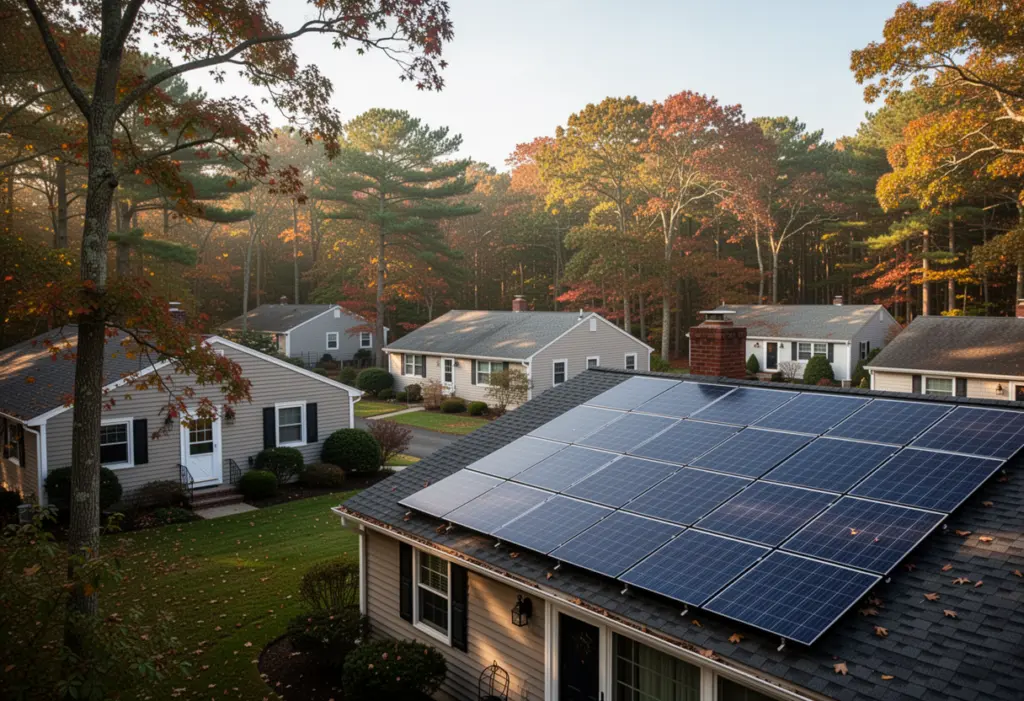
Brookhaven covers an enormous area of central and eastern Suffolk County, and a price quoted for a house in Centereach is not evidence of anything about a house in Shirley. Before comparing numbers, establish three things: who reviews your permit, what condition the roof is in, and whether the price you are shown is a cash price or a financed one.
Town or village makes a difference before anything else
The Town of Brookhaven building department handles the unincorporated hamlets, which is most of the town by population. But several incorporated villages sit inside it, including Patchogue, Port Jefferson, Bellport, Belle Terre, Poquott, Old Field and Lake Grove, and a village runs its own building department with its own forms, fees and review pace. Postal address is not the test. If your mail says Port Jefferson but you live in Port Jefferson Station, you are in the town, not the village.
The state Unified Solar Permit exists for residential systems of 25 kW DC and under and has been adopted by over 300 authorities having jurisdiction. Ask which form your installer will file for your address and how long the last few reviews at that office took.
ZIP codes and housing stock
The town spans a wide spread of postal areas, among them 11719 for Brookhaven hamlet, 11720 Centereach, 11763 Medford, 11772 Patchogue, 11776 Port Jefferson Station and 11967 Shirley. What they have in common is a large stock of single family houses built from the 1960s through the 1980s, which means asphalt roofs now on their second or third covering, 100 or 150 amp services, and mature tree cover that was small when the house was new.
Two consequences follow. First, a roof within a few years of replacement should be replaced before an array goes on it. Second, the shading study matters more than the panel brand. Ask whether the shade assessment was done on site or from satellite imagery, and ask what December and January production the model assumes.
The financing gap is the part nobody volunteers
A very low advertised loan rate is not free money. The fee that buys the rate down is normally folded into the system price, which is why the same array can carry one number in cash and a noticeably higher one on a long-term loan. The way to see it is to ask for both prices for the identical equipment list, in writing, and then compare. If the cash price is not available, that itself is an answer.
The monthly charge on capacity
PSEG Long Island operates the LIPA system across most of Suffolk, and the name on your own electricity bill is the only reliable confirmation that it is your utility. The Customer Benefit Contribution is charged on the DC size of the array and not on output, so it is the same in a cloudy December as in a bright June. The 2026 residential rate is $1.13 per kW-month, so a 9 kW system pays 9 x $1.13 = $10.17 a month, about $122 a year. It applies to systems interconnected on or after 1 January 2022, and it is recalculated annually rather than locked in.
Exports are credited under Phase One net metering at the full retail rate, and that structure holds for 20 years from interconnection.
Property tax needs three separate answers
RPTL 487 gives a 15 year exemption on the value the system adds, but a county, city, town or village may opt out by local law and a school district may opt out by resolution. In Brookhaven that is three checks: Suffolk County, the town or your village, and your school district. School district boundaries here do not follow town or hamlet lines at all, so check yours by name rather than by address assumption. The exemption also requires construction before 1 January 2030.
2026 incentives, in the order they matter here
NY-Sun is the one you will not see at all. NYSERDA paid it through the contractor as a reduction in price, in megawatt blocks that stepped down as each block filled, and Long Island’s last residential block closed on 17 April 2016. As of September 2026 NYSERDA has no open NY-Sun block for homes in any utility territory; check NYSERDA’s NY-Sun dashboard for a new one, and if a proposal shows a NY-Sun line anyway, ask which open block it comes from.
New York’s 25 percent credit capped at $5,000 on Form IT-255 remains available for a principal residence. The 30 percent federal residential credit does not: section 25D ended for expenditures made after 31 December 2025, with the test being completion of the original installation. Verify the current state of both at nyserda.ny.gov and tax.ny.gov before you sign, because these programmes change on their own schedule.
Frequently Asked Questions
Does the Town of Brookhaven issue every solar permit in the town?
No. Incorporated villages inside the town, including Patchogue, Port Jefferson, Bellport, Belle Terre, Poquott, Old Field and Lake Grove, run their own building departments. Your postal address does not decide which applies.
Why is the financed price higher than the cash price?
The fee that buys down a low loan rate is normally folded into the system price. Ask for a cash price and a financed price for the identical equipment list and compare them side by side.
What is the monthly capacity charge on a 9 kW system?
At the 2026 PSEG Long Island residential rate of $1.13 per kW-month, a 9 kW system pays about $10.17 a month, roughly $122 a year, billed on DC size rather than on production.
How do I check the property tax exemption in Brookhaven?
RPTL 487 requires three separate checks: Suffolk County, the town or your incorporated village, and your school district. Any of them may have opted out, and the system must be constructed before 1 January 2030.
This article is general information, not tax, legal or financial advice. Incentive amounts, eligibility rules and deadlines change and depend on your utility, your tax situation and your property. Confirm current terms with NYSERDA, your utility and a qualified tax professional before making a decision.
NY Solar Incentives
Independent New York solar research. We summarise NYSERDA, NY-Sun and federal programme rules from published sources and state plainly when a figure is an estimate. We are not a government agency and do not sell equipment.
Run the arithmetic on your own system
Check the dated program table and your arrangement before counting an incentive. Standard residential NY-Sun blocks are closed; Long Island Affordable Solar has a conditional income-verification route. The NY credit depends on qualified costs and tax liability, while the NYC abatement reduces future property-tax bills. The estimator keeps those timings separate.