Solar Incentives in Herkimer County, NY
Herkimer County stretches from valley towns into the Adirondacks, and the snow load at the top is not the snow load at the bottom.
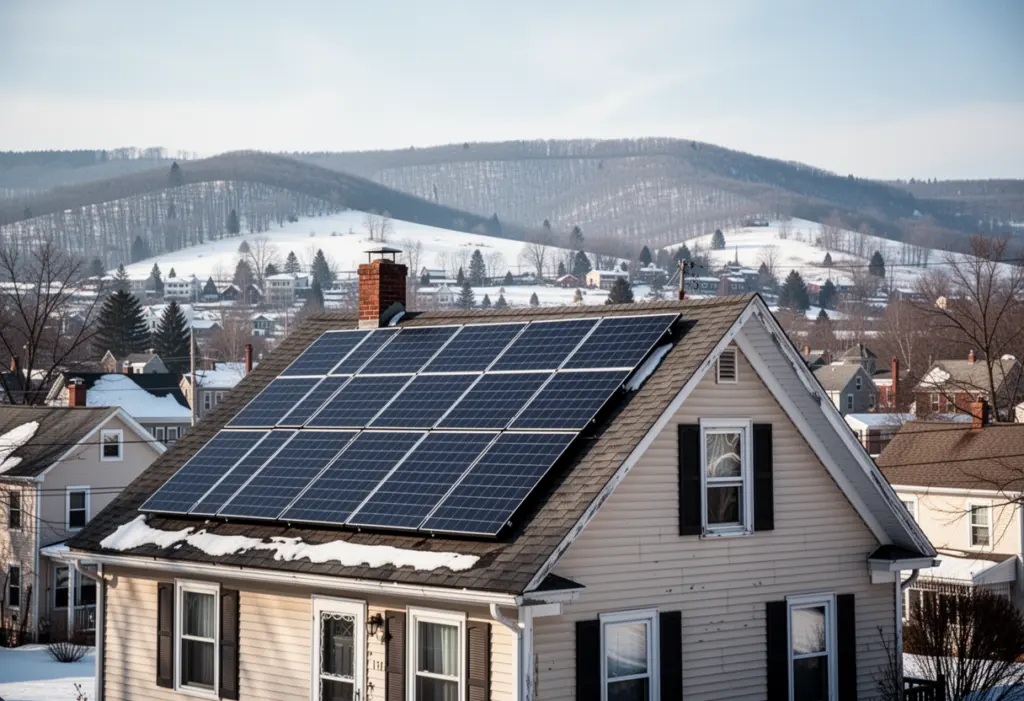
Herkimer County is a long thin county running from the Mohawk Valley deep into the Adirondacks — Herkimer, Ilion, Mohawk, Little Falls, Frankfort, Dolgeville, Old Forge. ZIP codes here begin 133 and 134. Its shape is the point: the conditions at the southern end and the northern end are genuinely different.
Two climates in one county
In the valley towns snow load is high but manageable, roughly comparable with the rest of the Mohawk Valley. In the Adirondack north — Old Forge and the towns around it — design snow loads are among the very highest in New York State.
So a quote written for Ilion is not a quote for Old Forge. Ask specifically:
- What snow load is the racking specified for, for this address?
- Who verified the roof can carry the array in addition to that load? A structural engineer’s letter is common at the northern end.
- Where does the snow discharge, and are snow guards included?
- What snow-cover assumption is in the production estimate? A model without one overstates the annual figure, and at the northern end it overstates it badly.
What snow does not do is decide whether solar works. Panels shed faster than the shingles around them, and the lost days fall in December and January when production is weakest anyway.
Old valley housing
Herkimer, Ilion, Mohawk and Little Falls carry old industrial-era housing, and roof age is frequently the gate: under roughly ten years of shingle life left means re-roof first, because removing and reinstalling an array later costs considerably more than mounting on a bare roof. Older wood-frame roofs also draw a structural letter more often than newer construction.
National Grid
Phase One net metering credits exports at the full retail rate and holds for 20 years from interconnection. The Customer Benefit Contribution is $0.97 per kW-month of DC system size for 2026 — the lowest of the major New York utilities: about $5.82 a month on a 6 kW system, roughly $70 a year, or $93 on 8 kW.
Billed on capacity regardless of production and recalculated annually.
Land, and why ground mounts suit the north
Herkimer County has space, and in the snowier northern towns a ground mount has an advantage that goes beyond the usual ones: it can be tilted steeply enough to shed reliably, and if clearing is ever needed it can be reached safely from the ground rather than from an icy roof.
It also removes the roof-age question. Ask what foundation is proposed and to what depth, because the frost line is deep here and that is a real part of the cost.
Sizing
Get twelve months of usage before accepting a design. Seasonal camps and second homes in the north have consumption patterns nothing like a year-round house, and a template will get both wrong.
2026 incentives
The 30% federal residential credit has ended — section 25D was terminated for expenditures made after 31 December 2025, with an expenditure treated as made when the original installation is completed.
Still available: New York’s 25% credit capped at $5,000 on Form IT-255 for your principal residence — worth noting in a county with many second homes, because a camp that is not your principal residence does not qualify; the state sales tax exemption; and RPTL 487’s 15-year property tax exemption where your town, the county and your school district have not opted out. The RPTL 487 exemption is not automatic: file form RP-487 with your assessor by the taxable status date (March 1 in most towns; January 2 in Nassau towns; May 1 or June 1 in Westchester towns; set by charter in cities; usually January 1 in villages), and the system must be built before January 1, 2030 (RP-487 instructions).
NY-Sun is not on that list. As of September 2026 NYSERDA has no open NY-Sun block for homes in any utility territory; check NYSERDA’s NY-Sun dashboard for a new one. The last standard upstate residential block (Block 14, $0.15/W, NYSEG, RG&E and National Grid territories) closed on 17 December 2025, and the upstate Affordable Solar block for income-qualified households closed on 9 March 2026.
Frequently Asked Questions
Is the snow load the same across Herkimer County?
No, and it matters. Valley towns like Ilion and Herkimer carry high but manageable loads, while the Adirondack north around Old Forge is among the very highest in New York. A quote written for one end is not a quote for the other.
Can I claim the New York solar credit on an Adirondack camp?
Only if it is your principal residence. Form IT-255 covers equipment installed and used at your principal residence in New York State, so a second home or seasonal camp does not qualify.
Why is a ground mount attractive in the northern towns?
It can be tilted steeply enough to shed snow reliably and can be cleared safely from the ground rather than from an icy roof. It also removes the roof-age question and lets orientation and tilt be chosen.
What does National Grid charge a Herkimer County solar customer?
The Customer Benefit Contribution at $0.97 per kW-month of DC system size for 2026, the lowest of the major New York utilities — about $70 a year on a 6 kW system and $93 on 8 kW.
This article is general information, not tax, legal or financial advice. Incentive amounts, eligibility rules and deadlines change and depend on your utility, your tax situation and your property. Confirm current terms with NYSERDA, your utility and a qualified tax professional before making a decision.
NY Solar Incentives
Independent New York solar research. We summarise NYSERDA, NY-Sun and federal programme rules from published sources and state plainly when a figure is an estimate. We are not a government agency and do not sell equipment.
Run the arithmetic on your own system
Check the dated program table and your arrangement before counting an incentive. Standard residential NY-Sun blocks are closed; Long Island Affordable Solar has a conditional income-verification route. The NY credit depends on qualified costs and tax liability, while the NYC abatement reduces future property-tax bills. The estimator keeps those timings separate.