Solar Incentives in Genesee County, NY
Genesee County is flat, open farmland between Buffalo and Rochester. That makes it one of the easiest places in New York to site solar well.
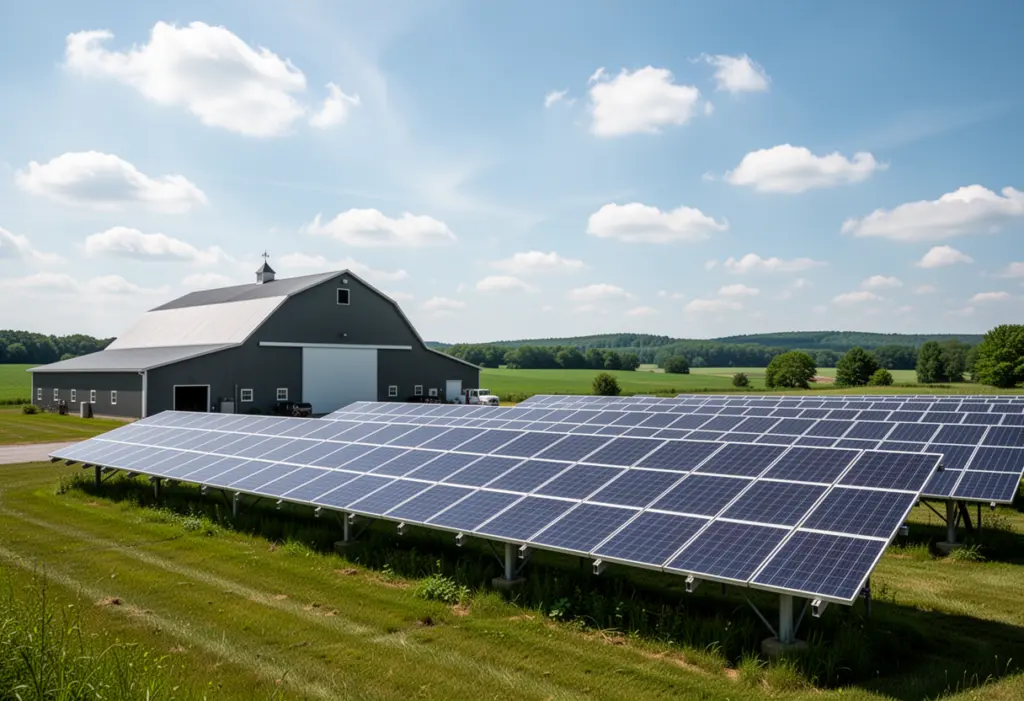
Genesee County sits between Buffalo and Rochester — Batavia, Le Roy, Oakfield, Bergen, Corfu, Alexander. ZIP codes here begin 140 and 144. It is flat, open and agricultural, and that combination makes it one of the more straightforward places in New York to put solar where it should go.
Flat and open is an advantage
Most New York solar articles spend their length on shading, because most of the state is wooded or hilly. Genesee County is neither. Open farmland with a clear southern horizon is the condition every other county’s article is working around.
Two consequences:
- Ground mounts are straightforward here — orientation and tilt chosen freely, no horizon to work around, roof age irrelevant, and maintenance and snow clearing at ground level. Ask for one to be quoted alongside the roof option.
- Wind, not shade, is the design factor on open ground. Ask what wind load the structure is specified for as well as the snow load.
An on-site assessment still matters — a farmyard has buildings and a village lot has street trees — but the county-level answer is genuinely favourable.
Farm solar: two different decisions
Keep them separate, because they get conflated constantly.
Solar to offset the farm’s own consumption — grain drying, cold storage, milking, the shop — sits on the business side of the tax code. The investment tax credit and depreciation did not follow the residential credit into repeal at the end of 2025, so this is a live question in 2026 for your accountant with your own figures. Get interval data from the utility rather than bill totals: for a commercial account the shape of the load is the analysis, and whether it carries a demand charge changes what solar is worth. Note also that commercial accounts with a demand charge are exempt from the Customer Benefit Contribution.
Leasing ground to a developer is a decades-long agreement, and this county sees plenty of offers. What matters more than the headline rent: term length and who controls renewals, decommissioning security backed by a bond or escrow rather than a promise, the array footprint and access route, effects on drainage and tile, rent escalation, the option period, and consequences for agricultural assessment. Take your own attorney rather than the developer’s paperwork.
National Grid
The Customer Benefit Contribution is $0.97 per kW-month of DC system size for 2026, the lowest of the major New York utilities — about $7.76 a month on an 8 kW system, roughly $93 a year. Billed on capacity regardless of production and recalculated annually. Phase One net metering credits exports at the full retail rate and holds for 20 years.
Snow and roofs
Western New York snow load is real and racking must be specified for it. Ask what snow-cover assumption is in the production estimate. And roof age is the usual residential gate: under roughly ten years of shingle life left means re-roof first.
2026 incentives
The 30% federal residential credit has ended — section 25D was terminated for expenditures made after 31 December 2025, with an expenditure treated as made when the original installation is completed.
Still available: New York’s 25% credit capped at $5,000 on Form IT-255, reaching leases and PPAs of ten years or more as well as purchases; the state sales tax exemption; and RPTL 487’s 15-year property tax exemption where your town or city, the county and your school district have not opted out. The RPTL 487 exemption is not automatic: file form RP-487 with your assessor by the taxable status date (March 1 in most towns; January 2 in Nassau towns; May 1 or June 1 in Westchester towns; set by charter in cities; usually January 1 in villages), and the system must be built before January 1, 2030 (RP-487 instructions).
NY-Sun is not on that list. As of September 2026 NYSERDA has no open NY-Sun block for homes in any utility territory; check NYSERDA’s NY-Sun dashboard for a new one. The last standard upstate residential block (Block 14, $0.15/W, NYSEG, RG&E and National Grid territories) closed on 17 December 2025, and the upstate Affordable Solar block for income-qualified households closed on 9 March 2026.
Frequently Asked Questions
Is Genesee County good for solar?
Unusually so. Flat open farmland with a clear southern horizon removes the shading constraint that dominates most of New York, which makes ground mounts straightforward and lets an array be oriented and tilted exactly as it should be.
What is the design factor on open farmland?
Wind rather than shade. On exposed ground ask what wind load the structure is specified for as well as the snow load, particularly for a ground-mounted array.
Can a Genesee County farm claim a federal solar credit?
A project to offset the farm's own consumption sits on the business side of the tax code, where the investment tax credit and depreciation did not follow the residential credit into repeal. It is a live question for your accountant with your own figures.
What should a farmer check before leasing land to a solar developer?
Term length and renewal control, decommissioning security backed by a bond or escrow, the array footprint and access route, effects on drainage and tile, rent escalation, the option period, and consequences for agricultural assessment. Use your own attorney.
This article is general information, not tax, legal or financial advice. Incentive amounts, eligibility rules and deadlines change and depend on your utility, your tax situation and your property. Confirm current terms with NYSERDA, your utility and a qualified tax professional before making a decision.
NY Solar Incentives
Independent New York solar research. We summarise NYSERDA, NY-Sun and federal programme rules from published sources and state plainly when a figure is an estimate. We are not a government agency and do not sell equipment.
Run the arithmetic on your own system
Check the dated program table and your arrangement before counting an incentive. Standard residential NY-Sun blocks are closed; Long Island Affordable Solar has a conditional income-verification route. The NY credit depends on qualified costs and tax liability, while the NYC abatement reduces future property-tax bills. The estimator keeps those timings separate.