Solar Incentives for Veterans in New York
There is no veterans-only solar programme in New York. There is a standard stack every homeowner can use, and two points where a veteran household should check the arithmetic more carefully than the brochure does.
On this page 8 sections
- 01The programmes that apply to you, and who applies them
- 02The first thing to check: can you use the credit
- 03The second thing: how the property tax exemptions sit together
- 04What to do with an offer described as a veterans programme
- 05The federal position, stated plainly
- 06The cost that no programme removes
- 07Where to confirm all of it
- 08Frequently Asked Questions
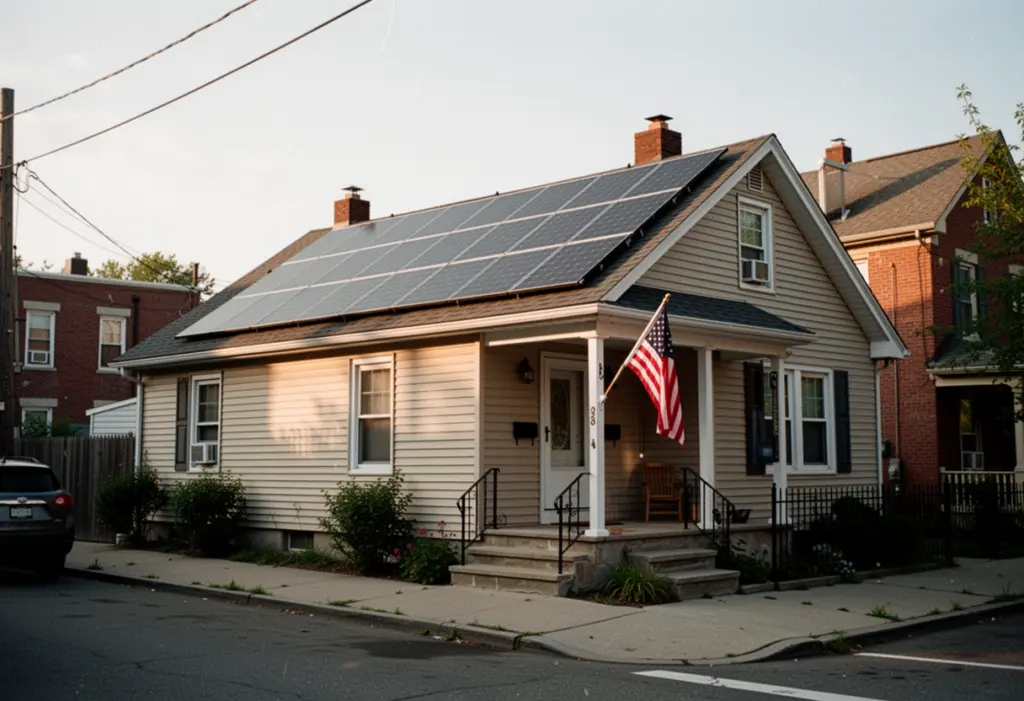
The honest starting point: New York does not operate a solar incentive restricted to veterans. What a veteran household can use is the same set of programmes available to every homeowner in the state. Two things do change with circumstances that are common in veteran households, and both are about how much of an incentive you can actually collect rather than which ones exist.
The programmes that apply to you, and who applies them
- NY-Sun reaches you, when a block for homes is open, through the contractor as a reduction in the price, set by region and by megawatt block, stepping down as each block fills. It is not a payment and not a filing. As of September 2026 NYSERDA has no open NY-Sun block for homes in any utility territory; check NYSERDA’s NY-Sun dashboard for a new one.
- Affordable Solar, NYSERDA’s contractor-applied incentive for income-qualified households, has closed as well: in Con Edison territory it ran from May 30 to October 15, 2025, and Upstate from December 18, 2025 to March 9, 2026.
- The state sales tax exemption on residential solar equipment applies at purchase, with each locality separately deciding whether to exempt its own share.
- The state credit is 25% of qualified solar energy system equipment expenditure, capped at $5,000, claimed by you on Form IT-255, for equipment installed and used at your principal residence in New York.
- RPTL 487 exempts the added value of the system from property tax for 15 years, where the taxing bodies have not opted out.
- Phase One net metering credits your exports at the full retail rate and holds that structure for 20 years from interconnection.
The first thing to check: can you use the credit
The state credit is not refundable. It offsets New York State tax you owe, and unused credit carries forward for up to five years. That matters more than usual where a large share of household income comes from sources that may not generate a New York tax liability. If your liability is small, the credit is worth less than the number a proposal prints, and if there is none it is worth nothing at all until there is.
So before letting any quote assume a flat $5,000 reduction, ask a tax preparer what your New York liability actually looks like across the next few years. A proposal that fills in the maximum without asking a single question about your tax position has not calculated anything — it has assumed.
The second thing: how the property tax exemptions sit together
If you already receive a veterans exemption on your property assessment, do not assume the solar exemption simply adds to it. RPTL 487 applies to the value the system adds, and it is available only where the taxing bodies have not opted out — the opt-out is available to a county, city, town or village by local law and to a school district by resolution. That means three separate enquiries for most homeowners, and the exception is the five city school districts of New York City, Buffalo, Rochester, Syracuse and Yonkers, which are fiscally dependent and levy no separate school tax.
Put the question to your assessor directly and in one call: does this municipality, this county and this school district exempt solar under section 487, and how does that sit alongside the exemption already on my parcel? The assessor answers both. An installer cannot. Note also that section 487 requires the system to be constructed before 1 January 2030, so it is not open ended.
What to do with an offer described as a veterans programme
Discounts aimed at service members and veterans are common and many are genuine. The test is simple and worth applying every time: ask which named programme it is, which body administers it, and where the terms are published. A discount that exists only in a sales conversation is a discount, not a programme, and it should be compared against the other quotes on price rather than accepted as an incentive nobody else could match. Ask whether it survives if you pay cash rather than finance, because a concession that only appears inside a financed offer is usually being paid for by the dealer fee inside the system price.
The federal position, stated plainly
There is nothing federal for a buyer in 2026. Section 25D was terminated for expenditures made after 31 December 2025, and an expenditure is treated as made when the original installation is completed, not when the system is energised. A system completed in December 2025 still qualifies; one completed this year does not, and there is no phase-down or transition. Any 2026 proposal showing a 30% federal line is materially wrong, and every net cost figure built on it is wrong too. Where the work forms part of constructing or reconstructing a structure, the expenditure instead counts as made when your original use of that structure begins.
The business-side credit does survive for the company that owns a leased or PPA system, which is why third party offers still price in an incentive the household never claims. New York reaches those arrangements too, provided the lease or the PPA runs ten years or more — the minimum applies to both — with the $5,000 acting as a lifetime ceiling for that agreement rather than an annual figure.
The cost that no programme removes
The Customer Benefit Contribution is charged monthly on the DC size of the array regardless of what it produces, on systems interconnected on or after 1 January 2022. On National Grid at the 2026 residential rate, an 8 kW array pays 8 x $0.97 = $7.76 a month, about $93 a year. Rates are recalculated annually and are not fixed at interconnection, and community solar subscribers pay none of it. Ask for that charge to appear as a cost line in any savings model you are shown.
Where to confirm all of it
Programmes here move: block levels step down, rates reset, localities change their sales tax election and taxing bodies opt out. Confirm with NYSERDA whether NY-Sun or Affordable Solar has reopened for homes, the credit and Form IT-255 with the Department of Taxation and Finance, the exemptions with your assessor, and the utility from the name printed on your own bill — and if that name is a village or city electric department rather than an investor-owned utility, you are outside Public Service Commission jurisdiction and the terms come from that utility directly.
Frequently Asked Questions
Are there solar incentives just for veterans in New York?
No. New York does not run a solar programme restricted to veterans. The same stack applies: the sales tax exemption, the 25% state credit capped at $5,000, and RPTL 487. NY-Sun and its Affordable Solar incentive for lower income households have no open block for homes as of September 2026.
Why might the state credit be worth less than the quote says?
It is not refundable and only offsets New York State tax you owe, carrying forward up to five years. Where household income generates little state liability, a proposal that assumes a flat $5,000 has assumed rather than calculated.
How does the solar exemption interact with a veterans property tax exemption?
Ask your assessor directly. RPTL 487 covers the added value of the system and only applies where the municipality, county and school district have not opted out, which is three separate checks.
How should I judge a veterans discount from an installer?
Ask which named programme it is, who administers it, and where the terms are published. Ask whether it survives if you pay cash, because a concession that appears only inside a financed offer is often paid for by the dealer fee.
This article is general information, not tax, legal or financial advice. Incentive amounts, eligibility rules and deadlines change and depend on your utility, your tax situation and your property. Confirm current terms with NYSERDA, your utility and a qualified tax professional before making a decision.
NY Solar Incentives
Independent New York solar research. We summarise NYSERDA, NY-Sun and federal programme rules from published sources and state plainly when a figure is an estimate. We are not a government agency and do not sell equipment.
Run the arithmetic on your own system
Check the dated program table and your arrangement before counting an incentive. Standard residential NY-Sun blocks are closed; Long Island Affordable Solar has a conditional income-verification route. The NY credit depends on qualified costs and tax liability, while the NYC abatement reduces future property-tax bills. The estimator keeps those timings separate.