How Much Roof Space Do Solar Panels Need?
The answer depends on two numbers from the module datasheet and on how much of your roof is genuinely usable, which is always less than the area you can measure from the ground.
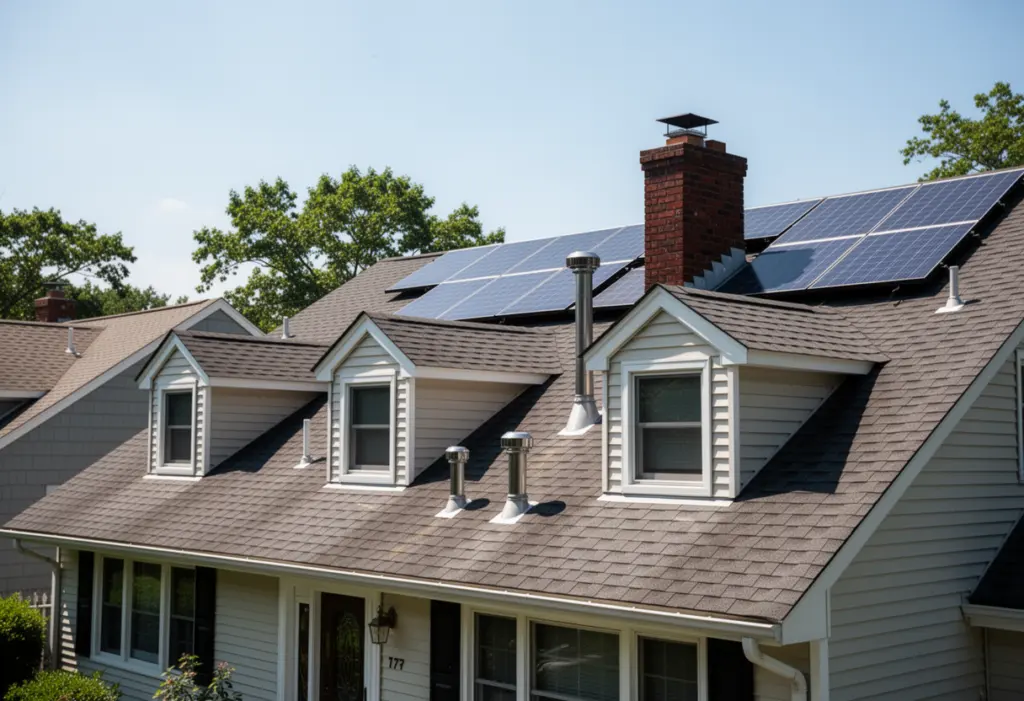
The space a solar array needs is set by two numbers on the module datasheet and by how much of your roof is genuinely usable. The second of those is the one that catches people out, because usable area is always smaller, sometimes far smaller, than the area a tape measure gives you.
The arithmetic, done with your own numbers
Take the rated wattage and the physical dimensions of the specific module being proposed. Divide the array size you want by the wattage to get a panel count, then multiply that count by the module area.
Worked with illustrative figures so you can follow the method: if the datasheet describes a 400 watt module of about 21 square feet, then a 7 kW array is 7,000 divided by 400, which rounds up to 18 modules, and 18 times 21 is roughly 380 square feet of unobstructed plane. Your datasheet will give different numbers, and that is the point. Do it with the module actually being quoted rather than a generic figure, because a proposal that switches to a physically larger module changes the fit on your roof and not just the price.
Why usable area is smaller than measured area
Very little of a typical New York roof is a clean rectangle. Subtract, in roughly this order:
- Code setbacks and access pathways. Fire access requirements vary by jurisdiction and the five boroughs work to a different process from the rest of the state. Ask your installer which authority reviews your permit and what clearances that authority requires, rather than assuming.
- Obstructions. Plumbing vents, bathroom and kitchen exhausts, chimneys, skylights, satellite mounts and dormers each remove more area than their own footprint, because the array has to be laid out in whole modules around them.
- Shaded portions. A plane that is shaded for a large part of the day is area you have but should not fill. A shading assessment done on site tells you which parts those are; a satellite estimate frequently does not.
- Planes facing the wrong way. North-facing area on a steep pitch contributes little in New York, and a small east or west facing plane can be more trouble than the modules it holds are worth.
The consequence is straightforward. Ask for a layout drawing, not just a system size. A drawing shows the modules on the actual roof planes, and it is where you discover that the south face holds twelve modules rather than the eighteen the proposal is priced around.
Do not fill the roof just because it fits
This is the uncomfortable part. There is a natural pull toward using every square foot available, and under New York’s Phase One net metering it is a poor instinct. Exports are credited at the full retail rate against your own consumption, so an array sized well beyond your usage builds a credit balance you never draw down.
Meanwhile the Customer Benefit Contribution bills on DC capacity every month regardless of what the array produces or whether you consume it. At the 2026 Orange & Rockland residential rate of $1.00 per kW-month a 6 kW array pays $6.00 a month, $72 a year. National Grid is the lowest residential rate in the state for 2026 at $0.97, so the same array pays $5.82 there. Those are modest numbers, which is exactly why oversizing slips through unexamined: two extra kilowatts is another $24 a year on Orange & Rockland, forever, for production you had no use for.
If the roof genuinely has room and you expect the load to grow, that is a reason to size up. Wanting to fill the plane is not.
Ground mounts and other planes
Where the roof cannot take a sensible array, a ground mount, a garage or an outbuilding is worth pricing. Ground mounts carry costs a roof does not, including trenching, racking foundations and in some municipalities a separate zoning review, so treat them as their own project rather than an easy substitute.
The incentives that turn on system size
Two are worth knowing before you decide how much roof to use. First, the New York sales tax exemption on residential solar equipment applies at the state level, and localities may separately elect to exempt their local share, so the total exemption differs by county and city. Ask the installer to show the tax line on the contract rather than trusting a headline price.
Second, and more consequential on a large array, New York’s 25% credit is capped at $5,000 on Form IT-255. The cap bites at $20,000 of qualified expenditure, because 25% of $20,000 is exactly $5,000. Every dollar of system cost above that earns nothing further from the state credit, which changes the marginal economics of the last few modules. The credit also requires the equipment to be at your principal residence in New York, and it is limited by your actual state tax liability, though unused amounts carry forward.
NY-Sun does not enter the sizing arithmetic in 2026: as of September 2026 NYSERDA has no open NY-Sun block for homes in any utility territory; check NYSERDA’s NY-Sun dashboard for a new one. The federal residential credit under section 25D is gone for expenditures made after 31 December 2025, measured by when the original installation is completed. Verify the current position with NYSERDA and the Department of Taxation and Finance before you commit, since these rules change on their own schedule.
Frequently Asked Questions
How do I calculate the roof space my system needs?
Divide the array size by the rated wattage of the specific module quoted to get a panel count, then multiply by that module's physical area. Use the datasheet for the module actually proposed, because a physically larger module changes the fit.
Why is my usable roof area smaller than my roof?
Code setbacks and access pathways, vents, chimneys, skylights and dormers, shaded portions, and planes facing the wrong direction all come out first. Obstructions remove more than their own footprint because modules are laid out whole.
Should I fill the whole roof if the space is there?
Usually no. Under full retail rate net metering an oversized array banks credits you never consume, while the Customer Benefit Contribution keeps billing on DC capacity. Size to your load, or to a load you can show is coming.
What if my roof is too small?
Price a ground mount, garage or outbuilding as its own project. It carries costs a roof does not, including trenching, racking foundations, and in some municipalities a separate zoning review, so it is not a straight substitute.
This article is general information, not tax, legal or financial advice. Incentive amounts, eligibility rules and deadlines change and depend on your utility, your tax situation and your property. Confirm current terms with NYSERDA, your utility and a qualified tax professional before making a decision.
NY Solar Incentives
Independent New York solar research. We summarise NYSERDA, NY-Sun and federal programme rules from published sources and state plainly when a figure is an estimate. We are not a government agency and do not sell equipment.
Run the arithmetic on your own system
Check the dated program table and your arrangement before counting an incentive. Standard residential NY-Sun blocks are closed; Long Island Affordable Solar has a conditional income-verification route. The NY credit depends on qualified costs and tax liability, while the NYC abatement reduces future property-tax bills. The estimator keeps those timings separate.