The Energy Affordability Program and Solar in New York
A bill discount reduces what you owe. Solar reduces what you buy from the grid. How the two combine is a question for your utility, and it should be answered before anyone signs anything.
On this page 8 sections
- 01Start with the utility, not the installer
- 02What is and is not available to an income-eligible household
- 03The uncomfortable part: the state credit may be worth nothing to you
- 04What a no-money-down offer actually is
- 05The monthly charge that comes with owning an array
- 06Questions to take to the utility and to NYSERDA
- 07Where to confirm the current position
- 08Frequently Asked Questions
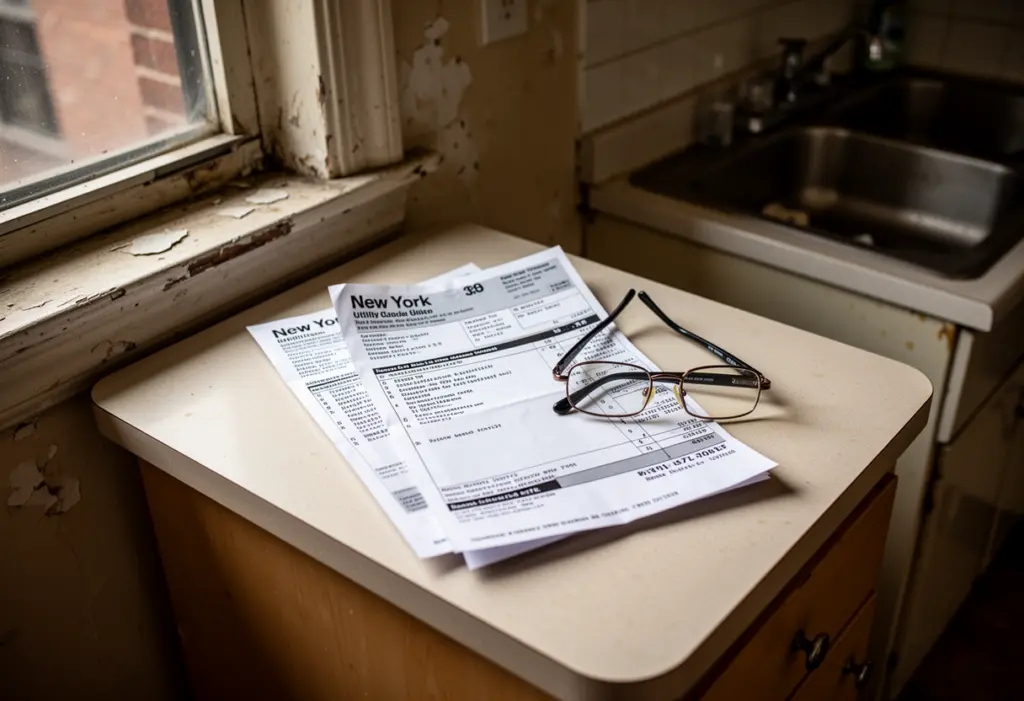
If your household receives an affordability discount on its electricity bill, the first thing to understand about solar is that the two touch each other. A bill discount reduces what you owe. Solar reduces how much electricity you buy from the grid. How those combine on one statement is a question for your utility, in writing, before anything is signed — and it is the question a sales pitch is least likely to raise.
Start with the utility, not the installer
Confirm the utility name printed on your own bill and ask that company directly how a solar credit interacts with the affordability discount on your account. Territory in New York does not follow county lines, and the answer comes from the company that actually bills you rather than from a general description of the state. If your electricity comes from a municipal electric utility — a village or city department rather than one of the investor-owned companies — you sit outside Public Service Commission net metering, outside the Customer Benefit Contribution and outside the state interconnection process entirely, and the terms are whatever that department sets. Ask them.
What is and is not available to an income-eligible household
- The Affordable Solar incentive: closed for now. NYSERDA has paid an extra NY-Sun incentive for households under 80 percent of area median income, applied by the contractor as a reduction on the price rather than paid to you. Con Edison’s Residential Affordable Solar block closed on 15 October 2025 and the Upstate one on 9 March 2026, and as of September 2026 NYSERDA has no open NY-Sun block for homes in any utility territory; check NYSERDA’s NY-Sun dashboard for a new one. If one opens, raise it yourself, because an installer who does not know about it simply will not apply it.
- The NY-Sun base incentive: also closed for now. Also contractor-applied, sized by system and region, and stepping down as each region’s megawatt block filled until the residential blocks ran out. If a new block opens it should appear as an itemised line, not folded into a single incentives applied figure; until then a proposal should show no NY-Sun deduction at all.
- Community solar. A subscription to a share of an off-site project, with credits appearing on your bill. Nothing is installed at your home, so renters and apartment residents are not excluded, and there is no roof, no permit and no interconnection application.
The uncomfortable part: the state credit may be worth nothing to you
New York’s solar credit on Form IT-255 is 25 percent of qualified expenditure capped at $5,000, and it is not refundable. It can only offset New York State income tax you actually owe. Unused credit carries forward for up to five years, which helps, but a household with little or no state liability may absorb a small fraction of it or none at all.
This matters because proposals are routinely built with the full $5,000 shown as money coming back. Where the liability is not there, that line is an assumption about your tax return that the person who wrote it has no way of knowing. Ask for the proposal with the credit set to zero and see whether the deal still works. If it only works with the credit, the deal is being sold on your tax position rather than on the equipment.
The federal side offers no rescue. Section 25D was terminated for expenditures made after 31 December 2025, with the expenditure treated as made when the original installation is completed, so a 2026 installation earns nothing federally regardless of income.
What a no-money-down offer actually is
A zero down payment is a financing structure, not a discount. It is either a loan whose fee sits inside the system price, or a lease or power purchase agreement in which a company owns the equipment and sells you the output. Both can be reasonable. Neither is free, and each has a different consequence at resale, so ask what happens to the agreement if the house is sold and get the transfer terms in writing.
One detail matters specifically here: New York’s credit reaches a lease or a power purchase agreement only where the term is ten years or more, and that ten-year minimum applies to the lease as well as to the power purchase agreement. A shorter agreement does not qualify, whatever a brochure implies.
The monthly charge that comes with owning an array
Systems interconnected on or after 1 January 2022 pay the Customer Benefit Contribution, billed on DC capacity rather than on production. A 6 kW array in National Grid territory pays 6 × $0.97, roughly $5.82 a month or about $70 a year at the 2026 residential rate. It is a small number, but it is charged in months when the array produces nothing, and the rates are recalculated annually rather than locked in. Community solar subscribers pay none of it, because those are front-of-the-meter projects.
Questions to take to the utility and to NYSERDA
- How does a net metering credit appear on an account that already receives an affordability discount?
- Is a NY-Sun or Affordable Solar block open for homes in my territory today, and if so, am I eligible and is it shown as a separate line on this proposal?
- If I subscribe to community solar instead, how does the credit appear alongside the discount?
- What is my New York State tax liability likely to be, and how much of a $5,000 credit could I actually use? Ask a preparer, not an installer.
Where to confirm the current position
Programme terms, income thresholds and incentive levels all change, and several of the numbers above are reset on an annual cycle. Confirm with NYSERDA whether any NY-Sun or Affordable Solar block for homes has reopened and at what amount, with the Department of Taxation and Finance for the IT-255 credit, and with the utility named on your bill for anything touching the bill itself. A page is a starting point for the questions, not a substitute for the answers.
Frequently Asked Questions
Does solar affect my utility bill discount in New York?
It changes the bill the discount applies to, because solar reduces what you buy from the grid. Ask the utility named on your own bill how a net metering credit and an affordability discount appear together on one statement, and get the answer in writing.
What is the Affordable Solar incentive?
A NYSERDA NY-Sun incentive for households under 80% of area median income, applied by the contractor as a price reduction rather than paid to the household. It is closed for now: as of September 2026 NYSERDA has no open NY-Sun block for homes in any utility territory, Affordable Solar included. If a new one opens, raise it yourself, because an installer who does not know about it will not apply it.
Will I get the $5,000 state tax credit?
Only to the extent you owe New York State income tax. The IT-255 credit is not refundable, though unused amounts carry forward up to five years. Ask for the proposal recalculated with the credit set to zero and see whether it still works.
Is community solar better if I rent?
It is the option that does not need a roof. Nothing is installed at your home, credits appear on your electricity bill, and subscribers pay no Customer Benefit Contribution because those projects sit in front of the meter.
This article is general information, not tax, legal or financial advice. Incentive amounts, eligibility rules and deadlines change and depend on your utility, your tax situation and your property. Confirm current terms with NYSERDA, your utility and a qualified tax professional before making a decision.
NY Solar Incentives
Independent New York solar research. We summarise NYSERDA, NY-Sun and federal programme rules from published sources and state plainly when a figure is an estimate. We are not a government agency and do not sell equipment.
Run the arithmetic on your own system
Check the dated program table and your arrangement before counting an incentive. Standard residential NY-Sun blocks are closed; Long Island Affordable Solar has a conditional income-verification route. The NY credit depends on qualified costs and tax liability, while the NYC abatement reduces future property-tax bills. The estimator keeps those timings separate.