Solar Panel Installation in Irondequoit, NY
Irondequoit sits between the bay and the lake on small, heavily treed lots. Shading decides more projects here than anywhere near Rochester.
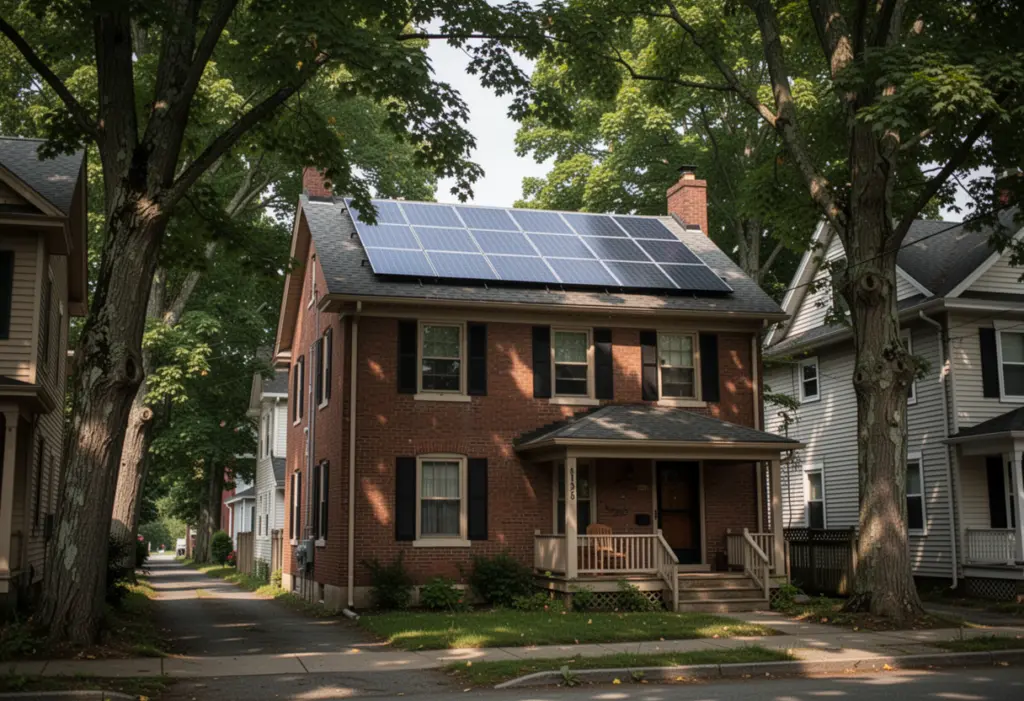
Irondequoit is a town on the neck of land between Irondequoit Bay and Lake Ontario, just north of Rochester. ZIP codes 14617 and 14622. Compact lots, older housing and a great deal of mature canopy — that combination is what defines a solar project here.
Shading is the binding constraint
Irondequoit’s established streets carry heavy mature tree cover, and lots are close together. The low December sun is what makes that decisive — an obstruction irrelevant in July removes hours of production in the month the net metering credit bank is being drawn down.
Three things follow:
- Insist on an on-site shading assessment. A satellite estimate does not capture a mature canopy accurately, and this is exactly the geography where the two diverge most.
- Ask for December and January figures, not only the annual total. A large gap between two installers’ numbers here usually means one of them has not visited.
- Per-panel electronics earn their cost. Microinverters or DC optimisers contain a shading loss to the affected panel rather than letting it drag on a whole string — which matters more here than on an open suburban lot.
If tree removal is proposed, treat it as your decision rather than an assumption folded into a production estimate. It carries real cost, may need a permit, and permanently changes a street where the canopy is part of the character.
Small lots, older housing
Usable roof area frequently caps the array rather than consumption. Fire-access clearances take proportionally more of a modest roof, and dormers and chimneys on 1920s to 1950s housing remove capacity that a larger roof would absorb. Ask what is limiting the system and how much went to clearances.
Two age-related checks: roof age — under roughly ten years of shingle life left means re-roof first — and service capacity, since 100 amp panels are common and fitting a solar breaker can require an upgrade or a line-side tap. Both belong in the quote rather than a change order.
Bay and lake exposure
Properties near the water carry greater wind exposure, so ask what wind load the racking and attachments are specified for as well as the snow load. Monroe County lake-effect snow is significant: ask what ground snow load the structure is rated for, whether snow guards are needed where the array discharges over a door or a walkway, and what snow-cover assumption is in the production estimate.
RG&E
The Customer Benefit Contribution is $1.31 per kW-month of DC system size for 2026 — about $6.55 a month on a 5 kW system, roughly $79 a year, or $9.17 on 7 kW, about $110. Billed on capacity regardless of production and recalculated annually.
Because roof area and shading cap systems here, the charge is usually modest in absolute terms. Phase One net metering credits exports at the full retail rate and holds for 20 years from interconnection. Confirm your utility from your own bill — several Monroe County villages run their own municipal electric utilities and are outside these rules entirely.
2026 incentives
The 30% federal residential credit is gone — section 25D was terminated for expenditures made after 31 December 2025, with an expenditure treated as made when the original installation is completed. On a modest system that loss is proportionally large.
Still available for a principal residence: New York’s 25% credit capped at $5,000 on Form IT-255; the state sales tax exemption; and RPTL 487’s 15-year property tax exemption where the town, Monroe County and your school district have not opted out, if you file form RP-487 with the assessor by the taxable status date. NY-Sun and its Affordable Solar blocks for lower-income households are not on that list: as of September 2026 NYSERDA has no open NY-Sun block for homes in any utility territory; check NYSERDA’s NY-Sun dashboard for a new one.
Where the canopy rules a roof out entirely — which happens on these streets — community solar needs no roof at all, and its subscribers pay no Customer Benefit Contribution.
Frequently Asked Questions
Is Irondequoit too shaded for solar?
For some properties, yes, and that is a real answer rather than a negotiating position. Heavy mature canopy on compact lots makes an on-site shading assessment essential, and community solar needs no roof at all where the trees rule one out.
Do microinverters help on a shaded Irondequoit roof?
Per-panel electronics — microinverters or DC optimisers — contain a shading loss to the affected panel rather than letting it drag on a whole string, which earns its cost more readily here than on an open suburban lot.
Why is my array smaller than my consumption suggests?
Usable roof area usually caps it. Fire-access clearances take proportionally more of a modest roof, and dormers and chimneys on older housing remove capacity a larger roof would absorb. Ask what is limiting the system.
What does RG&E charge an Irondequoit solar customer?
The Customer Benefit Contribution at $1.31 per kW-month of DC system size for 2026 — about $79 a year on a 5 kW system and $110 on 7 kW.
This article is general information, not tax, legal or financial advice. Incentive amounts, eligibility rules and deadlines change and depend on your utility, your tax situation and your property. Confirm current terms with NYSERDA, your utility and a qualified tax professional before making a decision.
NY Solar Incentives
Independent New York solar research. We summarise NYSERDA, NY-Sun and federal programme rules from published sources and state plainly when a figure is an estimate. We are not a government agency and do not sell equipment.
Run the arithmetic on your own system
Check the dated program table and your arrangement before counting an incentive. Standard residential NY-Sun blocks are closed; Long Island Affordable Solar has a conditional income-verification route. The NY credit depends on qualified costs and tax liability, while the NYC abatement reduces future property-tax bills. The estimator keeps those timings separate.