Heat Pumps and Solar in New York: Sizing the System
A heat pump moves your biggest electrical load into the months your panels produce least. Net metering handles that — up to a point.
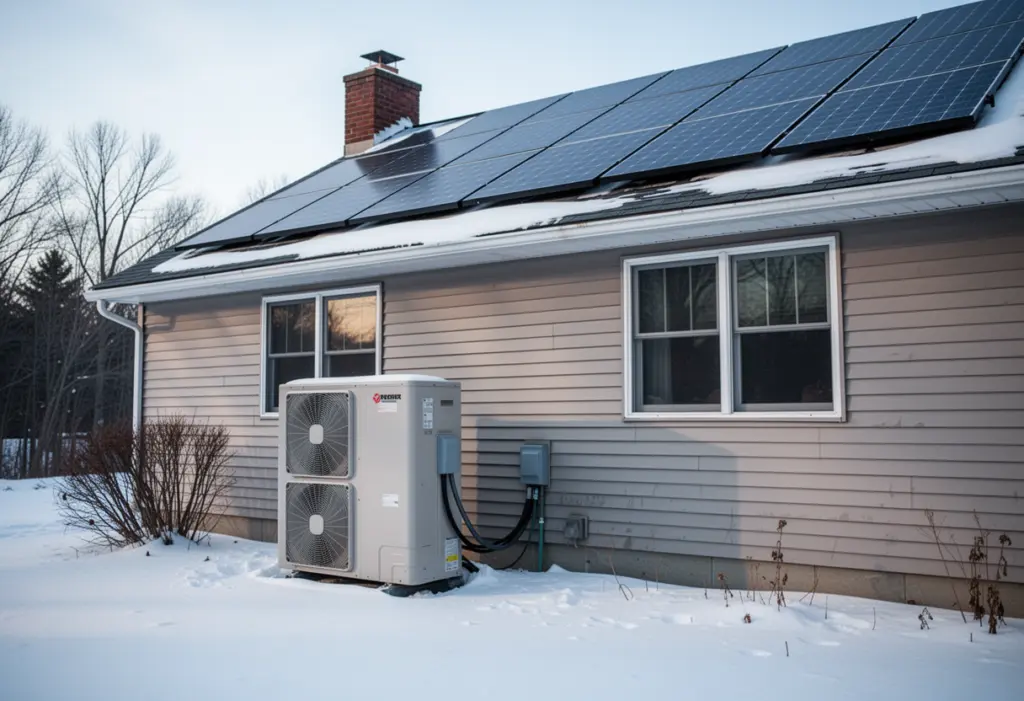
Adding a heat pump changes what a solar array has to do, and the change is not simply “more kilowatt-hours”. It is a timing problem, and sizing the array without understanding it produces a system that looks right on paper and disappoints in February.
The phase problem
A New York solar array produces most in May, June and July. A heat pump consumes most in December, January and February. The two are close to exactly out of phase.
That does not make the combination a bad idea. It makes net metering the mechanism that carries it: summer exports build a credit balance that winter consumption draws down. Under Phase One net metering, exports are credited at the full retail rate and the arrangement holds for 20 years from interconnection.
But it puts weight on assumptions that are casual in a normal residential quote:
- December and January production estimates matter now. Ask what the model assumes for those specific months rather than accepting an annual total. This is where a satellite estimate diverges most from a real on-site shading assessment.
- Snow cover matters more. Days of partial roof cover fall in the months of highest load. Ask what snow assumption is in the estimate.
- Cold-weather heat pump performance matters. Output and efficiency fall as it gets colder, and any backup resistance heat is a large additional electrical load. Size the array against the heat pump’s real cold-weather draw, not its rated figure.
Size against the future bill, not the past one
The most common error is sizing solar from twelve months of historic bills taken before the heat pump is installed. That understates the load by whatever the heat pump will add, and it produces an array that covers a house that no longer exists.
If both are planned, model the post-heat-pump load and size to that. If the heat pump comes later, say so now: ask what the array would need to be, whether the roof can carry it, and whether the proposed inverter and service panel have headroom to expand. Adding capacity later is a second interconnection application and a second permit.
The same applies to an EV charger, an induction range, or a heat pump water heater. Electrification is cumulative, and each addition lands on the same meter.
Two constraints that bite before the roof does
Service capacity. A heat pump, a solar breaker and possibly an EV charger on a 100 amp service is frequently more than the panel can take. A service upgrade is a real cost and it should be established before either project is quoted, not discovered between them.
The Customer Benefit Contribution. This monthly charge is billed on the DC size of the array, not on consumption, so a larger array sized for a heat pump costs more per month regardless of what it produces. For 2026 the residential rates run from $0.97 per kW-month on National Grid to $1.67 on Central Hudson. On a 14 kW array that is roughly $163 a year against $281 — worth putting into the arithmetic rather than discovering on a bill.
What net metering does not fix
Net metering settles annually rather than instantaneously, so an oversized array does not simply keep paying. Building a credit balance you never consume is not free — you paid for the panels, and you pay the monthly charge on their capacity. Size to the load you will actually have.
2026 incentives
The 30% federal residential credit is gone — section 25D was terminated for expenditures made after 31 December 2025, with an expenditure treated as made when the original installation is completed.
For the solar itself, New York’s 25% credit capped at $5,000 on Form IT-255 remains for a principal residence, alongside the state sales tax exemption and RPTL 487’s property tax exemption where your municipality, county and school district have not opted out, if you file form RP-487 with the assessor by the taxable status date. NY-Sun is not on that list: as of September 2026 NYSERDA has no open NY-Sun block for homes in any utility territory; check NYSERDA’s NY-Sun dashboard for a new one. Heat pump incentives are administered separately, frequently through your utility, and should be confirmed directly rather than assumed from a solar proposal.
Frequently Asked Questions
Does solar work with a heat pump in New York?
Yes, but the two are close to out of phase — panels produce most in summer, a heat pump consumes most in winter. Net metering carries that, with summer exports building a credit balance that winter consumption draws down.
How should I size solar if I am adding a heat pump?
Model the post-heat-pump load rather than sizing from twelve months of historic bills. Bills taken before the heat pump understate the load and produce an array sized for a house that will no longer exist.
Will my electrical service handle both?
A heat pump, a solar breaker and possibly an EV charger on a 100 amp service is frequently more than the panel can take. Establish this before either project is quoted rather than discovering it between them.
Does a bigger array cost more per month?
Yes. The Customer Benefit Contribution is billed on the DC size of the array regardless of production, running from $0.97 per kW-month on National Grid to $1.67 on Central Hudson for 2026 — roughly $163 to $281 a year on a 14 kW system.
This article is general information, not tax, legal or financial advice. Incentive amounts, eligibility rules and deadlines change and depend on your utility, your tax situation and your property. Confirm current terms with NYSERDA, your utility and a qualified tax professional before making a decision.
NY Solar Incentives
Independent New York solar research. We summarise NYSERDA, NY-Sun and federal programme rules from published sources and state plainly when a figure is an estimate. We are not a government agency and do not sell equipment.
Run the arithmetic on your own system
Check the dated program table and your arrangement before counting an incentive. Standard residential NY-Sun blocks are closed; Long Island Affordable Solar has a conditional income-verification route. The NY credit depends on qualified costs and tax liability, while the NYC abatement reduces future property-tax bills. The estimator keeps those timings separate.